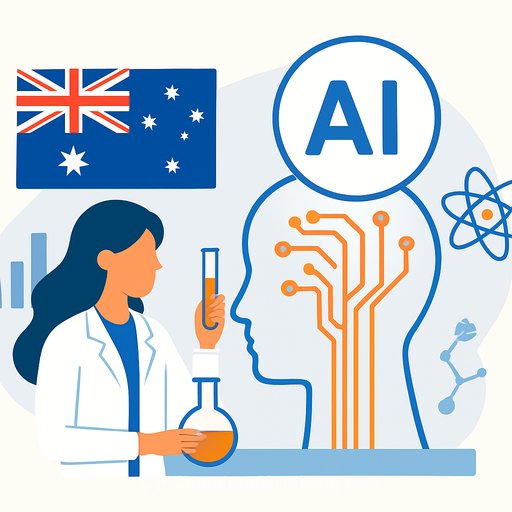
Australia's National AI Plan: why science must lead
Australia's National AI Plan puts research at the center of national capability. That's not a slogan. Without strong science, there's no trustworthy AI, no strategic compute, and no pipeline of skilled people to carry the work.
If you work in science or research, this is your brief: build the knowledge, methods and standards that industry and government can rely on. Below is a practical view of what matters and what to do next.
What the plan is trying to achieve
The plan seeks to lift national productivity, improve services, and support security through AI. To get there, it needs stable investment in research, efficient translation paths, and public trust built on evidence.
Investment that actually moves the needle
- Long-horizon funding: Back basic and applied research on multiyear cycles so labs can pursue hard problems without churn.
- Infrastructure: Prioritise shared facilities for compute, data, evaluation, and secure collaboration.
- Programs, not pilots: Fund cohort-based programs that connect labs, industry partners and agencies around defined technical goals.
Build the workforce Australia needs
- Interdisciplinary training: Pair AI methods with domain science (health, climate, materials, biosecurity, resources).
- Retention: Competitive fellowships, clear research careers, and industry secondments that return skills to the lab.
- Technical breadth: ML engineering, data engineering, evaluation science, safety research, and product transitions.
Make AI responsible by default
- Ethics in the workflow: Integrate risk assessment, audit trails, and human oversight into experimental design.
- Transparency: Document data provenance, model cards, and evaluation protocols that can be independently checked.
- Public trust: Communicate limits and uncertainties, not just performance gains.
Translate research into capability
- Co-development: Form joint teams across universities, research institutes, industry and government with shared KPIs.
- Testbeds: Use domain-grade datasets and sandboxed environments to validate safety, reliability and cost before deployment.
- IP pathways: Clear licensing, spin-out templates, and procurement routes for locally developed tools.
Data and compute: treat them as national assets
- Secure access: Tiered access to sensitive data with strong governance and reproducible pipelines.
- High-performance compute: Reserve capacity for AI training, fine-tuning and evaluation alongside simulation workloads.
- Stewardship standards: Metadata, versioning, and retention policies that make datasets reusable and auditable.
For reference, see national facilities such as NCI Australia and data initiatives like the Australian Research Data Commons.
Engage globally, protect local interests
- Standards participation: Join international working groups to shape evaluation, safety and interoperability.
- Data sharing with guardrails: Enable cross-border research while maintaining privacy, IP, and security.
- Talent circulation: Fellowships and exchange programs that bring expertise back into Australian labs.
Policy moves that would help
- Targeted funds for AI safety, evaluation science, and domain-AI integration (health, climate, resources).
- Incentives for university-industry-government consortia with deliverables tied to national priorities.
- Investment in shared compute, trusted data services, and secure collaboration platforms.
- Clear procurement pathways for locally developed AI tools, with preference for transparent models and auditable datasets.
- Mechanisms to ensure benefits are broadly shared: open tools where feasible, regional access, and training support.
For labs and institutes: actions you can take this quarter
- Map your projects to national priority areas and identify at least one industry or agency partner per project.
- Stand up an internal evaluation stack: dataset governance, reproducibility checks, and a red-teaming protocol.
- Allocate compute budgets explicitly for model evaluation and ablation, not just training.
- Publish concise model and data cards for your top projects; make them standard practice for new work.
- Set up a rolling seminar bridging domain experts and ML engineers; make co-authorship the norm.
Where to build skills fast
If you're standing up training for your team, explore role-based options here:
- AI courses by job to upskill researchers, engineers and analysts.
- AI certification for data analysis for labs working with large datasets.
Bottom line
Australia can lead in AI where it already leads in science-health, climate, resources, materials, biosecurity. That means consistent funding, serious infrastructure, and research culture that prizes transparency and translation. Do the small things now so the big bets have a real chance to pay off.
Your membership also unlocks: