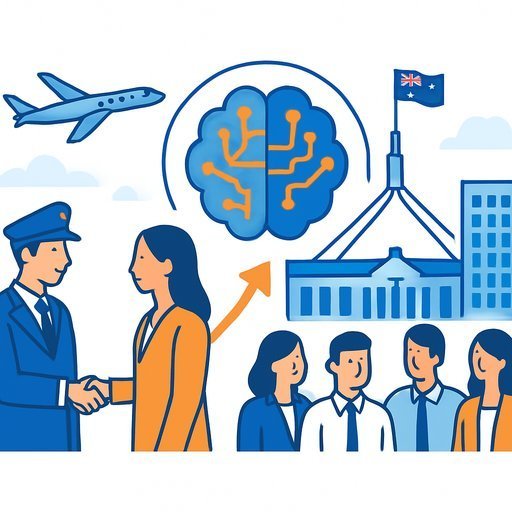
Labor's National AI Plan: No New Law, Bigger Focus on Skills, Data and Datacentres
The Albanese government has released its National AI Plan and chosen not to introduce a stand-alone AI act. Instead, it will lean on existing laws while pushing hard on economic benefits, skills, data access, and infrastructure.
Minister for Industry and Science Tim Ayres said the government's yardstick is simple: spread the benefits, reduce inequality, and support workers. The plan backs that up with funding for an AI Safety Institute and an agenda to open more public data for responsible AI use.
No new AI legislation (for now)
The government has ruled out a dedicated AI law at this stage. The position: current legislation can manage AI risks, and gaps will be addressed as they surface.
That signals flexibility over a fixed rulebook. It also means agencies and businesses should expect ongoing updates, guidance, and sector-specific standards rather than one omnibus act.
Data access: opening "high-value" datasets
The plan proposes unlocking non-sensitive datasets from the public sector-potentially including resources from the Australian Bureau of Statistics-and exploring ways to access private sector data. Government sources note licensing and compensation are on the table.
At the same time, the government has declined to support a broad text-and-data-mining exemption for copyright material. This sets a clear boundary: data access will expand, but creators' rights remain a core constraint.
Workforce first: "enable workers' talents"
The plan makes a pointed promise: technology should support people, not replace them. Ayres committed to consultation with unions and business on workplace adoption and guardrails.
Expect reskilling support, guidance on safe deployment, and an emphasis on sharing productivity gains. Agencies should budget for training and change management, not just software and infrastructure.
- Start with role-by-role impact mapping: which tasks can be augmented, which must stay human.
- Create clear rules for AI use, data handling, and accountability in decision-making.
- Invest in frontline training and practical playbooks, not just pilots.
If you need structured upskilling paths by job family, see AI courses by job.
AI Safety Institute: $30m to guide guardrails
The plan sets aside $30 million to establish an AI Safety Institute next year. Its job: advise government, test real-world risks, and recommend if or when new laws are needed.
This keeps the legislative door open without slowing adoption. Expect technical evaluations, practical guidance, and sector-specific risk frameworks.
Copyright and creators
The plan acknowledges unresolved questions around copyright for artists, writers, and journalists. With no blanket exemption for training on copyrighted content, any access to such material will likely require deals or licenses.
Agencies and vendors should plan for provenance tracking, rights management, and documented training data sources.
Datacentres: energy, water and cooling pressure
The document flags real infrastructure costs. Datacentres used around four terawatt hours in 2024-about 2% of grid power-and demand could triple by 2030.
Water use is also on notice. Operators will need more efficient cooling and a faster shift to renewables and heat-recovery designs to manage both cost and environmental impact.
What government leaders should do next
- Set a clear AI policy: permitted use cases, data rules, human-in-the-loop checkpoints, and audit trails.
- Run a dataset inventory: classify sensitivity, quality, and potential public value; prioritise "low-risk, high-impact" releases.
- Procure with standards: require model cards, eval results, privacy-by-design, and copyright provenance from vendors.
- Budget for training: include change management, prompt practices, and measurement of productivity gains.
- Plan for infrastructure: energy forecasts, water-efficient cooling, and renewable supply commitments.
- Engage early: unions, privacy and security teams, and creators' stakeholders for smoother rollout.
What to watch
- AI Safety Institute guidance, test results, and any triggers for new legislation.
- Data access frameworks, including licensing and compensation models for private datasets.
- Metrics for "benefits shared broadly" and how they're reported across sectors.
- Energy and water standards tied to datacentre approvals and procurement.
Bottom line
The government is backing AI's economic upside while keeping legal options open. Agencies and businesses that invest in skills, data discipline, and infrastructure efficiency will be best placed to capture gains without tripping over regulatory or ethical risks.
For practical training paths to get teams AI-ready, explore the latest AI courses or courses by job role. For policy context and updates, check the Department of Industry, Science and Resources at industry.gov.au.
Your membership also unlocks: