Australia's National AI Plan: a practical blueprint for opportunity, equity and safety
2 December 2025
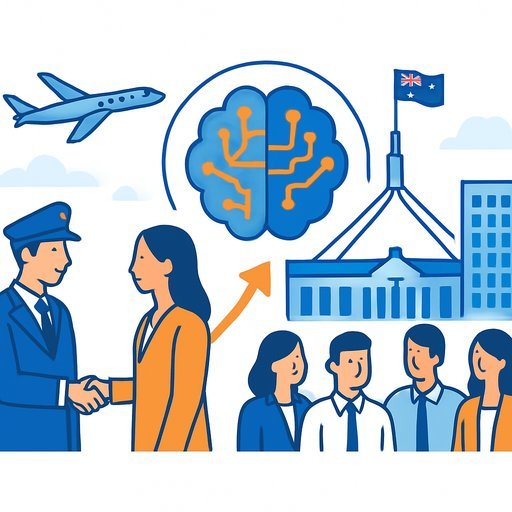
The National AI Plan is a core part of the Future Made in Australia agenda. It gives government, industry, research and communities a shared direction so technology lifts everyone, not just a few.
AI is changing how we work, learn and deliver services. Done well, it can boost productivity, strengthen local capability and improve resilience across the economy and public sector.
What the plan sets out
The plan outlines how Australia will become a developer and adopter of trusted, world-class AI. It focuses on four commitments:
- Innovate with purpose.
- Grow with inclusion.
- Build national capability that grows the economy and serves the public good.
- Ensure safety and trust in AI adoption.
Capturing the opportunity
Australia is already strong in AI research and adoption. The plan builds on that with investment in digital and physical infrastructure, local capability and global partnerships.
Major data centre investments by Microsoft, Amazon and Firmus, plus upgrades to the National Broadband Network, are positioning Australia as a regional hub for AI. More than $460 million is already committed to AI and related initiatives, with further support through programs like the new AI Accelerator round of the Cooperative Research Centres program.
What this means for government- Map agency AI use cases with measurable value (efficiency, service quality, risk reduction). Prioritise low-risk, high-impact pilots.
- Plan for compute, storage and networking needs. Align cloud procurement, data residency and cost controls with agency roadmaps.
- Back local capability where feasible. Use procurement levers to support Australian SMEs and research partnerships.
- Build repeatable delivery patterns (reference architectures, data pipelines, MLOps). Reduce one-off builds.
Spreading the benefits
The plan commits to benefits reaching every community-SMEs, regional Australia and people at risk of digital exclusion. Initiatives like the AI Adopt Program and the National AI Centre (NAIC) will help businesses and not-for-profits implement AI responsibly.
There is also sustained investment in skills and lifelong learning across schools, TAFEs and community organisations, with strong partnerships across industry, unions and education.
What this means for government- Make inclusion a default requirement in AI projects: accessibility, regional access, language support and low-bandwidth options.
- Offer practical onboarding for SMEs in supply chains (templates, sandboxes, data standards, security checklists).
- Embed AI literacy for the public sector workforce. Fund applied training for priority roles (policy, service delivery, audit, procurement, cyber).
- Protect workplace rights. Co-design change plans with staff and unions; monitor job impacts and create pathways into new roles.
Keeping Australians safe
Safety and trust sit at the centre of the plan. The government is establishing the AI Safety Institute (AISI) to monitor, test and share information on emerging capabilities, risks and harms. Laws and guidance will be updated over time to address privacy, bias and security.
Clear expectations on transparency, accountability and ethics will apply across government and industry, backed by international cooperation on standards and risk practice.
What this means for government- Adopt a risk-based approach to AI. Use proven guidance such as the NIST AI Risk Management Framework for classification, controls and assurance.
- Stand up model evaluation and monitoring: pre-deployment testing, red-teaming for safety, and ongoing performance checks.
- Strengthen governance: decision logs, human oversight for high-impact uses, DPIAs/PPIAs, algorithm registers and incident reporting.
- Secure the supply chain: vendor attestations, provenance checks, content authenticity measures and secure data handling.
- Align with privacy, security and discrimination law. Keep policies current as guidance evolves.
A plan for all Australians
The plan makes a simple promise: AI should serve people. As technology moves, the plan will be refined so protection and opportunity rise together.
For public servants, that means balancing delivery with duty of care-measurable benefits, clear guardrails and continual learning.
What agencies can do next (90-day starter checklist)
- Nominate accountable owners: a Senior Responsible Officer for AI and a cross-functional working group.
- Inventory AI use (live and proposed). Rate each item by impact and risk; apply proportionate controls.
- Publish minimum standards for AI procurement: data handling, model transparency, security, evaluation and exit options.
- Define acceptable use: where AI is allowed, restricted or prohibited; set human review points.
- Set up assurance gates: design review, pre-production testing, and go-live approval with clear sign-offs.
- Plan skills uplift: foundational AI literacy for all staff; deeper training for policy, risk, audit, cyber and delivery teams. Consider curated options for public sector roles via Complete AI Training.
- Pilot two to three high-value uses (e.g., triage, summarisation, compliance checks). Measure outcome, cost, time and risk.
- Tighten data foundations: quality, lineage, retention, access controls and logging.
- Integrate with security practice (e.g., Essential Eight), incident response and business continuity plans.
- Engage stakeholders early-citizens, frontline staff, unions, privacy and security teams-and publish plain-English summaries.
More information
Read the National AI Plan and follow updates on AI policy and initiatives as new guidance is released.
Contact: artificial.intelligence@industry.gov.au
Your membership also unlocks: