After Their Books Were Pirated to Train AI, Three Authors Went to Court - and Won
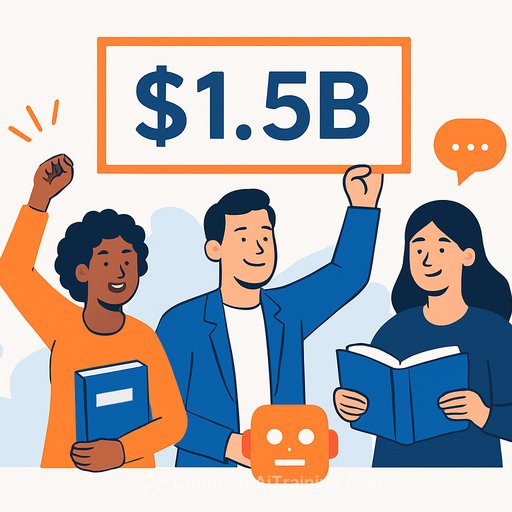
Three writers - Andrea Bartz, Kirk Wallace Johnson, and Charles Graeber - discovered their books inside the "Books3" dataset, a massive trove of pirated titles used to train AI systems. They sued Anthropic and secured a $1.5 billion settlement, the largest copyright recovery to date.
The payout is set at roughly $3,000 per book across 482,460 works. Copied and original files of affected books will be destroyed and barred from future commercial use.
What actually happened
In 2023, reporting revealed that AI companies were training models on books scraped from pirate libraries like LibGen and PiLiMi. Those files included works from rising authors and household names alike.
Bartz, Johnson, and Graeber became named plaintiffs and filed a class action. Anthropic settled in September 2025. The case established a clear signal: long-form books aren't free training data.
Why it matters to writers
Books provide unique, expressive, long-form language - exactly what large models need to mimic a human voice. That value is the point. It's also why consent and compensation matter.
One key nuance: a June 2025 ruling held that books can still be used for training if they're acquired legally and the use is fair. So the fight isn't over - it's entering a new phase.
If your title appears in Books3, move fast
- Confirm inclusion: Check whether your works were listed in Books3 via public reporting or notices you've received. Keep a clean list of titles, editions, ISBNs, and publication dates.
- File your claim: Watch for official settlement communications and submit your documentation before the deadline. Don't wait for reminders.
- Register your copyrights: If you haven't registered key titles, do it now. It strengthens your position in any dispute. U.S. Copyright Office
- Loop in your agent/publisher: Make sure they know about the settlement and your claim. Align on communications and record-keeping.
- Document everything: Save screenshots, emails, links, and any mentions of your work in training datasets or model outputs.
- Stay connected: Follow author advocacy updates and legal guidance so you don't miss new developments. The Authors Guild's AI hub is a solid start: Authors Guild AI resources
Protect your catalog going forward
- Register early and often: Make copyright registration part of your release workflow.
- Add AI clauses to contracts: Specify whether your work can be used for model training, under what terms, and at what rates. No ambiguity.
- Coordinate with your publisher: Ensure distribution partners aren't opting you into AI licensing without explicit permission.
- Monitor for misuse: Set alerts for your name, book titles, and distinctive phrases. Collect evidence, then send formal notices as needed.
- Centralize your rights: Track who holds print, audio, translation, and digital rights - and whether AI uses are covered.
What readers and teams can do
- Buy or borrow legitimately: Sales and library checkouts are oxygen for authors. Avoid pirate mirrors and shady "free ebook" hubs.
- Be mindful with AI features: If you're using AI summaries or chatbots, know that upstream decisions affect working writers.
- Support directly: Preorders, signed copies, events, newsletters, and recommendations matter more than most realize.
Where the case lands us
This settlement is a first corrective step, not a finish line. The court signaled that legally acquired books may still fall under fair use for training. That means the norms for consent, licensing, and compensation are being set right now.
The authors' stance is clear: writers should be treated as partners - not free raw material. If AI depends on books, authors belong at the table.
Practical next steps for working writers
- Audit your catalog for registration gaps and fix them.
- Create a standard AI licensing clause for your deals.
- File your settlement claim if you're covered - don't leave money on the table.
- Join or follow an advocacy group so you're not operating solo.
- Decide your own AI policy: where you're comfortable using tools, where you're not, and what "consent + compensation" means for you.
Want to use AI on your terms?
If you're integrating AI into your workflow and want a practical, ethics-first approach, here's a curated starting point for writers and creative teams: Courses by job.
The genie isn't going back in the bottle. But the terms are still being written. Make sure your name is on the page.
Your membership also unlocks: