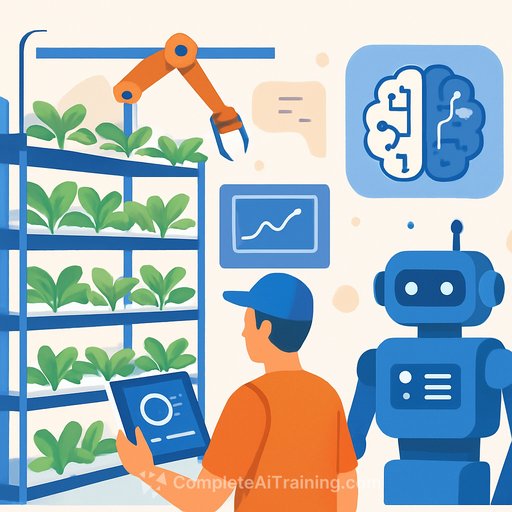
Indoor Farming Innovation 2025: A Product Playbook for Measurable Gains
Indoor farming in 2025 shifted from big bets to practical wins. Most launches centered on automation, AI, and decision-support tools that plug into existing farms instead of replacing them. Imaging, sensing, retrofit-friendly modules, and energy upgrades dominated roadmaps. The theme is clear: efficiency, reliability, and scalability.
Key Takeaways
- Automation and AI led new product launches, with a focus on visibility, precision, and responsiveness.
- Imaging, sensing, and AI monitoring matured into decision-support systems that complement operators.
- Substrates, growing media, and energy efficiency saw steady progress with retrofit-first packaging.
- Modularity and interoperability became non-negotiable as the market prioritized repeatable economic value.
Automation and AI: Center of the Roadmap
Teams prioritized tools that tighten feedback loops and reduce manual oversight. Think model-assisted decisions, actionable alerts, and controlled autonomy rather than full replacement systems. Edge-plus-cloud setups are becoming standard to manage bandwidth, latency, and uptime constraints inside facilities.
- Human-in-the-loop controls: predictive insights, operator approval, safe rollback.
- Closed-loop modules for climate, irrigation, and lighting with clear guardrails.
- Edge inference for real-time response; cloud for training, reporting, and fleet analytics.
- Data contracts across devices so models aren't derailed by schema drift.
Operational Intelligence: From Manual to Model-Assisted
Monitoring platforms evolved into decision engines. The best products turn noisy sensor data into prioritized actions with outcome tracking. Integration into existing controllers and workflows is the adoption unlock.
- Dashboards tied to KPIs: labor hours per kg, kWh per kg, water per kg, and forecast accuracy.
- Anomaly detection with root-cause hints and playbooks operators can trust.
- What-if simulation for setpoint changes, crop switches, and maintenance windows.
- API-first design, audit logs for compliance, and user roles to prevent misconfigurations.
Imaging, Sensing, and AI Integration
Imaging and sensing took a bigger role in plant health detection, growth-stage tracking, and yield forecasting. Models trained on historical runs offer predictive alerts that augment on-site expertise. The winners handled data quality: lighting shifts, occlusion, calibration, and ground-truth collection.
- Sensor abstraction layer so you can swap cameras, spectrometers, or root-zone probes without rewriting code.
- Edge preprocessing to stabilize lighting, denoise, and compress before inference.
- Active learning loops with labeled events from horticulture teams.
- Performance budgets: false positives, time-to-detect, and time-to-recover.
Beyond Software: Inputs and Energy Matter
Input-level improvements addressed variability at the root zone. New substrates and growing media focused on consistency, root development, and predictable outcomes across crops. Energy innovation targeted insulation, dehumidification, LED drivers, and isolated grow rooms that reduce waste.
- Substrate SKUs matched to crop stage and irrigation strategy.
- Root-zone sensor packs bundled with data models and dosing suggestions.
- Energy dashboards with real payback math, not just specs.
- Retrofit kits for insulation, airflow, and lighting that install fast and validate savings.
Modularity and Interoperability as Strategy
Growth comes from drop-in upgrades that minimize downtime and training. Backward compatibility is a sales tool. Support common industrial protocols to shorten integrations and reduce risk.
- Open APIs, event webhooks, and versioned schemas.
- Protocol support: MQTT for lightweight messaging and OPC UA for industrial interoperability.
- Sandbox mode for safe trials; no-code workflows for operator adoption.
- Install in hours, not weeks. Clear failure modes and local fallbacks.
Useful references: MQTT and OPC UA.
Metrics That Matter
- Efficiency: labor hours/kg, kWh/kg, water/kg.
- Crop outcomes: yield variance, loss rate, forecast error.
- Ops speed: time-to-detect, time-to-recover, install time.
- Reliability: uptime, MTTR, sensor calibration drift.
- Financials: payback months, total cost to serve per facility, attach rate on retrofits.
Go-To-Market Notes for Product Teams
- Wedge with retrofit kits for specific controllers or greenhouse models.
- Offer usage-based pricing tied to area or racks, with a clear path to expansion.
- Pilot plans with success criteria, on-site enablement, and a rollback path.
- Marketplace strategy: partner with sensor OEMs and facility integrators.
Access the Full Indoor Farming Innovation Dataset
This article shares selected insights from the Indoor Farming Trends in 2025 report. The full dataset breaks down releases by objective, technology, and application. To get the complete view, download the report from the publisher's site.
If you lead product and want to sharpen AI decision-support skills, explore design-focused courses: AI Design Courses.
Your membership also unlocks: