Bank of America's 270 AI Models: What Operations Leaders Can Use Right Now
Bank of America isn't experimenting with AI - it's running 270 AI and machine learning models across the business. Executives say most employees now use AI tools day to day, and the impact is showing up where operations teams care most: loss prevention, service efficiency, and delivery speed.
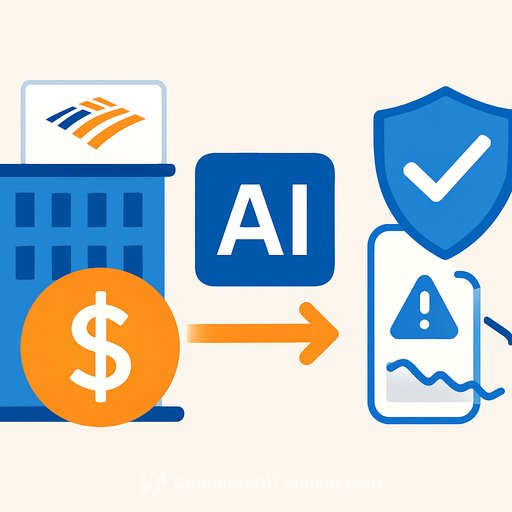
The bank's fraud loss rate has been cut in half with AI catching abnormal behavior earlier. Service call volume is down 60%, taking pressure off support queues and improving resolution times.
Proof points that matter to operations
- 270+ production models supporting risk, service, and internal productivity.
- Fraud loss rate reduced by 50% through prevention and anomaly detection.
- 60% reduction in service calls, implying higher self-serve and better first-contact resolution.
- 18,000 developers using coding agents; reported 20% productivity gains in parts of the software lifecycle.
Those productivity gains are being reinvested into new growth programs next year, according to the bank's technology leadership. That's the operating model: capture time savings, redeploy into higher-value work, and repeat.
Agentic AI is moving from pilot to practice
The number of technologists working on AI agents across financial firms has grown more than tenfold, per industry trackers. Bank of America is scaling coding agents to speed development and reduce handoffs - a practical way to shrink cycle times without ballooning headcount.
For ops, this means treating agents like teammates with defined scopes, SLAs, and guardrails. You wouldn't drop a new analyst into production without process docs and oversight. Same rule applies here.
Governance is the workload
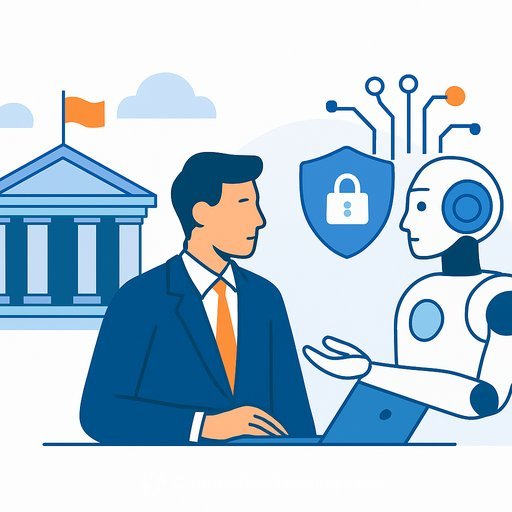
With global operations and changing rules, the bank is investing in compliance checks and oversight frameworks. The message to operators: assume governance load will rise as adoption expands, and budget for it early.
- Stand up model inventory and lineage: who owns it, what data it touches, where it runs, how it's validated.
- Apply model risk standards consistently (development, validation, monitoring, incident response).
- Enable data access across hybrid environments with auditable controls, not ad hoc connectors.
- Set agent scopes, escalation paths, and human-in-the-loop checkpoints for high-impact actions.
- Track ROI and risk together: productivity, quality, loss prevention, customer outcomes, and control breaches.
Helpful references: the NIST AI Risk Management Framework and the Federal Reserve's SR 11-7 model risk guidance.
Your AI operating playbook
- Start where outcomes are measurable: fraud, collections, customer service deflection, and developer tooling.
- Make an enterprise model roster: production status, owner, SLA, cost to run, and business KPI linkage.
- Create a gated release path: sandbox → supervised pilot → controlled rollout with champion/challenger testing.
- Instrument everything: log prompts, outputs, approvals, and overrides for audit and root-cause analysis.
- Budget for governance upfront: policy, validation, red-teaming, and monitoring won't pay for themselves.
- Reinvest time saved: convert efficiency into backlog burn-down, feature delivery, or customer improvement.
- Train the workforce: role-specific playbooks beat generic AI tips every time.
KPIs that show real progress
- Risk: fraud loss rate, false positives, investigation cycle time.
- Service: call volume deflected, average handle time, first contact resolution, CSAT.
- Engineering: lead time for changes, change failure rate, rework ratio, unit test coverage.
- Governance: model validation pass rate, incident count and time to contain, audit findings closed on time.
- Financials: cost per contact, cost per model, savings redeployed into growth work.
What BofA's approach signals
Scale matters. The bank's advantage isn't a single model - it's hundreds of targeted models, wired into processes, measured, and maintained. That's good operations hygiene with new tooling.
The path is clear: ship small, measure relentlessly, automate guardrails, and keep humans in control where stakes are high. Do that, and AI becomes a force multiplier for throughput and control, not a compliance headache.
Upskill your ops teams
If you're formalizing role-based enablement, you can browse practical programs here: AI courses by job and a curated list of AI tools for finance operations.
Your membership also unlocks: