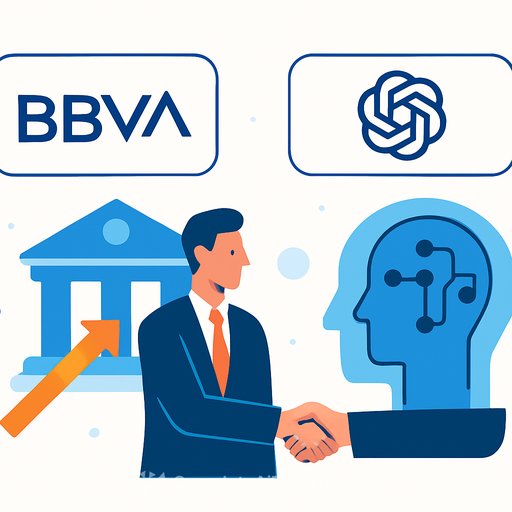
BBVA Teams With OpenAI to Drive AI Across Operations
A bank tying up with a leading AI provider signals one thing: AI is moving from experiments to everyday operations. For operations leaders, this is less about hype and more about throughput, accuracy, and control.
Here's what matters, what to build first, and how to measure it.
Why this matters for Operations
- Efficiency at scale: Reduce cycle times, rework, and escalations across customer service, back-office tasks, and IT operations.
- Consistency: Apply standard operating procedures with fewer slips. AI enforces policy, humans handle edge cases.
- Decision support: Summaries, root-cause analysis, and next-best-action inside the workflow, not in a separate tool.
- Cost control: Track cost-per-ticket and cost-per-document with clear unit economics for AI calls.
High-value use cases across the ops stack
- Contact center: Real-time agent assist, call summarization, disposition suggestions, and QA scoring.
- Back-office processing: Document intake, classification, entity extraction, and exception handling for loans, claims, and servicing.
- KYC/AML triage: First-pass review, risk summaries, and adverse media synthesis with human sign-off.
- Fraud investigations: Narrative building from multi-system data, guided checklists, and case notes.
- IT operations: Runbook search, incident summaries, and remediation suggestions from past incidents.
- Knowledge management: Policy Q&A and change summaries pushed to the teams who need them.
Architecture patterns that work
- RAG (retrieval-augmented generation): Keep facts grounded in your documents and systems. No free text without a source.
- Data controls: Role-based access, field-level filtering, and redaction for PII before model calls.
- Observability: Capture prompts, responses, latency, cost, and user feedback for each task.
- Guardrails: Policy checks, allow/deny lists, and output validation before anything hits a system of record.
90-day execution plan
- Weeks 0-2: Alignment and risk
- Pick 2-3 processes with clear volume and pain (AHT, backlog, error rate).
- Define success metrics and ceiling targets (e.g., -25% handle time, -30% rework).
- Complete privacy, security, and model risk reviews; decide data boundaries.
- Weeks 3-6: Pilot and proof
- Ship a workflow-integrated pilot with human-in-the-loop approvals.
- Create a prompt library linked to SOPs and policy sources.
- Start a feedback loop: thumbs up/down, correction capture, weekly tuning.
- Weeks 7-12: Scale and repeat
- Automate the "happy path," escalate edge cases.
- Roll out playbooks, training, and change communications tied to metrics.
- Stand up model governance: versioning, drift checks, and quarterly audits.
Risk, compliance, and controls
- Data leakage: Strip PII, log access, and restrict external calls.
- Hallucinations: Require source citations; block actions without evidence.
- Prompt injection: Sanitize inputs; isolate external content with strict rules.
- Auditability: Immutable logs of prompts, outputs, approvers, and final actions.
- Policy drift: Sync models with the latest policies; expire old prompts.
Metrics that matter
- Throughput: Items closed per FTE per week.
- Quality: First-pass yield, rework rate, and defect escape rate.
- Speed: Cycle time and SLA adherence by segment.
- Experience: CSAT/NPS for assisted interactions, agent effort score.
- Unit economics: Cost per task (model + infra) vs. baseline.
Team and ownership
- Model owner: Accountable for outcomes, drift, and compliance.
- Ops SME: Curates SOPs, sources, and exception rules.
- Risk partner: Reviews prompts, data flows, and red-team results.
- Enablement: Training, playbooks, and change management.
Tooling checklist
- LLM gateway with per-use policies and cost caps.
- Vector search for RAG and policy retrieval.
- Prompt/version management tied to releases.
- Evaluation harness with golden sets and acceptance thresholds.
- Production monitoring for latency, cost, and outcomes.
Skills to build inside your ops org
- Prompt design aligned to SOPs and compliance.
- RAG configuration and source curation.
- Measurement: setting guardrails, targets, and review cadences.
- Change leadership: communicating "what changes, what doesn't," and why.
If you want structured training for operations-focused AI adoption, explore these resources:
What this signals for financial services
AI is becoming part of standard operating procedure. The leaders won't be the teams that experiment the most; they'll be the ones that tie AI to clear metrics, guard it with strong controls, and roll it into existing workflows without drama.
If you're in operations, the move is simple: start small, measure hard, automate the predictable, and keep humans on the edges.
Further reading:
Your membership also unlocks: