
AI news ·
Beat the AI Hype: ASO Playbook for Real App Store Growth in 2025
AI is loud in 2025-this guide shows what's truly changing in App Store growth and what to stop doing. Get intent-led copy, sharper creatives, weekly tests, and metrics that count.
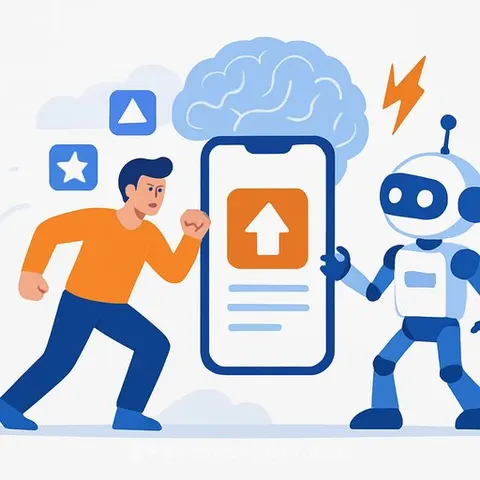
App Store Marketing in Flux: Your Strategic Blueprint to Beat the AI Hype
AI is everywhere in 2025. The real question: is it making your app grow, or just making your roadmap louder?
This blueprint trims the noise and focuses on what's actually changing in the App Store and Google Play-and how marketers can use AI with intention. Short playbooks, clear metrics, and moves you can ship this week.
What AI is actually changing in the App Stores
- Search is semantic, not literal: Query rewriting and intent-based ranking reduce the payoff from exact-match keyword stuffing. Topic coverage and relevance signals matter more.
- Creatives are machine-judged first: Computer vision and NLP scan your screenshots, videos, and copy for clarity, claims, and category fit. Low-signal visuals and generic stock assets underperform.
- Reviews shape conversion: Summarized review snippets surface common pains and features. If your page and replies don't echo user language, conversion drops.
- Personalization is stronger: Store surfaces adapt by user intent and history. Expect more fragmented traffic and smaller, more targeted wins.
- Experimentation gets more leverage: Native testing tools are central to growth. If you aren't testing creative and messaging every week, you're leaving installs on the table.
Reference material if you need it: Apple Product Page Optimization and Google Play Store Listing Experiments.
What to stop doing
- Spamming keywords and awkward synonyms for search. It reads poorly and doesn't win consistently anymore.
- Shipping generic AI-written descriptions with zero proof, zero user language, and zero testing.
- Running broad-match ads without intent clustering or creative alignment.
- Guessing at creatives. Guess, test, or lose-there's no middle ground.
The AI-forward ASO playbook
- 1) Map user intents from reviews: Export reviews, summarize with an LLM, cluster by jobs-to-be-done and pains. Label each cluster with exact phrasing users use.
- 2) Write for topics, not strings: Use clean, human copy that matches high-value clusters. Keep keywords natural. Cover the topic fully: problem, feature, outcome, proof.
- 3) Creative system, not one-off assets: Build sets for each intent cluster. First screenshot = the promise; second = proof; third = feature clarity. Video hook in the first 2 seconds.
- 4) Reviews as revenue: Use AI to draft reply templates by theme (bug, billing, feature request). Escalate urgent issues. Ask for updates after fixes. Your rating curve is a conversion lever.
- 5) Always-on testing: Run concurrent tests on Apple PPO and Play Experiments. Rotate one variable at a time. Target a 20-30% test cadence on creatives and copy.
- 6) Ads aligned to intents: Break campaigns by clusters. Pair creative sets to each. Use negatives to protect budgets and push winning intents.
- 7) Measurement with guardrails: Track by cohort and intent. Hold back regions or channels to quantify lift. Build a weekly "what moved, what didn't, what's next" loop.
- 8) AI governance: Keep a prompt library, brand rules, truth source for claims, and a human review step. Consistency beats randomness.
Where AI helps beyond content
- Demand sensing: Forecast seasonality and bursts from search trends and review velocity.
- Competitor tracking: Auto-tag creative changes, releases, and promotion spikes. Respond with targeted tests, not copycat moves.
- Localization at scale: Translate with AI, then refine with a native speaker. Mirror regional intents and proof points.
- Ops automation: Triage reviews, draft replies, label creative results, and prep experiment briefs automatically.
Simple weekly operating cadence
- Mon: Review last week's tests, decide next two experiments, update the intent board.
- Tue-Wed: Produce creatives and copy; QA against brand rules and claims.
- Thu: Launch tests. Sync ads with the same intents.
- Fri: Early readout. Log learnings and cut losers fast.
- Monthly: Reset benchmarks. Re-cluster reviews. Retire stale creatives.
Metrics that actually matter
- Store health: Search vs. Browse split, ranking on priority intents, share of impressions.
- Conversion quality: PDP CVR by traffic source and intent, creative win rate, rating trend.
- Unit economics: D1/D7 retention by cohort, blended CAC, payback, LTV vs. CPI by intent.
Quick wins to ship this week
- Summarize the last 90 days of reviews into 5-8 intent clusters. Rewrite your short description/subtitle to match the top two.
- Create two new first screenshots: one "promise + proof," one "problem + outcome." Test both.
- Spin up reply templates for the top three negative review themes and start closing the loop.
- Split ad campaigns by intent cluster and align creative sets to each.
- Set a rule: no release goes out without a matching test plan on the stores.
You may also like
- 00:15:37 Quick Commerce Profitability: Strategies for Retention, Frequency, and Growth
- 00:19:57 Beyond the Hype: How to Build a Working AI Product Roadmap
- 00:18:04 SEO for Mobile Apps: Driving Explosive Growth Beyond App Stores
- 00:11:45 Growth Team 2027: Your Guide to Hiring the AI-Ready Skillset of the Future
- 00:15:50 How to Build Multi-Brand App Loyalty: The PAYBACK Case Study & Blueprint
- 00:21:04 Don't Get Left Behind: Your Company's Guide to AI-Ready Marketing
Level up your team
If your marketers need a structured, hands-on upgrade for AI-driven workflows, this is a good starting point: AI Certification for Marketing Specialists.
Models are changing. Store mechanics are shifting. The teams who win keep testing, keep learning, and keep their strategy simple.