Strengthening India's Healthcare Backbone With Practical AI
India's healthcare story gets attention for new hospitals, advanced procedures, and flashy apps. But care doesn't run on headlines. It runs on the backbone: systems that keep hospitals functional, clinicians supported, patients tracked, and supplies available. That backbone is under pressure-and patient outcomes feel it first.
To build sustainable healthcare at scale, we need to relieve the system, not just add more tools. AI can help-quietly, reliably, and where it matters most-if we deploy it with discipline and policy clarity.
Why the Backbone Is Under Strain
- Workforce shortages and burnout: Too few doctors, nurses, and technicians-especially outside cities. Admin overload steals time from patient care.
- Urban-rural gap: Advanced diagnostics and ICU care are city privileges. Many patients travel long distances for basic tests and consultations.
- Fragmented health data: Records sit in silos or on paper. Continuity of care suffers, and planning becomes guesswork.
- Rising disease burden: Infectious disease, plus growing chronic and acute conditions. Early detection and long-term monitoring lag behind need.
Where AI Fits-and Where It Doesn't
AI is not here to replace clinicians. It is here to reduce avoidable workload, improve decisions, and support consistent care. Used responsibly, it frees humans to do human work: listening, examining, treating, and following up.
The goal is simple-less friction, fewer errors, faster detection, better use of scarce resources.
Early Diagnosis and Preventive Care
- AI-powered medical imaging: Tools can flag abnormalities on X-rays, CT scans, and retinal images. They help triage cases, detect TB, breast cancer, and diabetic eye disease earlier, and support non-specialists in low-resource settings.
- Population risk prediction: By analysing history, labs, and demographics, AI highlights who is at higher risk of chronic disease. This shifts effort to prevention and timely intervention.
Strengthening Primary Care
- Decision support for frontline workers: AI guidance for triage, referrals, and basic diagnostics can standardise care and reduce errors without overriding clinical judgment.
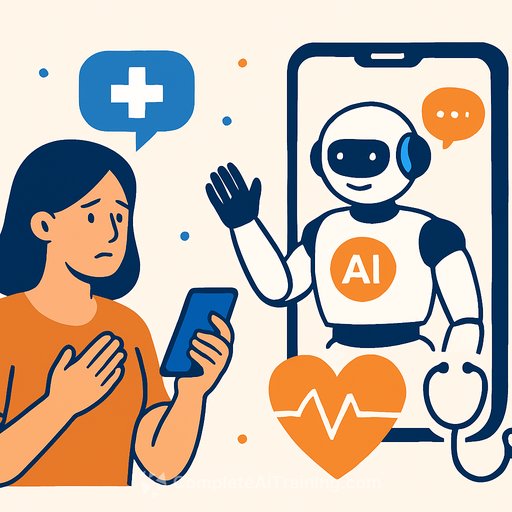
- Language-enabled assistants: Chat and voice tools in local languages improve health literacy and symptom guidance, closing an access gap created by India's linguistic diversity.
Hospital Operations and Resource Management
- Reducing administrative burden: Automate scheduling, documentation, discharge summaries, and reporting. Give clinicians back hours each week for direct care. See AI for Operations.
- Optimising patient flow and beds: Predict inflow, ED spikes, and occupancy. Match staff to demand, cut wait times, and prepare for surges-critical in public hospitals.
Making Health Data Work
- AI + electronic health records: With digitised records under national initiatives, AI can surface trends, care gaps, and outbreak signals for faster action and better planning. See India's Ayushman Bharat Digital Mission for the foundation.
- From silos to connected care: Interoperable systems reduce duplicate tests, improve handovers, and enable longitudinal care.
AI in the Healthcare Supply Chain
- Predicting demand: Forecast drug, vaccine, and consumable needs using history and disease trends to avoid stockouts and wastage.
- Equipment uptime: Predictive maintenance for diagnostic equipment reduces downtime and protects service continuity.
Ethics, Trust, and Responsible Use
- Data protection and consent: Sensitive health data requires clear consent flows, privacy safeguards, and accountability. Trust decides adoption.
- Avoiding bias, ensuring equity: Train models on diverse, representative data to serve rural and vulnerable groups fairly.
- Training the workforce: Clinicians and administrators need practical AI training to use tools safely and effectively. For structured options by role, see AI Learning Path for Medical Records Clerks.
Policy and Collaboration Will Decide Outcomes
- Policy must lead: Define where AI can be used, how it is validated, and who is accountable when it fails. Healthcare is high-stakes; guesswork is costly. For guidance on governance and strategy, see the AI Learning Path for CIOs.
- Integrate AI into public health: Bring AI to primary health centres and national programs. Create reference models that states can replicate.
- Data governance: Enforce interoperability, consent, and anonymisation standards to enable safe data use at scale.
- Outcome-driven public-private collaboration: Align incentives to cut diagnostic delays, improve rural access, reduce wait times, and support frontline workers.
What Healthcare Leaders Can Do This Quarter
- Audit top admin drains (documentation, scheduling, claims). Pilot automation in one department and measure hours saved.
- Deploy an AI triage or imaging support tool in a resource-limited unit with a clear protocol and human oversight.
- Adopt a minimal data standard for continuity of care. Start with discharge summaries and lab results.
- Set up an AI governance group (clinical, IT, legal) to review vendors, validate models, and track safety signals.
- Upskill staff with short, role-based AI training and practical SOPs. Include escalation paths when tools disagree with clinicians.
- Partner with public programs to align pilots with national priorities and funding pathways.
Clear Direction
India sits at a pivot point. AI can reinforce the healthcare backbone-or expose its weak links. The difference will be policy discipline, responsible adoption, and serious collaboration.
Let technology serve public health goals, not the other way around. Build the guardrails, train the people, and measure what matters. In healthcare, progress is defined by governance-and felt by patients.
For context on chronic disease priorities in India, see WHO India: Noncommunicable Diseases.
Your membership also unlocks: