Long-Range Perception That Works When Visibility Drops
Operations teams face a constant trade-off: push capacity without compromising safety. That tension peaks when visibility falls. Fog, snow, rain, or low sun cut the driver's range, and with it, operational certainty.
Long-range perception changes that equation. It gives drivers and ATO a longer decision window, keeps braking margins intact, and sustains performance when the view ahead is unclear.
Why Optical-Only Sensing Falls Short
Human vision and optical sensors weren't built for rail stopping distances. At 100 km/h, braking distances can reach ten times that of a car, so every meter of early detection counts.
Fog, rain, snow, glare, and darkness degrade cameras and LiDAR because they depend on optical physics. Under poor visibility, image quality drops, classification confidence falls, and speed restrictions follow.
Radar as the All-Condition Sensing Foundation
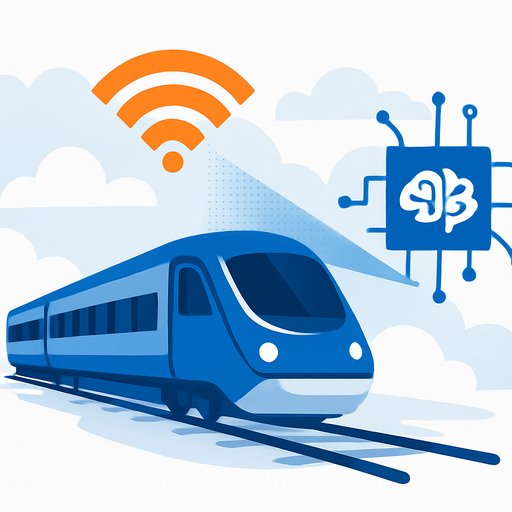
Radar-based systems give consistent long-range awareness in the same conditions that limit cameras and the human eye. Using millimetre-wave frequencies, radar scans the track ahead and detects obstacles beyond 1,000 m, in daylight or low light, with limited impact from fog, rain, or snow. Learn more about millimetre wave here: Millimetre wave.
For operations, the gains are direct: keep line speed where safe, reduce unnecessary slowdowns, and maintain confidence when visibility drops.
AI That Turns Signals Into Decisions
Radar provides the range; AI adds judgment. Modern systems combine classical radar processing (range/Doppler, angular estimation, CFAR, tracking) with physical AI models to extract structural and behavioral signatures from raw echoes.
This improves detection and classification for debris, vehicles, pedestrians, animals, rockfalls, and track obstructions at ranges that preserve braking margins. It also filters clutter and multipath noise, cutting false alarms so drivers and ATO get alerts they can trust.
Maintenance and Asset Insight, Built In
The same sensing stack supports asset and infrastructure monitoring. AI can learn a "healthy" baseline for track and near-track environments, then flag early signs of buckling, deformation, or change patterns.
That means earlier interventions, more stable workbanks, and fewer unplanned outages-practical wins for timetable resilience and budget control.
Operational Outcomes That Matter
- Support safe running at speed under low visibility.
- Fewer weather-driven slow orders and reduced reactionary delay.
- Better ATO performance and a path to higher Grades of Automation (see GoA).
- Cleaner, trusted alerts that fit cab workflows and reduce cognitive load.
NIART Systems: All-Visibility Perception for Rail
NIART Systems has built a multi-sensor, all-weather perception platform for long-range hazard detection in any visibility. It fuses high-resolution radar with multi-spectral electro-optical cameras (thermal and daylight), AI-driven perception, and advanced data fusion to deliver real-time, actionable alerts to drivers or ATO.
The system detects obstacles beyond 1,200 m and identifies key rail infrastructure like switches and signals. It is suitable for mainline, freight, passenger, and shunting use cases.
Field Results
On Indian Railways, trials on diesel and electric locomotives are tackling hazard-heavy routes and extreme winter fog corridors. Despite severe visibility loss, the system maintains reliable obstacle detection beyond 1,200 m, addressing a persistent operational challenge.
In Europe, it is integrated into Alstom's ATO for a joint autonomous shunting programme with ProRail and Lineas. It has consistently detected cars, people, wagons, and misaligned switches up to 600 m, showing maturity for GoA4 deployment.
What Operations Leaders Can Do Now
- Run a corridor-based pilot through a full weather season to benchmark speed profiles, false alarms, and driver acceptance.
- Integrate alerts with existing cab displays and operating rules; align with safety cases early.
- Plan for data feedback loops (incident replays) to improve models and procedures over time.
If your teams are building AI literacy to support deployment and change management, explore the AI Learning Path for Network Engineers.
Contact NIART Systems to find out more about this solution.
Your membership also unlocks: