AI Operations Needs Flexible Orchestration, Not More Tools
The pace of AI isn't slowing down. Your infrastructure has to adapt on demand, not just scale harder.
At IBM's TechXchange in Orlando, Solution Architect David Levy and Integration Engineer Raafat "Ray" Abaid made a clear case: traditional automation and tool sprawl are holding teams back. The answer is flexible orchestration that unifies how you run AI and ML workloads across the stack.
The current state: manual work and tool overload
Ray laid it out plainly: deploying apps VM by VM is slow, error-prone, and a drain on Ops time. Log into each server, repeat the same steps, fix issues one by one-meanwhile your queue stacks up.
Then add tool sprawl. Web teams on Kubernetes, training on Slurm, batch on Airflow, inference via custom SSH. Four teams, four platforms, four ways to debug. When something breaks, diagnosing the root cause becomes guesswork.
Where Kubernetes fits-and where it struggles
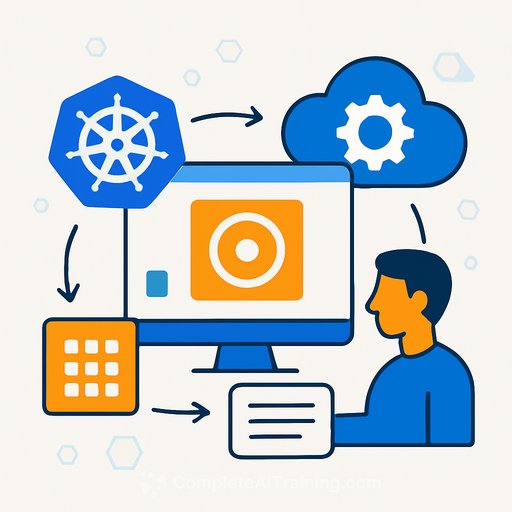
Kubernetes is excellent for long-running, stateless services. But AI/ML needs short-lived GPU jobs, frequent experiments, and scheduled training runs. A typical deployment needs multiple YAML files (config maps, secrets, storage, deployments). That overhead is fine for apps, heavy for fast-changing AI work.
Use Kubernetes where it shines, but don't force every AI workflow through it. For reference, see the official docs for context on core patterns: Kubernetes documentation.
What flexible orchestration looks like
- One orchestrator to run web services, ephemeral training jobs, batch pipelines, and inference-across on-prem and cloud.
- Simple job specs that declare CPU/GPU, memory, placement, retries, priorities, and schedule. No ticket ping-pong.
- Automatic deployment, scaling, retries, and failover. A server dies; the workload is rescheduled without drama.
- GPU-aware scheduling, quotas, and fair-share so high-value jobs don't wait behind low-priority runs.
- Unified logs/events for faster troubleshooting. One place to look, one operational model.
- Policy guardrails: RBAC, secrets, storage, and network policies applied consistently.
Why Ops teams benefit
For practical, ops-focused guidance on running AI at scale, see AI for Operations.
- Cycle times drop: data scientists self-serve training in minutes instead of days.
- Fewer tickets; more time for platform reliability and capacity planning.
- Cleaner root-cause analysis with a single event stream and log surface.
- Lower cognitive load: one platform, one set of workflows, shared vocabulary.
- Better GPU utilization with preemption, priorities, and job placement controls.
Practical adoption path (no forklift rebuild)
Keep Kubernetes for microservices. Introduce a workload orchestrator that handles batch, training, and inference alongside services. Unify identity, logging, and policy step by step.
- Weeks 1-2: Inventory workloads. Tag CPU/GPU needs, durations, data locality, and SLOs.
- Weeks 3-4: Create job templates (training, batch, inference) with defaults for images, secrets, and volumes.
- Month 2: Pilot a nightly training pipeline. Wire CI/CD to submit job specs on merge.
- Month 3: Consolidate logs/metrics/alerts. Retire ad-hoc SSH scripts and scattered cron jobs.
From there, it's a rinse-and-repeat migration. You're moving specs, not rebuilding your stack.
What to measure
- Lead time: request to first successful run
- MTTR for failed jobs and services
- GPU utilization and queue wait times
- Ticket volume tied to deployment and scheduling
- Cost per training/inference run
The bigger picture
Model classes shift fast-from transformers to today's large-scale inference. With flexible orchestration, you don't redesign infrastructure each time. You write a new job spec that matches the workload's needs.
That keeps your platform stable while your AI stack evolves. Less thrash for Ops, faster iteration for data science, and a cleaner path to scale. For executive strategy and governance around AI infrastructure, consider the AI Learning Path for CIOs.
If your batch pipelines are part of the sprawl, it helps to level-set on best practices: Apache Airflow documentation.
Want a structured way to upskill teams around AI operations and job design? Explore role-based programs here: Complete AI Training - Courses by Job.
Your membership also unlocks: