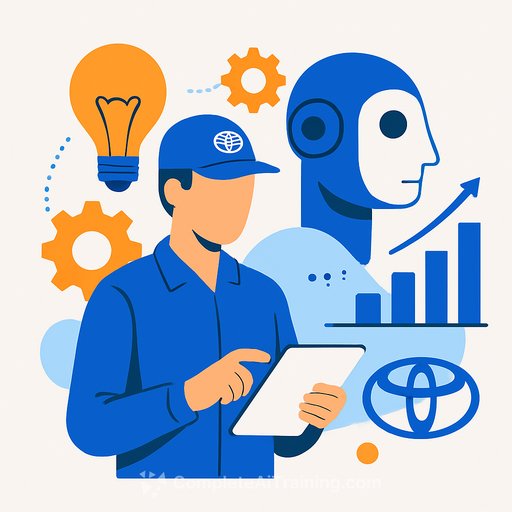
Reimagining operations with agentic AI at Toyota
Agents alone won't create an edge. Process redesign and people will. That's the core of Toyota's approach to agentic AI: start with the problem, then pick the fit-for-purpose tech that helps team members, customers, and the company move forward.
The digital innovations group sits inside operations and supply chain, not off to the side. That matters. It keeps the work grounded in end-to-end outcomes, not isolated wins inside a single function.
From spreadsheets to scenarios: resource allocation
Resource allocation used to mean 75 spreadsheets, 50+ people, and long nights. Now, Toyota is building a global planning system that reduces the core team to 6-10 planners and retires the spreadsheets. The extra capacity is redeployed to higher-priority work.
An AI agent pulls demand, checks supply, and walks planners through scenarios. It handles the routine steps so humans can make the calls that move the business.
- Auto-ingest demand signals and current supply
- Surface constraints in real time
- Generate scenario options (optimize for revenue or other targets)
- Produce models in minutes instead of hours of overtime
ETA management without the mainframe maze
Tracking vehicle status used to require 50-100 mainframe screens. A new vehicle management tool replaces them with real-time visibility from premanufacturing to dealer delivery. Agentic AI takes it further with targeted prompts and actions.
If a team member asks, "How many vehicles are delayed in the West, and why?" an agent can return a precise status report. If a vehicle is sitting in a yard, the agent drafts an email to the logistics provider with the exact bin and truck instructions, and alerts the dealership with the recovery plan-before anyone logs in for the day.
As these agents mature, human effort shifts from firefighting to preventing repeat issues.
Process redesign and trust over algorithms
The real gains don't come from automating yesterday's process. They come from rethinking the work. Toyota is investing here because the differentiator is embedding AI into daily decisions without breaking trust.
Technology is the easy part. Change management is hard. A new Talent & Experiences function focuses on upskilling, transparency, and bringing team members into design early so they help shape the change, not receive it.
If you're formalizing guardrails, frameworks like the NIST AI Risk Management Framework can help align governance, approval flows, and auditability.
The stack that makes this work
Everything runs on a public cloud platform with a connected data hub across the value chain. Above that sits a services layer, then an intelligence layer where agents operate. Products share a common UX and are accessed through a single portal called "Cube."
Inside Cube, the Command Center is integrating agentic AI for observability. Today, agents monitor and manage uptime. Next: monitoring costs and agent interdependencies as usage scales.
What operations leaders can apply this quarter
- Start with a specific value-stream problem and success metrics (ETA accuracy, OTIF, plan cycle time, overtime).
- Map the process and isolate decisions. Let agents handle repetitive steps; keep humans in charge of exceptions and approvals.
- Stand up a minimal data backbone: core product master, event streams, and demand signals. Retire bespoke spreadsheets early.
- Prototype a single agent that auto-pulls data and generates scenarios. Time-box it to 4-6 weeks with a clear "go/no-go" gate.
- Build trust: approvals, audit logs, replayable decisions, and clear escalation paths. Use lightweight policies aligned to NIST RMF.
- Create a small talent pod for enablement. Pair AI specialists with planners and logistics leads. Use shadow-to-own transitions.
- Measure before/after: planning cycle time, spreadsheet count, overtime hours, delay dwell time, ETA variance, and team satisfaction.
- Scale from one agent to a system of agents. Add observability for uptime, cost, and cross-agent dependencies.
Expected outcomes
- Scenario modeling in minutes, not hours
- Smaller core planning team, with staff redeployed to higher-impact work
- Fewer interfaces and fewer handoffs (mainframe screens retired)
- Faster ETA recovery and clearer communication to logistics and dealers
- More time spent on prevention and process improvement
Agentic AI is a means, not a trophy. The advantage comes from reworking the process, embedding decisions into daily operations, and bringing people along with clear roles and trust.
If you're building team capability in AI for operations, explore curated courses by job for practical upskilling.
Your membership also unlocks: