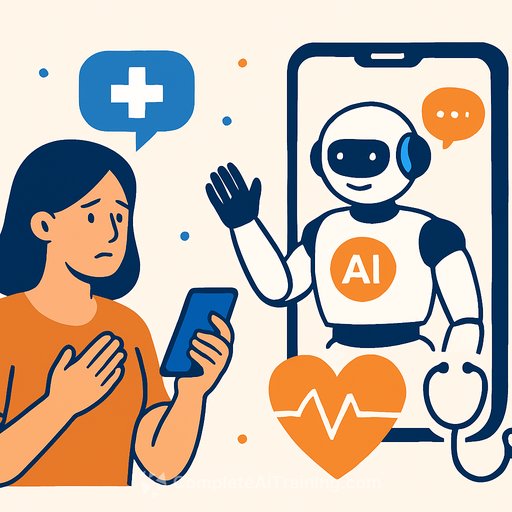
AI In Singapore's GP Clinics: Cost, Access, And Real-World Value
Singapore is investing in AI for public healthcare, yet many independent GPs still sit on the sidelines. The gap comes down to three friction points: cost, access to clinical-grade tools, and clear proof of value. For smaller practices, those obstacles can be enough to pause adoption.
Some doctors use general AI for admin work. Fewer are paying for clinical tools, and even fewer can point to a strong return that justifies the spend.
What Clinics Are Spending
At Assure Family Clinic, Dr Joanne Koay spends up to S$2,200 a year on a Ministry of Health-approved platform. It supports health screening, genomics-based wellness planning, and early cancer risk detection.
In Bukit Timah, Dr Joshua Chua pays roughly S$100 a month across four tools. He uses AI for dictation post-consult, translating foreign reports (see AI Translation Courses), and generating Excel formulas to track vaccinations and labs. The clinic absorbs most of the cost, but he acknowledges some fees could eventually pass on to patients if subscriptions escalate.
Why Many Are Holding Back
Cost is the first wall. Access is the second. "If it's not easily accessible to GPs, then the hurdle will be very high," said Dr Song Majinyang, who uses ChatGPT's free tier for emails, SOPs, and workflows (see ChatGPT Courses) but avoids paid clinical tools for now.
She also questions clinical relevance: generic chatbots give generic answers, while advanced models are locked in pilots or limited releases. Add data privacy concerns, and the upside can feel distant for a small practice.
For singleton clinics, the math can be simple. "If you have to adopt newer technology… the cost is usually harder to bear for singleton GPs," said Dr Roland Xu. He notes that documentation is still manageable without AI in low-volume settings, and patients rarely ask whether their doctor is using AI.
Data Security: The Non-Negotiable
De-identification is now a baseline. Dr Chua keeps patient identifiers out of third-party tools. Dr Song wants stronger guarantees that no one "reads behind the content."
On the imaging side, RadLink Group's medical director, Dr Eng Chee Way, takes a local-first approach. They use AI for chest X-rays, mammograms, and CT lung scans, with data stored locally and not uploaded to vendors or cloud platforms.
If your clinic is evaluating vendors, align expectations early with national guidance from the Ministry of Health and data protection baselines from Singapore's PDPC.
Where AI Helps Today
Imaging support is maturing. Dr Eng is a strong advocate: AI doesn't fatigue and stays consistent across cases. Still, hallucinations exist and models miss things beyond their training data.
His view: full autonomy isn't ready. The best setup is human + AI, like "flying a plane, where you have auto navigation and a pilot at the same time." That reduces blind spots without handing over the cockpit.
On the primary care frontline, admin use cases are low risk and easy to test: dictation, translation, inbox triage, and spreadsheet logic. Clinical decision support should be piloted with guardrails and clear evaluation criteria.
Practical Takeaways For GP Owners
- Start where risk is low: transcription, translation, templated letters, stock/inventory tasks.
- Set a strict PHI policy: de-identify by default; block uploads of sensitive data into external tools.
- Prefer local or VPC options for clinical data; verify encryption, access logs, and data retention terms.
- Pilot one clinical use case at a time with clear success metrics (accuracy, turnaround time, patient follow-up rates).
- Track ROI monthly: subscription costs, time saved per staff member, reduction in rework or errors.
- Train your team on prompt hygiene and red flags (hallucinations, overconfident outputs, language ambiguities).
- Maintain human oversight: mandate clinician review before any AI-influenced clinical action.
- Document your workflow: inputs, outputs, verification steps, and who signs off.
- Revisit your budget quarterly; sunset underperforming tools quickly to avoid fee creep.
Cost, Access, And Fit
For some clinics, AI is still an add-on. For others-especially those managing imaging or larger volumes-it's becoming part of standard practice. The difference comes down to patient mix, workload, and the clinic's tolerance for subscription overhead.
If a tool saves meaningful time or sharpens early detection without raising risk, it's worth a pilot. If it adds cost and complexity without improving outcomes, skip it for now and revisit later.
Next Steps
If you're planning internal upskilling on safe prompts, workflow design, and vendor evaluation, explore curated options for administrative roles such as AI Training for Administrative Assistants.
Your membership also unlocks: