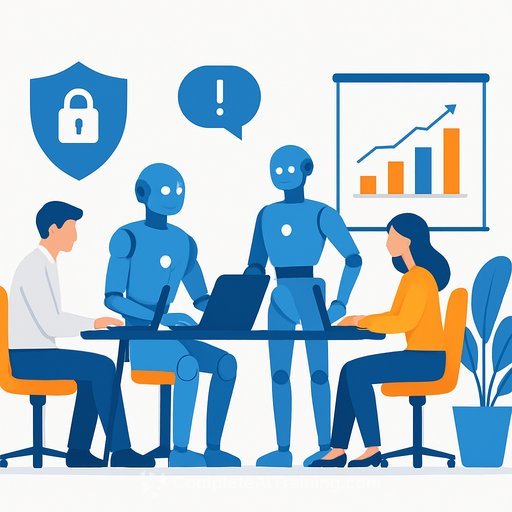
Management consultants are in trouble as AI boosters eat themselves
The pitch was simple: adopt AI to move faster and cut costs. Clients listened. Now the same logic is circling back on the advisors who sold it, squeezing billable hours, compressing rates, and pushing work in-house.
If you manage a P&L, this matters. The Big Four and their peers are automating deliverables, trimming junior ranks, and chasing fixed-fee work while clients expect "days, not months." That flywheel can turn into a doom loop if you don't reset how you buy and build AI capability.
What's actually happening
- Generative tools draft proposals, PMO artifacts, and first-pass analyses. The stuff that justified large teams is getting commoditized.
- Clients are building small, focused AI squads to ship pilots in weeks, not quarters.
- Procurement is pushing outcome-based pricing and reusable assets, not headcount.
- Risk, privacy, and model drift add new delivery overhead that generic playbooks miss.
- Data quality and integration remain the bottleneck, not the model choice.
The doom loop mechanics
- Sell efficiency: Advisors promise 30-70% cycle-time cuts with AI accelerators.
- Spend shifts: Clients cut external hours, demand automation and IP transfer.
- Leverage breaks: Firms automate junior work, shrinking the training pipeline that feeds the partner model.
- Margins fall: More fixed-fee work, fewer "long-tail" hours, heavier risk scrutiny.
- Push more AI: To protect margins, firms double down on automation-tightening the loop.
What managers should do now
- Stand up an internal AI bench: A small product-style team embedded in operations beats a rotating cast of contractors. Give them a backlog tied to concrete KPIs.
- Rewrite SOWs: Milestone payments. Source code, prompts, and playbooks transfer to you. Clear data rights. Outcome definitions agreed up front.
- Standardize the stack: Approved models, guardrails, and monitoring. Treat prompts as code. Adopt a lightweight MLOps/LLMOps workflow.
- Fix data first: Canonical metrics, a semantic layer, and lineage. AI magnifies messy data.
- Use consultants surgically: Buy accelerators for specific use cases (claims triage, policy drafting, KYC summaries), not blank-slate transformations.
- Governance that moves: Clear RACI, pre-approved templates, red-team tests, and a fast lane for low-risk use cases.
New rules for working with consultants
- Insist on knowledge transfer: internal playbooks, prompt libraries, and enablement sessions included in scope.
- Demand portable architecture: avoid hard lock-in to a single model or vendor.
- 30/90 cadence: pilot in 30 days, prove value, scale in 90. No endless discovery phases.
- Pay for outcomes: hours saved, cases handled, cycle time cut-not slide count.
- Bring legal and security in early: reduce rework and approval churn later.
Operating model that actually ships
- Center of enablement: A small team sets standards, reviews risks, and curates reusable components. Business units own delivery.
- Talent plan: Reskill ops analysts and product managers into AI product roles. Pair them with data engineers.
- Finance model: Track benefits monthly. Charge back cloud, model, and consulting costs to the units that drive usage.
Metrics that matter
- Time-to-first-use-case (days)
- Percent of priority processes augmented by AI
- Cost-to-serve per unit after AI
- Model incidents per 1,000 interactions
- Rework rate of AI outputs
- Knowledge reuse index (assets reused per new use case)
Risks to watch (and how to blunt them)
- Privacy and bias: Run DPIAs and bias tests. Use allow/deny lists for data fields. See the NIST AI RMF for practical controls.
- Model drift and supply risk: Version prompts, pin model versions where possible, and monitor quality. Keep a fallback model ready.
- Shadow AI: Offer approved tools and log usage. Block risky endpoints. Train managers on safe patterns.
- IP and copyright: Clarify ownership of prompts, fine-tunes, and outputs in every contract.
Where this ends up
Consulting doesn't vanish-it shifts. Less bodies-on-benches, more systems integration, data plumbing, and change execution. The advantage goes to managers who build a lean internal engine, use advisors for accelerators, and keep ownership of the assets that matter.
If you need structured upskilling for your team, explore role-based paths such as AI Learning Path for CIOs, AI Learning Path for Project Managers, and AI Learning Path for Vice Presidents of Finance. Keep the capability in-house; rent the rest only when it speeds up delivery.
Helpful resources
Your membership also unlocks: