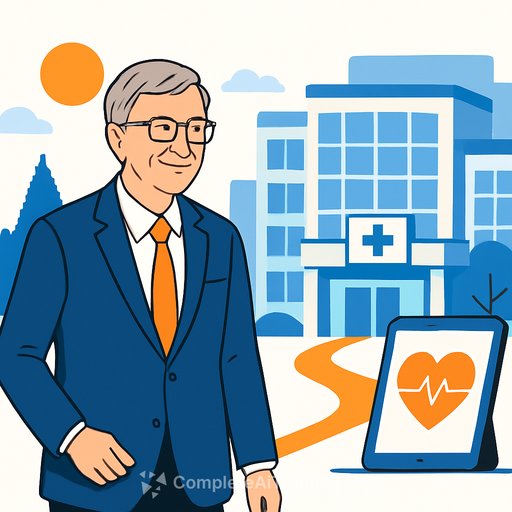
Andhra Pradesh's next phase of public healthcare: tech, prevention, and data at the core
Andhra Pradesh is rolling out comprehensive public healthcare reforms with technical support from the Bill & Melinda Gates Foundation. Minister for Health Satya Kumar Yadav said the effort supports Chief Minister N. Chandrababu Naidu's 'Healthy Andhra Pradesh' goal. Bill Gates is scheduled to visit Amaravati on Monday (February 16) to review ongoing work and align on next steps.
What the collaboration covers
- Universal access to affordable care through modern technology and systemic reforms.
- Stronger nutritional security and better public health outcomes through scalable solutions.
- A shift from reactive, treatment-led care to preventive and predictive models.
- Early disease detection, personalised health profiles, advance warning systems for potential illnesses, individual health cards, and expanded digital services including telemedicine.
Expert governance and structure
Based on the Foundation's recommendation, the State has constituted a high-power advisory group with 10 international experts to review systems and recommend reforms. Three sub-committees are being formed to drive specific focus areas and speed up implementation.
'Sanjeevani': real-time surveillance in action
The State launched 'Sanjeevani' with Tata MD as an integrated, real-time health monitoring initiative. The pilot that began in Kuppam has expanded across Chittoor district and is slated for statewide rollout. The programme links health centres through technology to strengthen public health surveillance and rapid response.
AI adoption and the MedTech Challenge
Andhra Pradesh is taking concrete steps to bring AI-based technologies into clinical and public health services. A national discussion on an AI-based health policy was hosted in Vijayawada last December with the Gates Foundation and representatives from other States.
Through the State's 'MedTech Challenge', around 100 applicants submitted AI-enabled medical devices and solutions. After two screening rounds, 20 were shortlisted and are now being tested in government hospitals. Final selections are expected by the end of March.
- Focus areas: AI-supported diagnostics, portable point-of-care testing, smart monitoring and wearables, telemedicine for remote regions, and integrated data for disease surveillance.
Data integration and decision support
Health data from multiple sources will be integrated with the State's RTGS "Aware" platform to enable earlier outbreak detection and data-driven policy. The Foundation is also supporting a Digital Modelling and Intelligence Decision Centre (DMIDC) at Dr. NTR University of Health Sciences to strengthen analytics and strategic planning.
What this means for healthcare leaders and clinicians
- Shift care pathways: Rework protocols to prioritize screening, risk scoring, and follow-up for NCDs, maternal-child health, and infectious disease signals.
- Build early-warning workflows: Define thresholds for alerts, assign owners for response, and set escalation timelines across PHCs, CHCs, and district facilities.
- Strengthen telemedicine operations: Standardize scheduling and triage, ensure bandwidth and device readiness at last-mile centres, and train staff for remote consult etiquette and documentation.
- Validate AI-enabled tools: Require clinical validation, bias checks, human-in-the-loop review, and clear fallback procedures. Document performance in local settings before scale-up.
- Tighten data governance: Implement consent flows, role-based access, audit logs, and data minimization. Create a playbook for de-identification and breach response.
- Improve interoperability: Map data fields across systems, standardize patient identifiers, and reduce duplicates to support clean feeds into RTGS "Aware".
- Measure what matters: Track time-to-diagnosis, avoidable admissions, turnaround for point-of-care tests, outbreak detection lead time, and patient satisfaction.
- Plan for equity: Monitor access gaps in remote and tribal areas; align telemedicine hours, transport, and community outreach to close them.
Healthcare leaders looking to strengthen capability around AI strategy, governance, and analytics can consult the AI Learning Path for VPs of Strategy for a structured set of topics and best practices applicable to implementing AI-enabled initiatives.
Key milestones to watch
- Bill Gates' review visit to Amaravati on February 16.
- Ongoing pilots for AI-enabled solutions in government hospitals; final decisions due by end of March.
- Gradual statewide expansion of 'Sanjeevani' following district-wide deployment in Chittoor.
Useful references
Your membership also unlocks: