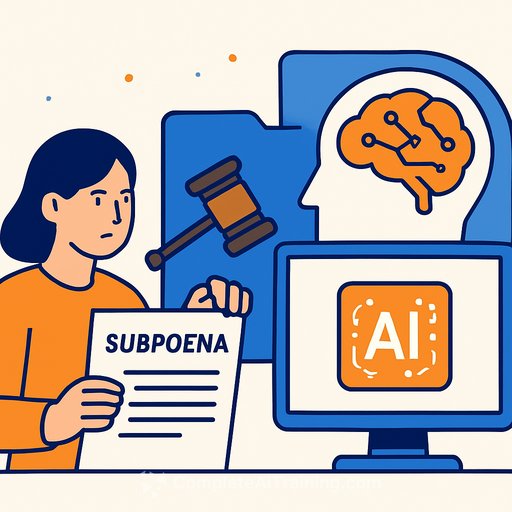
AI Congress introduces subpoena rights for AI-trained content: what creatives need to know
Congress just put transparency on the table for anyone whose work may have been fed into generative AI. The bipartisan TRAIN Act would let copyright owners use administrative subpoenas to find out if their songs, images, writing, videos, or other works were used to train AI models-without permission or payment.
This isn't a lawsuit shortcut; it's a flashlight. If passed, you could request records identifying whether your specific works were in a developer's training data. If a company refuses to comply, the bill creates a rebuttable presumption that they copied your work.
What the TRAIN Act actually does
The bill creates a clear, low-friction process for rights holders to get answers. You file a proposed subpoena and a sworn declaration with a district court clerk stating a subjective good-faith belief that your copyrighted works were used to train a generative AI model.
If your paperwork is in order, the clerk issues the subpoena. The developer must quickly disclose copies of the training material or records sufficient to identify, with certainty, the training material related to your works. Subpoenas are limited to works you own or control.
Who counts as a "developer" under the bill
- Entities that design, code, produce, own, or substantially modify generative AI models.
- Third-party dataset curators who engage in or supervise curation or use datasets for model training.
- Not covered: noncommercial end users.
"Substantially modify" includes retraining or fine-tuning models-so updates that materially change functionality or performance are in scope.
What counts as "training material"
Individual works or components used for training, including text, images, audio, video, and any annotations describing that material. The focus is practical: did your work (or parts of it) help shape the model?
Safeguards, sanctions, and confidentiality
- Confidentiality: If you receive copies or records, you can't disclose them without authorization or consent.
- Bad-faith requests: Courts may impose sanctions under Rule 11(c) of the Federal Rules of Civil Procedure if a request is made in bad faith. Rule 11 overview
- Non-compliance by developers: Creates a rebuttable presumption that your work was copied.
Why this matters now
Legal pressure on AI training is intensifying. We've seen a record settlement from Anthropic over alleged book copying, mixed court outcomes on fair use (including a win for Meta in a specific dispute), and a detailed U.S. Copyright Office report laying out a case-by-case framework for when AI training needs permission.
Researchers have also shown large models can regurgitate copyrighted text nearly verbatim, which raises clear risks for authors and publishers; for deeper technical and methodological background, see AI Research Courses. Meanwhile, platforms like LinkedIn have broadened data collection for AI training, and publishers from Ziff Davis to Reddit have filed suits over unlicensed use.
Bottom line: discovery is hard, evidence is buried, and creators lack a clean way to verify use. The TRAIN Act is designed to change that.
What leaders are saying
Rep. Madeleine Dean framed the bill as a needed update to protect the dignity and authenticity of human work-and to give creators a way to learn whether their art trained AI. Rep. Nathaniel Moran called AI a strong engine of opportunity, paired with a call for transparency so innovation respects original work.
Creative groups lined up in support: the RIAA, SAG-AFTRA, Recording Academy, Human Artistry Campaign, A2IM, the American Federation of Musicians, Copyright Clearance Center, Global Music Rights, IATSE, the Nashville Songwriters Association International, and STM publishers all backed the bill's transparency mandate.
Who can actually use this process
Legal or beneficial owners of copyrighted works-musicians, visual artists, writers, filmmakers, photographers, designers, podcasters, publishers, labels, and their authorized representatives. Your declaration must state a subjective good-faith belief that your identifiable works were used for training.
How to prepare now (before subpoenas are available)
- Catalog your works: Keep a dated, searchable inventory with file hashes, ISRC/ISWC/ISBN/DOI where relevant, and original source files.
- Prove ownership: Store registrations, contracts, split sheets, cue sheets, model releases, and licenses in one secured place.
- Monitor signals: Look for suspiciously verbatim outputs, leaked dataset indexes, transparency reports, and model cards naming sources or curation partners.
- Document evidence: Save prompts, outputs, and comparisons showing unusual likeness or verbatim reproduction.
- Use opt-out/permissions: Where available, set platform permissions and metadata; update website terms and robots/meta signals to limit dataset scraping.
- Ready your declaration: Draft a template that ties your good-faith belief to concrete indicators (dataset lists, output matches, partner disclosures).
- Coordinate with counsel/unions: Align on targets, scope, and confidentiality handling before you request records.
- Update contracts: Add clear language on AI training, dataset use, and derivative model rights in your licensing and work-for-hire agreements.
Process recap (fast version)
- File proposed subpoena + sworn declaration with the district court clerk.
- Clerk issues if forms are proper-no full litigation required to get basic info.
- Developer must disclose copies or records sufficient to identify relevant training material.
- Non-compliance triggers a rebuttable presumption of copying.
- Confidentiality applies; bad-faith requests can be sanctioned.
Scope and definitions worth noting
- Artificial intelligence: Uses the definition from the National AI Initiative Act of 2020.
- Generative AI models: Systems that emulate input structures to produce synthetic content-text, image, audio, video, and more.
- Substantially modify: Actions like retraining or fine-tuning that materially change functionality or performance.
Legal backdrop (context for your strategy)
- Settlements: Anthropic agreed to pay at least $1.5B in a high-profile author case.
- Fair use: Courts are split; one ruling favored Meta for specific plaintiffs, but it doesn't shut the door on others.
- Policy: The U.S. Copyright Office urged case-by-case analysis rather than blanket rules. See the Office's AI resource hub: copyright.gov/ai
- Research risk: Academics extracted large portions of copyrighted books from production models, showing memorization issues.
- Global signals: Data protection authorities are outlining how privacy law applies to model training, and suggesting irregularities may be widespread.
What this unlocks for creatives
Leverage subpoenas to confirm usage, then choose your path: negotiate licenses, seek removal, or pursue claims if warranted. Even if you stop at disclosure, the information itself changes the conversation-with platforms, labels, agencies, and clients.
Most importantly, it puts your catalog back in your hands. You can't protect what you can't see.
Next steps
- Audit your catalog and paperwork this week.
- Identify likely models or datasets that intersect with your niche.
- Draft a plain-English declaration now, so you can move fast later.
- Talk with peers. Collective action can surface patterns across outputs and datasets.
If you're updating your skill stack to work with AI on your terms, explore practical learning paths by role here: AI Learning Path for Training & Development Managers
Your membership also unlocks: