Does putting Elon Musk in Black Mirror really promote AI advertising?
Brands are getting bolder with AI video. The glitches are fading, the budgets are shrinking, and studios are cranking out slick work that would've been unthinkable two years ago. But "can we make it?" is a different question from "should we?"
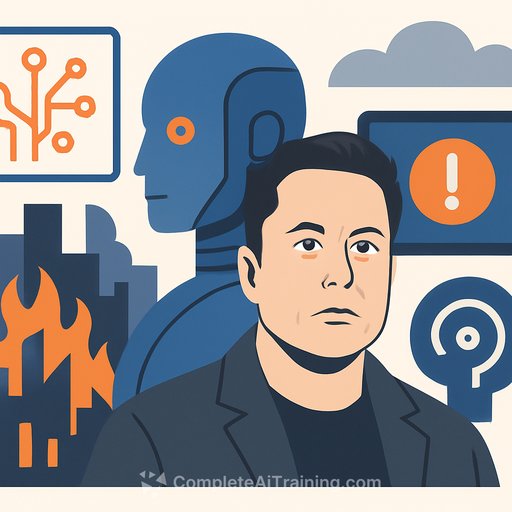
A recent spot from a Belgian AI video shop answers that with a strange flex. It casts AI-aged versions of Elon Musk, Jeff Bezos and Sam Altman in a 2036 mockumentary where out-of-work humans pedal bikes to power AI models. They call it Energym - "fulfilling the machine's need for energy and the people's need for purpose."
The craft is tight. The branding holds together. The likeness work is convincing. And yet, the message? It leans straight into Black Mirror territory - a premise that famously doesn't end well.
Attention vs. affinity
Virality is not victory. Attention is not affinity. You can rack up views with a dystopia, but what does it make people feel about your brand? Fear, cynicism, and moral fatigue don't sell adoption unless you carefully flip the script with a hopeful turn.
This execution doesn't flip it. Even Grok chimed in with a gym-bro take: "pedal hard, stay fit, light up the world." That reads like a punchline, not a brand promise.
The optics problem
There's a physics gap: a human on a bike barely charges a phone, let alone a model farm. Laughing off AI's energy demand while using the faces of tech billionaires lands as tone-deaf, not clever. If you're going to touch the energy angle, own it with facts and solutions.
Context matters here. AI's energy use is under a growing microscope. If you center your story on energy and exploitation, expect blowback unless you show real accountability. For background, the IEA's overview of data centers and AI electricity use is a useful reference point: IEA: Data centres and data transmission networks.
What creatives can learn (and apply on your next brief)
- Decide the emotion first. What should the audience feel at the end - safety, opportunity, relief, ambition? Build every scene to earn that.
- Don't let the tool be the hero. If the audience remembers the technique more than the idea, you shipped a demo, not an ad.
- Test the premise with real humans. Run quick sentiment checks (small panels, social dark posts) before you go wide. Watch for fear, confusion, or sarcasm spikes.
- Handle likeness and consent. Public figures don't equal public domain. Rights, disclosures, and clear context reduce legal and trust risk.
- If you use dystopia, flip it. Show the tension, then resolve it with a credible, brand-aligned answer. End on agency, not nihilism.
- Address the energy story if you raise it. Quantify, mitigate, and communicate. Otherwise it reads like you're in on the joke at the audience's expense.
- Measure beyond views. Track brand lift, favorability, and "would consider" - not just watch time.
A cleaner framework for AI-led campaigns
- Human insight: The fear, hope, or job-to-be-done your audience actually feels.
- Brand truth: One credible promise you can keep today, not a sci-fi wish.
- Emotional arc: From tension to resolution that aligns with your promise.
- Role of AI: Why AI is in the story at all - and how it helps the human.
- Risk map: Likeness, legality, safety, energy, bias - plus your mitigation plan.
- Success metric: The single number the team optimizes (e.g., qualified leads, uplift in trust).
Where dystopia can work
- Satire with a safety message: If you're advocating for guardrails, dystopia can sharpen the point.
- Thought leadership: If you offer concrete fixes, not just vibes, the darkness gives your solution weight.
Bottom line
This ad proves that generative video can fake convincing near-futures and familiar faces. It doesn't prove that those futures make people like your brand. If the takeaway is "AI exploits people for energy," you just funded a PSA against your own product.
Make the idea serve the audience, then let AI serve the idea. If you want to build practical skill with production tools (and know what "good" looks like), explore Generative Video. For message discipline and brand safety in this space, see AI for PR & Communications.
Your membership also unlocks: