Block's AI-Centered Reorg: What Product Teams Should Act on Now
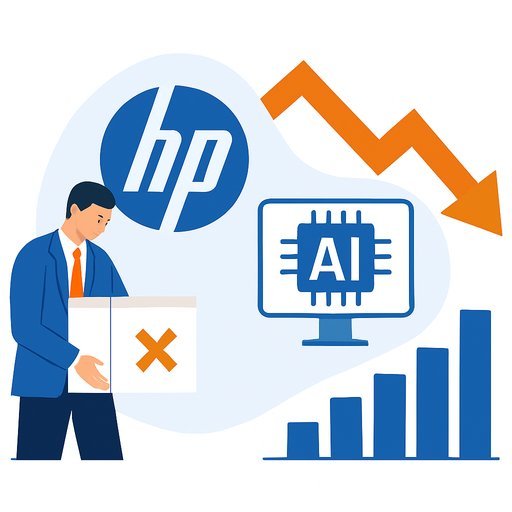
Block (NYSE:XYZ) is cutting over 40% of its workforce and reorganizing around deep AI integration across products and operations. CEO Jack Dorsey is pushing for a leaner cost base, faster product delivery, and clearer focus on core bets. Management characterizes the move as proactive from a position of financial strength and has raised guidance.
For product leaders, the signal is clear: AI won't be an "add-on." It will be a core platform capability, with data, tooling, and delivery pipelines rebuilt to ship AI-native features faster and cheaper.
The move at a glance
- Workforce reduced by 40%+ to streamline costs and speed releases.
- Company-wide pivot to embed AI across products and internal workflows.
- Guidance raised, suggesting confidence in execution and unit economics.
Market context you can't ignore
The stock last closed at $64.45. It's up 27.0% over the past week and 6.7% over the past month. Longer term, shares are down 20.2% over three years and 68.1% over five years - volatility that keeps execution front and center for anyone building the roadmap.
Quick assessment
- Price vs Analyst Target: At $64.45, shares trade about 24% below the $85.29 analyst target.
- Valuation Lens: Estimated to be 21% below fair value, screening as undervalued.
- Recent Momentum: 30-day return of ~6.7% suggests buyers have had the edge lately.
Key considerations for product development
- Profitability baseline: Profit margin is 5.4%, below last year's 12% and under the 13.9% industry average. Any disruption from restructuring needs to be managed against this weaker starting point.
- AI roadmap execution: Tie each AI initiative to a measurable cost-to-serve reduction or revenue lift. Set stage gates (data readiness, offline evals, live guardrails) before expanding rollout.
- Velocity without regressions: Expect pressure to ship faster. Balance with an eval harness for LLMs, automated red-teaming, and human-in-the-loop review for sensitive flows.
- Platform first: Invest in shared model services, feature stores, prompt libraries, and eval pipelines so teams don't reinvent the stack.
- Data flywheel: Formalize data contracts, feedback capture, and user-consented labeling. Every launch should improve the training set.
- Change risk: A 40%+ reduction creates knowledge gaps. Codify domain knowledge, freeze critical paths, and pair departing owners with keepers to protect continuity.
- Compliance and trust: Build to the NIST AI Risk Management Framework from the start to avoid costly rework later.
A practical playbook to ship AI features faster
- 1) Re-segment the portfolio: Kill or pause features without a clear AI edge or margin impact. Double down on core money-makers.
- 2) Define AI-eligible use cases: Rank by data availability, inference cost, and user benefit. Require a clear "why AI vs automation vs rules."
- 3) Thin-slice releases: Ship the smallest useful AI upgrade in 6-8 week increments. Expand by segment and channel as metrics prove out.
- 4) Metrics that matter: Track cycle time, release frequency, defect escape rate, cost-to-serve per transaction, and margin per product line. Benchmark delivery using DORA metrics.
- 5) Evaluation harness: Create offline test suites for accuracy, safety, bias, and cost; add online A/B with guardrails for drift and hallucinations.
- 6) Model strategy: Standardize "fit for purpose" choices (specialized small models for speed/cost, larger models for complex flows). Document build/partner criteria.
- 7) Data operations: Set data contracts, retention, and consent. Close the loop with in-product feedback to power continual fine-tuning.
- 8) Cost controls: Cap inference spend per user action; cache, batch, and quantize; prefer retrieval over generation where possible.
- 9) Org enablement: Stand up a central AI platform team; embed AI PMs and MLEs in squads; publish playbooks and prompt libraries.
- 10) Continuity plan: For areas hit by layoffs, require runbooks, on-call maps, and "last known good" configs before ownership changes.
What to watch next
- Execution of the AI roadmap and the speed at which it improves efficiency and product quality.
- Updates to guidance and whether profitability trends move closer to the 13.9% industry average margin.
- Release velocity, cost-to-serve, user retention, and incident rates during the transition.
Helpful resource for teams
If you're formalizing skills and operating models for this shift, explore the AI Learning Path for Product Managers.
This analysis is general in nature, based on historical data and analyst forecasts, and is not financial advice. It doesn't account for your objectives or financial situation and may not include the latest company announcements.
Your membership also unlocks: