BMKG and Tomorrow Indonesia Validate AI Nowcasting for 0.5 km, 3-Hour Rainfall Forecasts
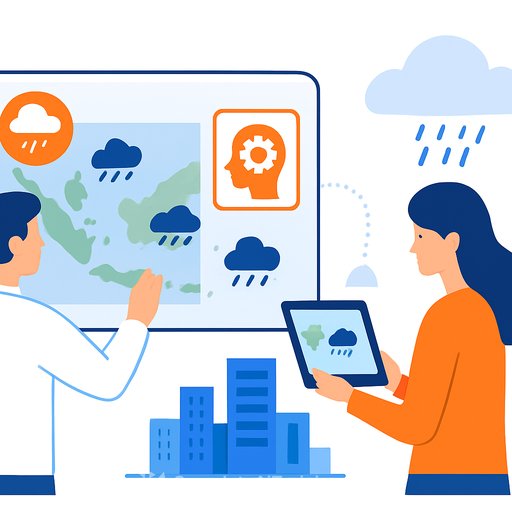
Jakarta, 19 Jan 2026 - BMKG and PT Environmental Intelligence Indonesia (Tomorrow Indonesia) have completed a feasibility study for AI-driven nowcasting that predicts precipitation up to three hours ahead. The Unified Precipitation (UP) system blends BMKG radar with global satellite data and AI modeling, delivering 0.5 km spatial resolution with faster update cycles.
"The AI-based Unified Precipitation (UP) system has demonstrated performance beyond conventional numerical weather prediction models," said Tomorrow Indonesia President Director Muhamad Fitriansyah. He emphasized improved detection of high-intensity rainfall within short windows where quick decisions matter.
What's New
UP integrates multi-source observations-national radar mosaics and global satellites-into a single AI pipeline. The output: higher-resolution precipitation fields and quicker refresh rates, which help forecasters and emergency managers act in time-sensitive situations.
Technical validation covered Jakarta and West Java, areas with complex mesoscale dynamics and frequent hydrometeorological risk. Higher spatial detail and faster updates are intended to support earlier, more accurate warnings in dense urban settings.
Why It Matters for Science and Operations
- Operational readiness: 0.5 km fields allow more precise thresholding for urban flood alerts, drainage capacity checks, and localized impact models.
- Short-fuse decisions: Faster updates improve lead time for warnings and airport, port, and grid operations.
- Cross-sector value: BMKG highlights applications in disaster management, agriculture (crop scheduling), aviation (convective risk), maritime, and renewable energy.
Governance and Collaboration
BMKG Deputy for Meteorology Guswanto underscored that BMKG remains the national authority for data governance, scientific validation, and public information. The collaboration with Tomorrow Indonesia is non-commercial, transparent, and compliant with regulations.
The partnership began with a cooperation agreement on February 4, 2025. Next steps include expanding coverage to Sumatra and Sulawesi and developing targeted applications such as crop planning and aviation safety. "This enhancement of weather services is about saving lives and optimizing national economic efficiency," said Guswanto.
For Research Teams: Practical Next Steps
- Verification workflow: Establish event-based and continuous verification against radar QPE and gauges (e.g., intensity thresholds for urban flooding). Track skill over minutes-to-hours windows where nowcasting is most useful.
- Integration: Feed UP outputs into hydrological, landslide, and sector models. Revisit thresholds to leverage 0.5 km resolution-legacy settings built for coarser NWP may underperform.
- Latency budgeting: Map ingest-to-alert latency across your chain. The value of faster updates disappears if downstream systems add delay.
- Human-in-the-loop: Pair AI fields with forecaster pattern recognition (e.g., rapid convective growth) to reduce false alarms while preserving lead time.
Context and Resources
- Agency context: Learn more about BMKG's services and mandates at BMKG.
- Concepts and best practices: Overview of nowcasting and short-range guidance via ECMWF's nowcasting primer.
If your lab is building or maintaining ML pipelines for environmental data, you may find curated training helpful: AI Research Courses.
Your membership also unlocks: