BMW: From AI Experimentation to AI Embedded in All Areas
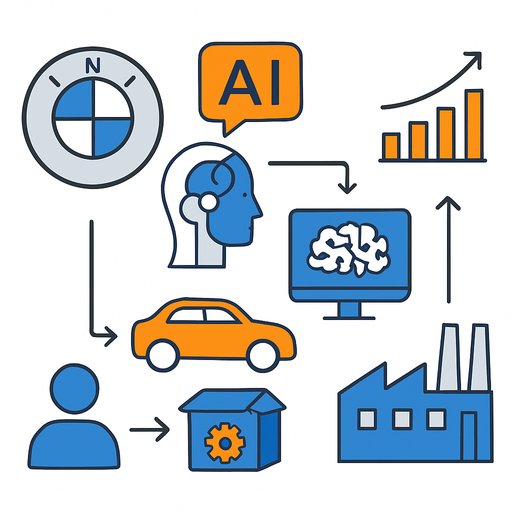
BMW Group is moving AI from side projects to the operating system of the company. Leadership expects every process to be AI-supported, and there are already hundreds of live use cases across development, production, and sales.
Why now? Efficiency, innovation, and a clear return on investment. As Marco Gorgmaier, VP Enterprise Platforms and Services, Data, AI at BMW Group, puts it: "We're scaling artificial intelligence along the value chain, from development and production through to sales. In the foreseeable future, every process at the BMW Group will be AI-supported."
Why this matters for product development
For product teams, this shift means faster cycles, fewer physical prototypes, and higher confidence in decisions made earlier in the process. AI becomes a default teammate across simulation, test planning, supplier selection, and change management.
BMW's approach is model-agnostic and governed. That combination keeps options open while keeping data secure and usage compliant.
Data ecosystems as a force multiplier: Catena-X
BMW is betting on open, standardised collaboration through Catena-X, the first data ecosystem for the automotive industry. It enables partners to calculate product carbon footprints across the entire value chain and spot risks sooner through secure data exchange. Learn more about the initiative at Catena-X.
Dr Nicolai Martin, Member of the Board of Management of BMW AG, Purchasing and Supplier Network, cites a live example: the BMW iX kidney grille from Landshut. "Thanks to Catena-X, it is possible to calculate the product carbon footprint across the entire value chain - from raw material extraction to the final product." For product development, that turns sustainability constraints into concrete design inputs instead of late-stage surprises.
Generative AI for everyone, with guardrails
BMW has rolled out a generative AI self-service platform so employees can build solutions without needing deep technical skills. The BMW Group AI Assistant provides access to tools while enforcing clear governance and security standards.
Crucially, the company avoids dependence on any single LLM provider. That keeps architecture flexible as models improve and requirements change.
Engineering and virtual simulation
AI is embedded in simulation-heavy work: crash testing, aerodynamics, and autonomous driving scenarios. More is handled virtually, which cuts the need for physical prototypes and accelerates iteration.
This is backed by the AI Lab in Landshut, where teams pressure-test new ideas and bring them to series production. The result: faster learning loops and higher-quality decisions earlier in the V-cycle.
Physical AI on the line
BMW is deploying Physical AI in production, including humanoid robots that learn from real factory data. The AEON project at the Leipzig plant integrates these systems into series manufacturing.
For product teams, this means designing for robotic manipulation from day one: consistent tolerances, robust fixturing strategies, and test sequences that assume human-robot collaboration.
Procurement intelligence with multi-agent systems
BMW's AIconic platform centralises procurement workflows through a chat interface that coordinates multiple agents. The Tender Assistant helps teams produce stronger documents by reusing proven templates and best practices.
The Offer Analyst compares supplier submissions quickly, checking legal points and departmental needs using natural language processing and intelligent search. That shortens selection cycles and tightens the feedback loop with engineering.
What product leaders can copy next quarter
- Prioritise 5-7 high-value AI use cases tied to cycle time, quality, or material cost. Kill the rest.
- Stand up a model-agnostic gateway so teams can switch between LLMs and domain models without rewiring systems.
- Launch a self-service AI workspace with approval flows, data access controls, and usage logging from day one.
- Create supplier data contracts aligned to Catena-X standards for PCF and part genealogy.
- Move to a virtual-first test plan for crash, aero, and ADAS scenarios, then reserve physical tests for edge cases.
- Wire AI outputs into PLM so simulations, requirements, and change notes stay in one source of truth.
- Pilot a Physical AI cell on a repetitive station; measure uptime, quality drift, and retraining cadence.
- Equip procurement with multi-agent assistance for tenders, redlines, and offer comparisons.
Risks and how BMW addresses them
- Data leakage: keep sensitive data out of external models; use strict access controls and redaction.
- Model drift and wrong answers: enforce human-in-the-loop for critical decisions; log prompts and outputs.
- Vendor lock-in: maintain LLM independence and portability at the platform level.
- ROI theater: set baseline metrics and require a business owner for each use case before scaling.
Signals to watch
- End-to-end carbon footprint reporting becoming a supplier requirement in RFPs.
- Virtual tests accepted as a sign-off gate for well-bounded scenarios.
- Robots trained on production data sustaining high uptime in mixed-model lines.
- Procurement cycles shrinking as AI handles comparisons and document assembly.
"We are now entering the next chapter: scaling AI across our organisation to unlock new levels of efficiency and to empower smarter, faster and more forward-looking decision-making," says Dr Nicolai Martin.
If you're building similar capabilities, explore AI for Product Development for playbooks, tools, and training that fit engineering-heavy teams.
Your membership also unlocks: