Small AI Models Outperform European Weather Forecasts for West African Rainfall
Rainfall forecasting across tropical Africa fails regularly, leaving farmers, water managers, and disaster teams without reliable guidance. Boston University Professor Yves Atchadé built a deep learning model that matches or beats Europe's state-of-the-art numerical weather prediction system for Ghana-using a fraction of the computational resources.
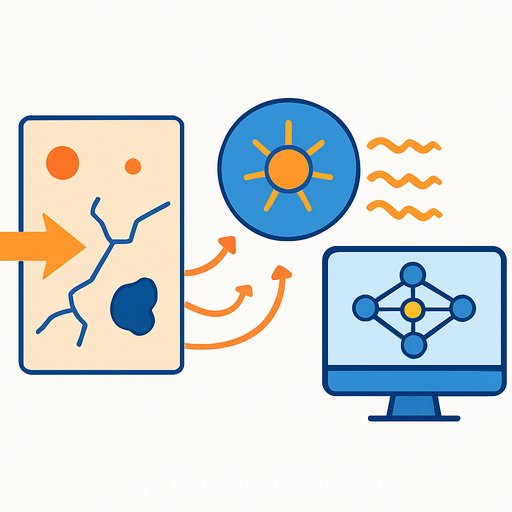
Atchadé's team trained their model on satellite rainfall data from NASA and Japan's Global Precipitation Measurement mission, combined with atmospheric reanalysis from the European Centre for Medium-Range Weather Forecasts. The model predicts 24-hour rainfall 12 to 30 hours in advance.
The Model Learns Physics, Not Just Patterns
A common risk with deep learning weather models is that they memorize historical data rather than capture actual physical processes. Atchadé's group prevented this by treating the model as a statistical system first, applying regularization and rigorous validation to avoid overfitting.
"After we fit the model, we looked to understand what was learned by the model, and we compared that to what scientists know about rainfall formation in the area," Atchadé said. The model identified meaningful combinations of humidity, wind patterns, and large-scale atmospheric waves that predict rainfall across the region.
In Ghana experiments, the deep learning model outperformed ECMWF's forecasts at both matching observed rainfall and identifying heavy rain events.
Local Forecasts, Local Control
Many African countries rely on weather predictions generated in Europe rather than from their own institutions. Models built by local researchers that match or exceed European forecasts train local scientists and give farmers better data for planting and harvesting decisions.
"If local researchers can build models that match or surpass those, it's a way to train local scientists and to give farmers better information," Atchadé said.
Communicating Uncertainty
Statistical weather models make probability statements, not certainties. Atchadé's team uses ensemble modeling-running multiple simulations to map different possible futures-the same approach operational weather forecasts use.
When explaining results to farmers and decision makers, the team avoids technical language. "We talk about the model output. We talk about possible scenarios and the likelihood of each," Atchadé said. Farmers need to know: will it rain in the next two days, or is there a real risk of flooding?
Next: Seasonal Monsoon Forecasting
Atchadé's lab is expanding from daily rainfall predictions to a larger question: forecasting the West African monsoon months in advance. A credible forecast in March or April about monsoon timing would be far more useful to farmers than a single day-ahead rainfall number.
"For farmers, it is perhaps the most important prediction we can make," Atchadé said.
Learn more about AI for Science & Research applications.
Your membership also unlocks: