AI Arms Race: Insurers vs. AI-Enabled Fraud
Fraud hasn't disappeared. It's getting faster, cheaper and more convincing. Reports indicate insurance fraud exposure is up to 20x higher than in banking, with overall fraud growing roughly 8% year over year. Traditional red flags and manual reviews aren't keeping up.
The shift is clear: deepfakes, synthetic voices and AI-generated images are changing how claims are created, verified and paid. The result is a claims surface that looks legitimate on the surface and collapses only under forensic scrutiny. To stay ahead, carriers are moving from rules to probabilities, from one-off case reviews to pattern detection across networks.
Synthetic voices are breaking phone-based trust
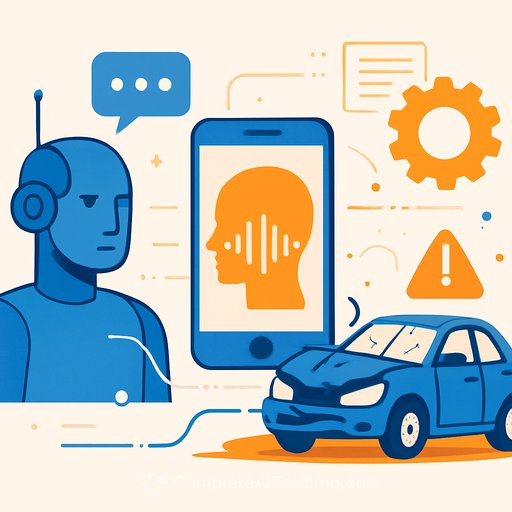
Call centers are taking the brunt. Insurers saw a meaningful rise in fraud tied to synthetic voice attacks in 2024, with voice clones impersonating policyholders, providers and even internal staff using seconds of scraped audio. These voices copy tone, cadence and emotional inflection well enough to push agents past verification steps.
Emotionally tuned voice models make social engineering feel natural. That's a problem when verbal confirmation has long been treated as a primary trust signal. If your phone workflows still rely on static knowledge-based questions and agent judgment, you're exposed.
Deepfakes, disinformation and a wider claims surface
AI-generated photos and documents are flooding motor claims: fabricated crash scenes, manipulated damage shots, and synthetic proofs that pass a casual glance. Networks can now mass-produce claims, supporting documents and metadata with consistency that overwhelms traditional SIU queues.
Analysts frame this as a disinformation challenge, not just a single-claim problem. Coordinated campaigns reuse artifacts across carriers and geographies, exploiting the gaps between siloed systems and inconsistent review standards. See Swiss Re's SONAR series for broader risk signals around synthetic media and coordinated threats: Swiss Re SONAR.
From rules to probabilities
Rules still matter, but they're no longer the first line. Carriers are moving to probabilistic, pattern-driven systems that look at thousands of variables across claims, policy changes, images, voiceprints and submission behavior. The question isn't "Did this break a rule?" It's "How closely does this match known fraud patterns across time, channel and network?"
Cross-carrier signal sharing is becoming essential. A single claim might look clean in isolation and light up when seen alongside similar images, timestamps, IP ranges or device fingerprints used elsewhere.
Fighting gen AI with gen AI
Computer-vision models trained on AI artifacts are now screening claim photos for manipulation. Industry groups are building shared detection platforms to spot synthetic identities, image reuse and coordinated behavior across carriers, starting with motor. Claims flagged by one insurer can help others connect patterns that would otherwise slip through.
Generative models also help defenders. Using adversarial simulations to create rare, high-impact fraud scenarios improves model recall where historical data is thin. This mirrors a broader trend: 7 in 10 financial institutions now use AI and machine learning to combat fraud, up from 66% in 2023. Even payments networks are testing AI for pre-emptive pattern detection; for example, SWIFT has worked with banks on AI tests to prevent cross-border payment fraud.
What insurers can do now
- Harden the phone channel: Add voice biometrics with liveness checks, dynamic challenge-response, and step-up authentication for sensitive changes (beneficiary, payout method, address, bank details).
- Treat media as suspect by default: Run image/video forensics on all high-value and high-velocity claims. Check for GAN artifacts, lighting inconsistencies, EXIF anomalies, device reuse and template fingerprints.
- Upgrade identity proofing: Use multi-signal identity resolution (devices, IP, behavior, document lineage). Re-verify identity on policy changes that move money.
- Model the network, not just the claim: Graph features across people, providers, devices, addresses, payment endpoints and time. Score clusters, not just individuals.
- Simulate fraud to train models: Use generative approaches to create edge-case scenarios (staged crash rings, deepfake call trees, multi-carrier image reuse) and boost detection coverage.
- Instrument the intake funnel: Log and analyze every step: document uploads, retakes, retries, metadata edits, and time-to-submit. Spikes here often precede confirmed fraud.
- Human-in-the-loop triage: Auto-flag and route cases with clear next-best actions. Provide investigators with artifact heatmaps, lineage graphs and explanation features to speed decisions.
- Create a cross-carrier feedback loop: Share indicators (image hashes, device IDs, provider IDs, payout endpoints) via industry platforms to collapse repeat attacks.
- Tighten governance: Put model risk management, bias checks and performance monitoring on a cadence. Archive signals, decisions and outcomes for audit and retraining.
- Run live playbooks: Maintain response runbooks for voice attacks, deepfake media, and credential stuffing. Drill agents on empathy traps and "urgent relief" scripts.
Metrics that matter
- Precision/recall by fraud type (voice, image, identity, provider, payout) across segments and channels.
- Lift vs. rules-only baselines and impact on loss ratio, indemnity leakage and time-to-pay for clean claims.
- Feedback speed from investigation outcomes to model updates (days, not months).
- Network disruption: repeat fraud attempts per cluster after countermeasures go live.
- Agent behavior change: adherence to step-up flows, abandonment of outdated scripts, false pass rate on coached social-engineering tests.
Team capability: the force multiplier
Tools help, but trained people close the gap. Upskill claims, SIU, and call-center teams on generative media, voice risk, and hands-on detection workflows. If you want structured upskilling paths for insurance roles and adjacent skills, explore curated options here: AI courses by job.
Fraudsters now move at model speed. Insurers that pair shared signals, adversarial training and disciplined human review will keep their loss ratios in check and their honest customers happy. Everyone else funds the next wave of attacks.
Your membership also unlocks: