Your Brand Isn't in AI Answers. That's a Problem.
Enterprise marketing teams operate on a familiar assumption: if your content ranks in search, buyers will find you. That assumption is breaking down. AI search platforms are changing how enterprise buyers research and evaluate vendors, and the shift is already affecting visibility in ways that don't show up in traditional metrics.
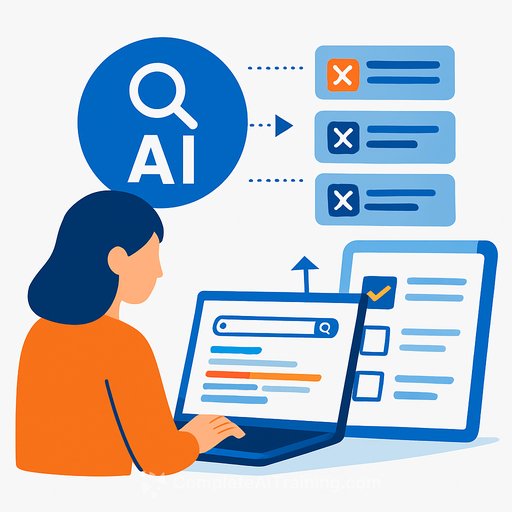
Instead of scanning multiple search results, buyers increasingly rely on synthesized answers from AI systems. These answers present a distilled perspective backed by a small number of cited sources. If your brand isn't cited, it isn't part of that perspective. If it isn't part of the perspective, it isn't part of the buying conversation.
The Shortlist Is Now Defined by a Single Answer
In enterprise software, early-stage buyer research shapes categories, requirements, and initial vendor sets. AI search is compressing this phase. Buyers ask complex questions and receive fully synthesized responses that frame the market for them, often including only a handful of vendors.
The shortlist is no longer built through extended research across multiple sites. It's increasingly influenced by a single answer. For marketers, visibility is no longer about being present across many touchpoints. It's about being present within the answer that defines the category.
SEO Rankings No Longer Guarantee Visibility
Many enterprise teams still invest heavily in SEO expecting strong rankings to drive visibility. While SEO remains important, it's no longer sufficient. AI systems don't rank pages in the traditional sense. They select and synthesize information, often citing sources that aren't top-ranking results but provide clearer, more direct, or more contextually useful information.
This creates a gap between ranking performance and actual influence. You can rank highly and still be absent from the answers your buyers consume. A well-structured piece of thought leadership in the right environment can be repeatedly cited, even without dominating traditional search rankings.
Visibility has shifted from rankings to references.
Citations Now Define Competitive Position
The most important question is no longer "Do we rank?" It's "Are we cited?" Citations are how AI systems validate and construct their answers. They represent the sources selected to shape the narrative a buyer receives. When your content is cited, your perspective is embedded directly into the answer. When it isn't, your brand is effectively removed from consideration.
This matters especially in enterprise technology, where buyers rely on trusted third-party validation. AI systems amplify this behavior by favoring sources that appear credible, structured, and informative enough to support synthesis.
Third-Party Authority Amplifies Your Reach
AI systems consistently draw from sources they interpret as authoritative, neutral, and well-structured. This often elevates industry publications, expert-driven platforms, and high-signal content hubs over brand-owned properties.
For enterprise marketers, this creates both a challenge and an opportunity. Brand content alone is often insufficient to secure consistent citation. However, when your expertise is embedded within authoritative third-party environments, your chances of being cited increase significantly. These platforms act as intermediaries that translate your perspective into a format AI systems are more likely to trust and reuse.
Your distribution strategy is now directly tied to your visibility in AI search.
The Cost of Absence Compounds Over Time
When competitors are cited and you aren't, they gain disproportionate visibility at the exact moment buyers form their understanding of the market. They shape the narrative. They define the criteria. They become the default options.
Your absence isn't perceived as neutrality. It's perceived as irrelevance. As AI systems continue to reference the same sources, those sources reinforce their position as authoritative inputs. The gap between cited and non-cited brands widens, making it increasingly difficult to re-enter the conversation.
Building a Citation Strategy
Enterprise marketing teams need to evolve their approach. Content strategy can no longer be measured solely by traffic, rankings, or engagement. It must be evaluated based on whether it contributes to AI-generated answers and earns citations within them.
This requires a shift toward citation strategy. It involves creating content that is not only discoverable but also structured, credible, and insight-rich enough to be selected and reused by AI systems. It also requires placing that content in environments already trusted as inputs into those systems. Most organizations are currently underinvested in this area.
Leading enterprise marketing teams are already adapting. They're identifying where AI systems source information, aligning their thought leadership with those environments, and structuring their content to increase its likelihood of being cited. They're also recognizing this isn't a purely internal effort. It requires partnerships with platforms that have established authority and visibility within AI search.
This isn't about abandoning SEO. It's about extending beyond it to compete in the layer that now determines influence.
What This Means for Your Marketing
AI search is not a future trend. It's an active shift reshaping how enterprise buyers discover and evaluate solutions. Visibility is no longer defined by where you rank. It's defined by whether you're included in the answers your buyers trust.
If your brand isn't cited, it isn't considered. In enterprise technology markets, not being considered means not being bought.
Learn more about AI for Marketing or explore the AI Learning Path for Marketing Managers to understand how to adapt your strategy.
Your membership also unlocks: