Mali Puts AI to Work in Classrooms to Teach Local Languages
Mali now recognizes 13 official languages under its 2023 constitution. French is off the list, yet it still dominates instruction. A new push from the Education Ministry aims to flip that script by using AI to help students read and write in the languages they speak at home.
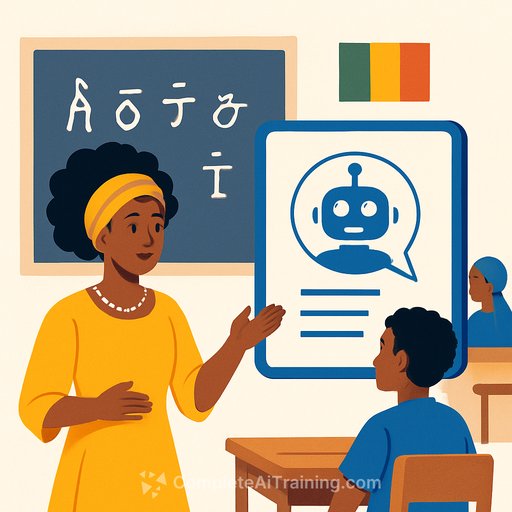
The ministry tapped RobotsMali to produce classroom content in Bambara, the most widely spoken language in the country. The team has created more than a hundred short stories for students, written, translated, and illustrated with AI tools like ChatGPT and Leonardo.
Why this matters for educators
Students learn faster when the language of instruction matches the language of daily life. Illustrated stories speed up recognition and meaning, building confidence and decoding skills in early grades. As RobotsMali's Mamadou Dembele notes, images help students connect words to concepts quickly.
The student feedback is simple and telling. "It helps me speak better with my friends. All of this is good," said 13-year-old Clarisse Yasségué Togo. Another student, 17-year-old Fatoumata Sacko, put it plainly: "Bambara is our language. We should prioritise it."
The gap this initiative addresses
After independence in 1960, Mali attempted to shift schooling into national languages several times. Efforts stalled due to limited books, training, and political will. RobotsMali's approach targets that content gap with a scalable pipeline of new stories that teachers can use immediately.
The broader context matters too. Relations with France have shifted in recent years, especially following the 2020 and 2021 coups. The project signals a clear intent to reduce dependence on the former colonial language inside classrooms.
How schools can implement a similar model
- Start with one widely spoken local language and a narrow set of grades. Keep scope tight for quick wins.
- Build a bank of short, levelled stories (100-300 words) tied to phonics and vocabulary targets.
- Use AI for drafting and illustration, then run teacher reviews for accuracy, cultural fit, and age appropriateness.
- Print low-cost booklets and share digital copies via phones or school devices. Aim for both online and offline access.
- Train teachers on short routines: echo reading, choral reading, picture walks, and quick comprehension checks.
- Localize content: names, places, and contexts students recognize. Invite families to contribute folktales for adaptation.
Quality, safety, and sustainability
- Accuracy checks: Have two reviewers per story-one language specialist and one classroom teacher.
- Bias and cultural review: Avoid stereotypes; represent everyday life realistically.
- Assessment: Use weekly running records and phonics checks to track fluency and decoding.
- Device-light delivery: Prepare printable PDFs and lightweight files for low-bandwidth schools.
- Teacher support: Short how-to guides and 10-minute demo videos can be enough to get started.
What this looks like in practice
Create a simple story on a familiar theme-market day, planting season, or a neighborhood game. Generate the first draft with AI, then translate to Bambara and simplify sentences for early readers. Add 4-6 illustrations that clearly match the text.
Test in one classroom. Time a reading, note stumbling points, adjust vocabulary, and reprint. Repeat across grades, gradually increasing length and complexity.
Early signals from Mali
Students report feeling more connected and confident. Teachers gain a steady stream of relevant texts without waiting months for new books. As Dembele put it, "It makes me proud to see my little brothers and sisters learning with so much joy."
Further reading and resources
- UNESCO: Multilingual education and mother tongue learning
- World Bank: Learning in the mother tongue
- Practical AI courses by job role (for school leaders and teachers)
If you work in education and plan to pilot this approach, start small, measure learning gains, and refine fast. The goal is simple: more children reading confidently in the language they live in-then building up to strong bilingual literacy over time.
Your membership also unlocks: