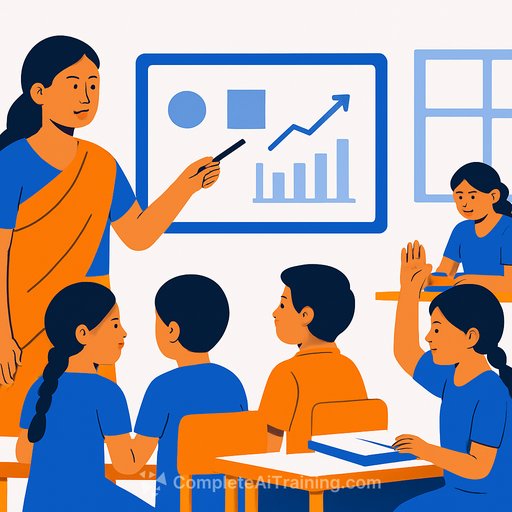
Maharashtra to partner with Educate Girls on AI-led model and open schools for adults
The Maharashtra Education Department announced plans to collaborate with Educate Girls to adopt its AI-driven approach and expand open schooling options for adults. The goal is clear: reduce dropout rates among girls and create second-chance pathways for those who missed formal education.
Ranjeet Singh Deol, Principal Secretary, School Education and Sports Department, said, "Bringing over 20 lakh girls back to education is no small feat. How is AI transforming teaching and learning practices in Indian classrooms? By starting in the most challenging geographies, Educate Girls has built strong field experience. When you focus on the most marginalised girls, the gaps become visible and solvable. Even in progressive States like Maharashtra, pockets of vulnerability remain. Your model on out-of-school girls will strengthen our policies and help us act faster using your AI-driven insights."
Why this matters to education leaders
Dropout rates among girls remain a concern, especially at higher grades. According to UDISE+ 2024-25, the national picture looks like this:
- Preparatory (Classes III-V): 1.8%
- Middle (VI-VIII): 2.9%
- Secondary (IX-XII): 6.6%
Key state-level signals:
- Madhya Pradesh: 10.2% dropout at Secondary
- Maharashtra: 7.3% at Secondary
- Rajasthan: 3.6% at Preparatory and Middle; 5.2% at Secondary
- Bihar: 9.8% at Preparatory
- Uttar Pradesh: 0% at Preparatory; 1.5% at Secondary
These numbers point to early-warning needs at the upper grades and targeted support in specific districts. Policy moves that blend data, open schooling, and community engagement will move the needle faster.
What Maharashtra plans to do
- Use AI-led targeting to identify out-of-school girls in micro-pockets and accelerate re-enrolment.
- Scale open schools for adults to give adolescent girls and women practical pathways back into learning and exams.
- Strengthen last-mile outreach with community volunteers and faster policy response loops.
At the event, 55,000 Team Balika volunteers were also honoured for enrolling out-of-school girls and helping families overcome social barriers. Community trust plus timely data is a strong mix.
Proof of concept: second-chance learning that works
Adolescent girls and women aged 15-29 who scored 75% and above in State Open School Class 10 under Educate Girls' second-chance programme, Pragati, were felicitated. Many balanced household duties, restrictive norms, and years away from school-and still succeeded.
Since 2007, Educate Girls has supported enrolments of over 20 lakh girls across 30,000 villages in Rajasthan, Madhya Pradesh, Uttar Pradesh, and Bihar. Maharashtra now plans to replicate the open-school model to reach learners who missed schooling due to social or economic constraints.
AI in education: not a threat, but a change agent
AI can help administrators and teachers do the right thing faster: spot risk early, focus outreach, and tailor support. It won't replace educators; it gives them sharper tools and timely signals.
- Early warning: predict dropout risk using attendance, transition points, and socio-economic markers.
- Targeting: cluster villages/hamlets with high out-of-school counts to prioritise field visits.
- Personalised support: recommend bridge modules and test-prep plans for open school candidates.
- Operations: optimise volunteer routing and follow-up cadence to cut time-to-re-enrolment.
Practical steps for district and school teams
- Map data sources: UDISE+, school registers, village lists, and community surveys. Keep them current.
- Stand up a simple analytics pipeline: risk flags at student level; hotspot maps at cluster/block level.
- Codify the open-school pathway: counselling, bridge courses, exam registration support, and flexible study schedules.
- Equip the field: low-bandwidth data capture, basic AI literacy for staff/volunteers, and clear SOPs for follow-ups.
- Review monthly: track re-enrolment, attendance recovery, bridge-course completion, and exam pass rates.
- Guardrails: consent, data minimisation, bias checks, and transparent criteria for referrals.
As Mr. Deol noted, "When you focus on the most marginalised girls, the gaps become visible and solvable." That focus, backed by good data and community networks, is what converts intent into outcomes.
Momentum for 2035
Educate Girls' Founder Safeena Husain said the mission is powered by partnerships with government and communities. "With the 2025 Ramon Magsaysay Award energising our path forward, we enter the new year with renewed purpose and a bold ambition to reach 10 million learners by 2035."
For educators building AI capability
If you're planning AI pilots or skills development for your teams, explore practical training paths and course maps by role. A useful starting point: AI courses by job function.
The takeaway: combine AI-led identification, open-school pathways, and community mobilisation. That's how you cut dropout at scale and keep girls learning-consistently, and soon enough to matter.
Your membership also unlocks: