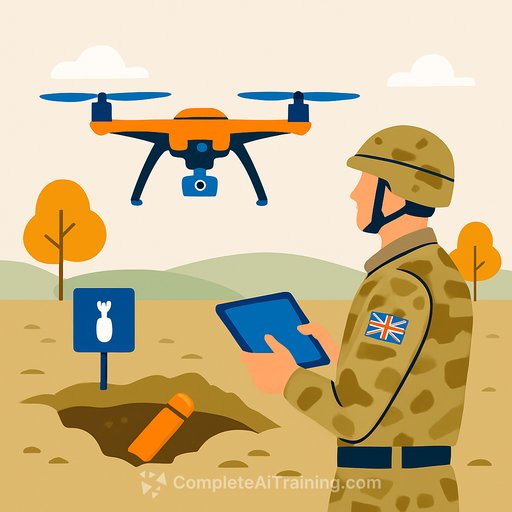
British Army trials AI drones for faster mine detection
The British Army and the Defence Science and Technology Laboratory (Dstl) have completed field trials of AI-powered drones designed to detect buried ordnance. Project GARA, conducted in Essex in April 2026, tested aerial systems equipped with advanced sensors to locate explosive devices faster and with less risk to personnel.
Mine-clearing operations typically require teams to work slowly through contaminated areas on foot. The trials demonstrated that AI-enabled drones can accelerate this process by scanning terrain from above and identifying buried threats without exposing soldiers to danger.
What the trials showed
The drones combined AI analysis with sensor data to detect ordnance buried beneath the surface. The system reduced both the time required to clear areas and the physical risk involved in traditional search methods.
This represents a practical deployment of AI in a high-stakes operational environment rather than a laboratory experiment. The real-world results offer immediate relevance to military and civilian operators managing explosive ordnance disposal.
Relevance for operations teams
For operations professionals, the trials illustrate how AI systems can improve safety and efficiency in hazardous tasks. The approach combines automated detection with human oversight-drones gather data, AI processes it, and operators make final decisions.
Operations managers overseeing similar programs may find value in understanding how AI-powered systems integrate into existing workflows. The AI for Operations resource covers practical applications of AI in process optimization and automation. For those managing teams deploying these technologies, the AI Learning Path for Operations Managers addresses workflow integration and operational decision-making.
Your membership also unlocks: