
AI news ·
Broadcom and Nvidia lead AI stock selloff after strong US jobs report spooks markets
Broadcom fell 7.49% and Nvidia dropped 5.93% on June 5 after a stronger-than-expected jobs report stoked fears the Fed will hold rates higher longer. The S&P 500 lost 2.6% and South Korea's Kospi crashed 9% as the selloff spread globally.
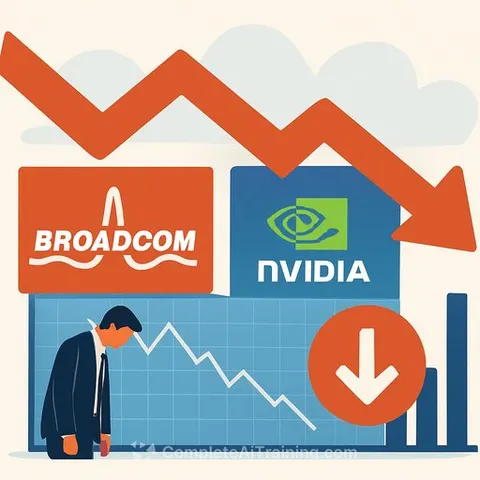
AI Stocks Plunge on Stronger-Than-Expected Jobs Data
Broadcom and Nvidia led a sharp selloff in semiconductor stocks after a stronger-than-expected US employment report raised concerns about sustained interest rates. Broadcom fell 7.49% to close at $387.52, while Nvidia dropped 5.93% to $205.70 on June 5, 2026.
The broader market tumbled alongside chip stocks. The S&P 500 fell 2.6%, the NASDAQ dropped 4.2%, and the Dow Jones slipped 1.3% in the session.
What Triggered the Decline
The US jobs report came in significantly stronger than economists expected. That data raised the odds the Federal Reserve would keep interest rates higher for longer, prompting investors to reassess valuations across high-growth sectors.
The selloff revived questions about whether mega-cap tech stocks had become overvalued after months of gains. Nvidia's valuation had reached roughly $5 trillion before the correction, leaving little room for error when sentiment shifts quickly.
Margin Concerns at Broadcom
Broadcom's sharp decline put profit margins back in focus even as the company's revenue continues to grow. Investors worry that rising costs could erode profitability as competition in custom chips intensifies.
Tech giants including Amazon, Alphabet, and Microsoft have begun building their own proprietary AI chips. That shift adds competitive pressure on established chip suppliers already dealing with stretched valuations.
Asian Markets Follow
The selling spread quickly to Asia as the AI trade unwound globally. South Korea's Kospi index crashed 9%, with SK Hynix shares falling 4.1% and Samsung Electronics dropping 7.8%.
South Korea's heavy reliance on chip and technology exports made it particularly vulnerable. When AI demand gets questioned, memory chipmakers typically face the sharpest corrections.
The VanEck Semiconductor ETF (SMH) also declined as nearly every major chip name weakened in unison. The selloff showed how tightly global markets are connected to a single trade theme - once Wall Street sentiment flipped, Asian markets were dragged along within hours.
The Path Forward
Some analysts view the sharp pullback as a buying opportunity if company fundamentals remain intact. The real risk persists until the Fed's interest-rate path becomes clearer.