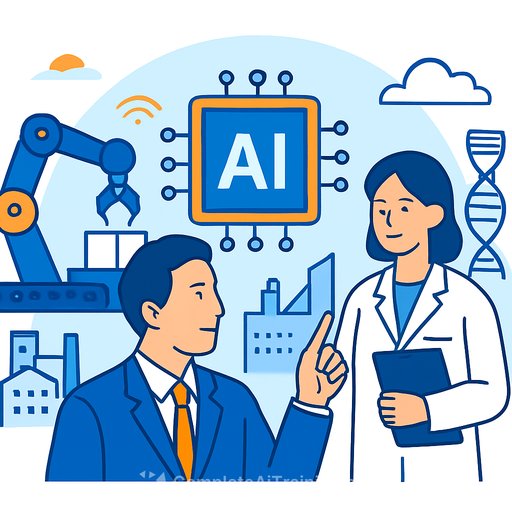
South Chungcheong's AI Grand Transition: Broader, Farther, Stronger
South Chungcheong is moving on an AI grand transition (AX) with two clear aims: secure future growth engines that align with national policy, and make daily life safer and more convenient for residents. The approach is straightforward-apply AI across industries and government, build the infrastructure behind it, and grow the talent to run it.
Strategy at a glance
- Broader: Expand AI use across manufacturing, biotech, and agro-livestock-fisheries-plus public administration.
- Farther: Build sustainable infrastructure (data centers powered by reliable energy, water, renewables) to support long-term services.
- Stronger: Launch an AI Special Committee (32 members from big tech, industry, academia, and research) and stand up a dedicated AI department on Jan. 1 next year.
- Measurable target: Lift manufacturing AI utilization from 7.3% (2024) to 40% by 2030.
- Focus areas: Technology, space (infrastructure and testbeds), and people (skills and jobs).
Pillars and near-term projects
The nation's first AI manufacturing technology convergence center opened on Sept. 9. An industrial AI certification support center is planned for next year, enabling full-cycle support-from R&D to testing and certification-inside the province.
By 2027, the province plans to train 15,000 region-specialized AI professionals and secure "super-gap" competitiveness in core sectors such as the future vehicle AX ecosystem (worth 1 trillion won). Aging industrial complexes will be upgraded into smart complexes with AI-driven autonomous processes.
Investment wins this term
During the 8th popularly elected term, the province has attracted 4.09257 trillion won from 297 companies-roughly triple the 1.45 trillion won brought in during the previous term. In 2023 alone, investment reached 1.51442 trillion won, surpassing the prior full-term total.
What's behind it: a strong transport network linking national hubs within one to two hours; an industrial base of 181 complexes; a 130 billion won fund for SMEs; and a 600 billion won venture fund. The province backs this with hands-on services like export consultations and buyer matching.
Bio and green bio bets
Attracting major firms has advanced semiconductors, future mobility, and secondary batteries. Biotech was a gap-until Celltrion's investment. That move ties into the Naepo agri-bio convergence industry cluster in Sapgyo-eup, Yesan, spanning 500,000 pyeong with integrated research, production, and distribution.
The expected payoff: 300 billion won in investment, 300 jobs, and a lift for the local economy. The province is also prioritizing biohealth-regenerative medicine, biomedical devices, and microbiome diagnostics and therapeutics-because these areas extend healthy lifespans and reduce medical costs.
To support this, the province operates the Sleep Industry Promotion Center and the Bio and Medical Comprehensive Support Center for end-to-end assistance from device development to approvals and commercialization. It also runs a full-cycle support system for microbiome pharmaceutical commercialization and established a Bio Industry Division last year.
AI for daily life and public services
AI city pilots will address practical issues: mobility for older adults, river flooding, and wildfires. For structural challenges-north-south disparities and the urban-rural mix-the province plans living lab experiments and models that can scale nationally.
Inside government, AI will be introduced to raise performance and speed up services. This year, 700 public officials received training on using generative AI, with expansion planned to build sustained capability. For agencies building internal curricula, a quick way to scan relevant skills pathways is here: AI courses by job.
Talent pipeline and jobs
Five software-centered universities in the province will deliver AI and software major and convergence programs. About 15,000 learners are set to complete training by 2027, with scale-up possible if more universities join.
The province is tightening the "education-field-jobs" loop: employment support programs that match companies' AI needs with local talent, plus an industrial AI transition alliance that places AI technologists into real demonstrations alongside provincial research institutes.
What other local governments can borrow
- Set a clear utilization metric (e.g., manufacturing AI use from 7.3% to 40% by a target year).
- Build full-cycle support in one region: R&D, testing, certification, and pilot adoption.
- Site data centers where power, water, and renewables are dependable and scalable.
- Stand up a cross-sector AI committee (industry, academia, research) and a dedicated public department.
- Pick pilots that matter to residents: senior mobility, floods, wildfires, and admin service speed.
- Pair anchor-firm attraction with SME/venture funds and export/buyer support.
- Upgrade aging complexes into AI-enabled smart zones to retain industry and attract new tenants.
What's needed from the center
Data availability will decide outcomes. The province needs AI data centers to store and manage data at scale-backed by high-capacity power, grid expansion, and reliable water. Public data held by the central government-especially for industries where South Chungcheong specializes-should be opened for AI training.
Nationwide standards for data quality and formats are urgent to reduce friction and improve model performance. Designation as a regional AI innovation hub would accelerate progress and position the province as a core node in smart manufacturing. For policy frameworks and benchmarks, the OECD AI Policy Observatory is a useful reference point.
Naepo agri-bio convergence cluster: quick view
- Location: Sapgyo-eup, Yesan
- Scale: 500,000 pyeong
- Model: One-stop base for research, production, and distribution
- Impact: Expected 300 billion won investment and 300 jobs
Profile: Kim Tae-heum, Governor of South Chungcheong
- Born in 1963 in Boryeong
- Sogang University Graduate School of Public Policy (Master's in Public Administration)
- Member of the 19th-21st National Assembly
- Chair, Korea-Laos Parliamentary Friendship Association
- Chairperson, National Assembly Agriculture, Food, Rural Affairs, Oceans and Fisheries Committee
Your membership also unlocks: