Broadridge Takes Stake in DeepSee to Automate Post-Trade Email Workflows
Broadridge Financial Solutions has acquired a minority stake in DeepSee, a Utah-based firm focused on agentic AI, and is rolling out automated email orchestration across post-trade operations. Tom Carey, president of Broadridge Global Technology and Operations, will join DeepSee's board as part of the deal.
The initial target: email-heavy workflows in fails research and inventory optimization. The goal is simple-move from manual inbox handling to intelligent, auditable flows that cut cycle times and reduce operational risk.
Why this matters for operations leaders
Post-trade teams live in email. Requests, breaks, counterparty clarifications, and SLAs all bottleneck in inboxes. Turning those threads into structured workflows-with clear ownership and machine assistance-unlocks throughput without adding headcount.
As Carey put it, Broadridge is bringing agentic AI directly into post-trade workflows to improve productivity and resilience. That's the direction the market is heading, and firms lagging on deployment risk falling behind peers that are already shipping AI into production.
How the solution works
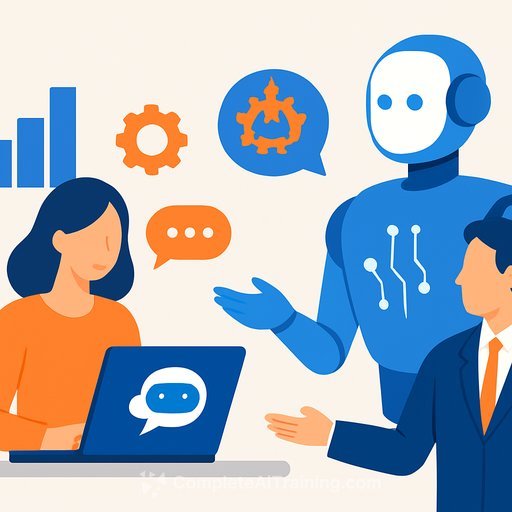
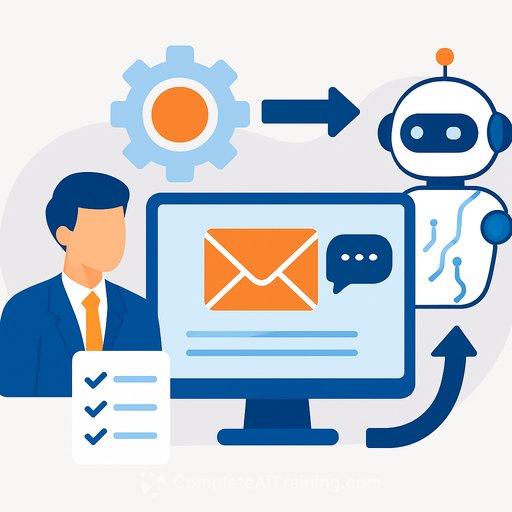
DeepSee converts inbound email into connected workflows where AI agents, internal systems, and human operators work together. Pre-trained agents automate routine steps; domain-specific models turn unstructured messages into actions.
Real-time dashboards track SLA adherence, operational trends, and team performance. Broadridge processes over $15 trillion in daily trades, already runs AI tooling through its OpsGPT platform for settlement efficiency, and is layering DeepSee into that stack.
Deployment status
The tech has been deployed across Broadridge's business process outsourcing operations serving 60+ clients. It integrates with existing post-trade capabilities and can run via the Broadridge platform or as a standalone system.
Broadridge generates more than 7 billion communications annually and employs over 15,000 people across 21 countries, so scale and interoperability are core to the rollout.
Industry context
Pressure to show concrete returns on AI is rising after years of pilots. Multiple firms are now launching AI agents across financial services-from retail investing features at Public to agent frameworks for banks and insurers from providers like SAP Fioneer.
Meanwhile, institutions are testing blockchain-based settlement flows in fixed income, some now handling higher volumes than crypto-native products. Automation and straight-through processing are back on the priority list-this time with AI agents and measurable SLAs.
Vendor quotes
"This latest investment and partnership underscores Broadridge's commitment to delivering innovative AI-powered solutions that transform operations, reduce risk, and enhance the client experience," said Carey. "Working with DeepSee, we are bringing agentic AI directly into post-trade workflows, helping clients move from manual email handling to intelligent automation, unlocking new levels of productivity and operational resilience."
DeepSee founder and CEO Steve Shillingford added: "From the beginning, DeepSee's vision has been to leverage the power of AI agents to transform the complex processes of financial services into actionable outcomes that drive immediate, production-ready business impact."
Practical takeaways for post-trade teams
- Start where email volume is highest and logic is repeatable: fails research, inventory transfers, break clarification, asset servicing exceptions.
- Define the interface: how an email becomes a case, how agents classify/route, and when humans intervene.
- Instrument outcomes: first-response time, time-to-resolution, right-first-time rate, exception rate, and touches per ticket.
- Use SLAs as the control plane: set thresholds, auto-escalate misses, and log reasoning for audit.
- Tie into existing systems: case management, settlement, inventory, reconciliation, and data lakes for lineage.
Governance and risk checklist
- Data controls: PII redaction, regional data residency, email retention, and model input/output logging.
- Auditability: full trails for classifications, actions taken, and human overrides.
- Quality: target classification accuracy by workflow; monitor drift and frequent-fail patterns.
- Latency: keep routing/classification near real time; measure queue backlog and spike handling.
- Security: vendor access boundaries, content encryption, and strict role-based access.
- Change management: playbooks for new templates, counterparties, or product types.
Questions to ask your vendor and team
- What's the current precision/recall for key intents (fails research, inventory move, break clarification)?
- How are ambiguous cases handled and escalated? What's the human-in-the-loop threshold?
- What's the average handling time reduction and SLA uplift observed in production?
- How are new counterparties/templates learned without degrading performance?
- What are the audit exports, retention policies, and evidence standards for regulators?
- What's the pricing model (per email, per seat, per workflow) and how does it scale with volume?
What could go wrong-and how to mitigate it
- Misclassification causing SLA misses: use confidence thresholds, auto-route low-confidence cases to humans.
- Template drift: set up continuous evaluation and weekly fine-tuning based on error buckets.
- Hidden queues: enforce dashboarding for backlog, spikes, and aging to prevent silent failure.
- Compliance gaps: lock down PII handling and produce audit trails by default.
Bottom line
Turning inboxes into workflows is a direct path to throughput, control, and measurable ROI. Broadridge's investment in DeepSee signals that AI agents are moving from concept to production inside post-trade-where SLAs and audit trails matter.
If your 2026 plan still treats email as unstructured noise, you're leaving capacity and control on the table.
Broadridge continues to expand its AI-enabled operations stack. For practitioners mapping tools and training for finance operations teams, see these curated resources: AI Productivity Courses, AI Learning Path for Production Planners, and AI Learning Path for Supply Chain Analysts.
Your membership also unlocks: