BTech AI vs. BTech Machine Learning: A practical guide for educators and advisors
AI isn't a distant idea anymore. It drives search, recommendations, support chats, and the apps students use all day. That interest shows up in course choices: BTech in Artificial Intelligence and BTech in Machine Learning are the new favorites. Here's a clear way to help students pick the degree that fits their strengths and goals. Advisors can use the AI Learning Path for Training & Development Managers to align course recommendations with institutional goals and student outcomes.
What each degree actually teaches
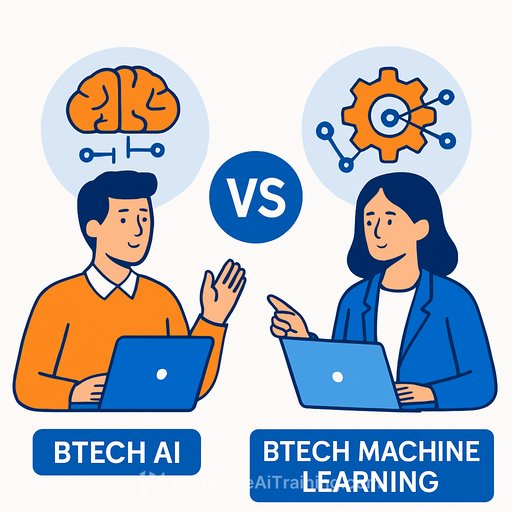
BTech in Artificial Intelligence: Teaches how to build intelligent behavior into software and systems. Students cover machine learning, natural language processing, computer vision, and basic robotics. The emphasis is on designing solutions that sense, decide, and respond in useful ways.
BTech in Machine Learning: Centers on how machines learn from data. Students go deep into models, algorithms, optimization, and training methods. The emphasis is on accuracy, evaluation, and improving performance through data and experimentation.
Subjects you'll typically see
- AI curriculum highlights: Programming, data structures, AI fundamentals, machine learning, deep learning, computer vision, NLP, robotics, and ethics in AI.
- ML curriculum highlights: Calculus, linear algebra, probability, statistics, data modeling, feature engineering, and machine learning algorithms (supervised, unsupervised, reinforcement basics).
How labs and projects differ
- AI labs/projects: Chatbots, voice interfaces, image recognition tools, and simple robots. Often team-based, focused on building end-to-end intelligent applications.
- ML labs/projects: Large datasets, model training, validation, and tuning. Prediction systems, recommendation engines, and user behavior analysis with clear metrics.
Core skills students build
- AI program strengths: Systems thinking, human-computer interaction basics, integrating models into products, and responsible AI practices.
- ML program strengths: Mathematical rigor, statistical reasoning, data pipelines, experiment design, model evaluation, and iteration.
Career paths and where graduates get hired
- After BTech AI: AI engineer, software developer with AI focus, robotics engineer, AI application designer. Employers include product companies, startups, healthcare, automotive, and research labs.
- After BTech ML: Machine learning engineer, data scientist, data analyst, research engineer. Common in IT services, finance, e-commerce, and any organization with large data operations.
Both routes offer strong job options. ML-heavy roles expect comfort with math and data handling. AI-focused roles value broader system design and the ability to connect models to real use cases. For ML-focused study plans and role-based skills, see the AI Learning Path for Data Scientists.
Who tends to thrive in each program
- BTech AI is a good fit for students who: Enjoy building apps and interfaces, like seeing tech help people directly, and want to connect models to real products.
- BTech ML is a good fit for students who: Like math, pattern-finding, structured experiments, and improving models through careful iteration.
Advising checklist for educators
- Interests: Systems and applications (AI) vs. data and modeling (ML).
- Math comfort: Strong math preference suggests ML; moderate math with broader build interest suggests AI.
- Project style: End-to-end apps and prototypes (AI) vs. experiments and metrics (ML).
- Campus strengths: Labs, faculty, industry tie-ups, and internships; direct students to the program with stronger resources in their area of interest.
- Portfolio plan: AI: demos and integrations; ML: notebooks, benchmarks, and reproducible experiments.
Practical tips to set students up for success
- For AI students: Keep building math fundamentals (linear algebra, probability). It improves model intuition and debugging.
- For ML students: Build basic front-end/back-end skills and study product use cases. It helps turn models into working features.
- For both: Add ethics, data privacy, and responsible deployment to every project brief.
Next-gen careers to watch
- Applied AI in healthcare diagnostics, assistive tech, and medical imaging
- ML for risk modeling in finance and fraud detection
- Autonomous systems and smart manufacturing
- AI-driven personalization in education and retail
For engineers targeting manufacturing and autonomy roles, the AI Learning Path for Process Engineers maps relevant skills and projects. If you want students to track skills and hiring signals year to year, point them to the Stanford AI Index. For curated learning paths organized by job role, see Complete AI Training: Courses by Job.
Bottom line for course selection
AI focuses on intelligent behavior and product integration. ML focuses on learning from data and model performance. Neither is "better" in general; the right choice matches the student's interests, strengths, and how they prefer to learn.
Guide them to sample syllabi, lab work, and portfolio expectations before committing. A clear preview now leads to stronger engagement, better projects, and more confident career steps after graduation.
Your membership also unlocks: