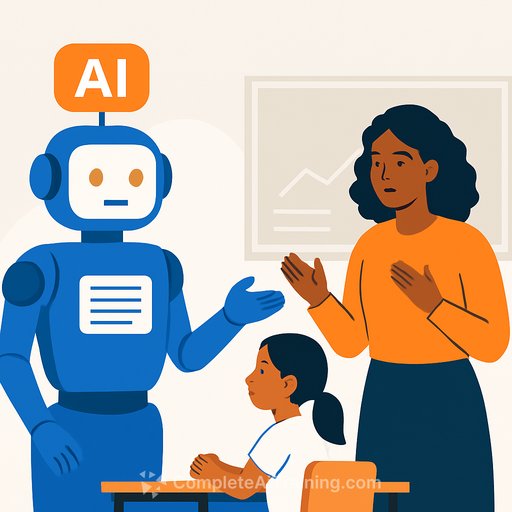
Boston University Forum Examines AI's Role in K-12 Education
Faculty and educators gathered at Boston University on March 25 to discuss how artificial intelligence will reshape teaching and learning in schools. The 2026 BU Wheelock Forum drew approximately 250 people-teachers, administrators, and scholars-to address a question many in education are asking: What does teaching and learning mean in an AI world?
The forum featured a keynote from Aaron Rasmussen, cofounder of online education platforms Outlier.ai and MasterClass, followed by a faculty panel discussion and a dance performance incorporating AI technology.
Educators Must Guide AI Development
Rasmussen emphasized that the education sector faces pressure to adapt to AI or risk being left behind. "We are up against a time horizon here where the culling, for lack of a better word, has begun in many industries, and education is one of them," he said.
He argued that educators should lead decisions about how AI is developed and used in schools. "When we think about the way AI is changing education, we need to think about who is going to guide AI to make education better," Rasmussen said. "And it seems to me that educators would be the best people to do that."
Concerns About Access and Equity
Naomi Caselli, an associate professor of Deaf education at Wheelock, raised specific concerns about AI bias. Most large language models expect users to know written or spoken language, which excludes people who use sign languages, she said.
Caselli also flagged concerns about AI's involvement in surveillance, its environmental costs, and questions about who profits from the technology. "We have to be wise and compassionate in foreseeing those risks," she said.
The Risk of Over-Reliance
Michael Alan Chang, a computer scientist and assistant professor at Wheelock, urged caution against saturating classrooms with AI without careful thought. "Oftentimes pausing is seen as a fearful reaction," he said. "In another framing, it can totally be about courage. It's the courage to resist this urge to just chug forward."
In social contexts like education, the "move fast and break things" approach common in tech doesn't work, Chang said.
TJ McKenna, who directs BU Wheelock's new AI and Education PhD and Master's programs, pointed to research showing the dangers of over-reliance. In one study, students using an AI system improved their performance by 48 percent on an assignment. When researchers removed the AI and retested them, those same students performed 17 percent worse than a control group that never had access to AI.
"Once you start leaning on those crutches, it becomes really hard," McKenna said.
Building AI Literacy Early
Nermeen Dashoush, a clinical associate professor, said schools must teach AI literacy starting before children enter school and continuing through early grades. "My role is to make sure that they have the skills to wherever the tool goes, they're able to kind of dissect it," she said.
Dashoush emphasized ensuring all children have access to AI education. "If I'm going to design something, I want to make sure that all children have access to it," she said, "and that means also making sure that I'm meeting them where they are."
For educators looking to deepen their understanding of AI in teaching, resources like the AI Learning Path for Teachers offer structured guidance on classroom integration and best practices.
Your membership also unlocks: