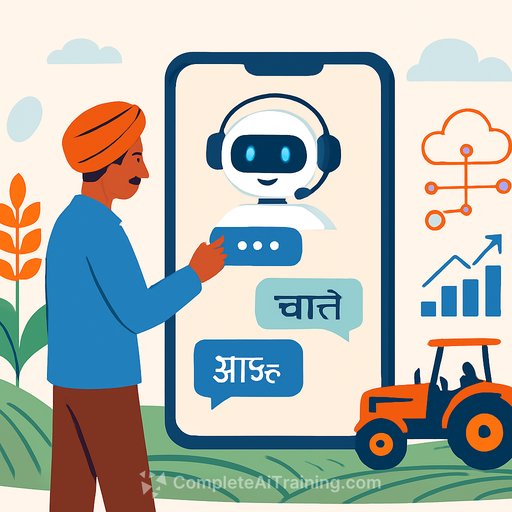
Bharat-VISTAAR: A multilingual AI tool to unify AgriStack and ICAR advisories
The Union Budget announced Bharat-VISTAAR (Virtually Integrated System to Access Agricultural Resources) - a multilingual AI tool that brings AgriStack portals and ICAR's package of practices onto one advisory layer. The goal is simple: better decisions for farmers, higher productivity, and lower risk through context-specific guidance delivered in local languages.
For government teams, this is more than a tech rollout. It's a coordinated push to connect data, Research, and last-mile extension so advice reaches fields on time and is applied correctly.
What Bharat-VISTAAR does
- Integrates AgriStack's digital farmer records with ICAR's validated practices.
- Uses AI to convert research and field data into local-language advisories, specific to crop, soil, weather, and growth stage.
- Supports precision input use, risk reduction, and timely decisions at the field level.
Industry, research, and startup leaders have backed the move, noting that digital advisory works best when paired with strong on-ground extension and timely delivery. Expect stronger adoption where state departments and KVKs align operations, training, and data flows.
Why this matters for government stakeholders
- One platform to operationalize AgriStack and ICAR guidance across states.
- Consistent, auditable advisories that reduce variability in field instructions.
- Better targeting of schemes through farmer-level data and feedback loops.
- Lower cost per advisory as content scales across crops, seasons, and regions.
Implementation priorities (next 3-9 months)
- Data governance and consent: Define consent flows, data minimization, retention, and role-based access for state, district, and block teams.
- APIs and standards: Map AgriStack IDs, land records, soil cards, weather feeds, and scheme data into interoperable APIs; keep vendor lock-in out.
- Model validation: Co-develop and validate advisory logic with ICAR institutes and KVKs; publish version histories and change logs.
- Language coverage: Prioritize local languages for voice, IVR, and SMS; include offline-first modes for low-connectivity areas.
- Last-mile extension: Train extension workers to interpret and contextualize advisories; define escalation paths for complex cases.
- Weather and risk: Integrate IMD and disaster alerts; add contingency crop plans and pest risk indices where data allows.
- Monitoring: Set district-level KPIs-advisory delivery time, adoption rate, input optimization, and yield impact by crop.
- Citizen support: Provide helplines, grievance redressal, and feedback capture to improve advisory quality over time.
- Security: Enforce audit trails, encryption, and incident response playbooks; run red-team tests before scale-up.
How it will work on the ground
- Data in: Farmer profiles, crop stage, soil health, weather, and local pest/disease signals.
- Model layer: ICAR practices and state advisories translated into decision trees and AI prompts, reviewed by agronomists.
- Delivery: App, WhatsApp, SMS, IVR, and call centers in local languages; extension workers for in-person support.
- Feedback: Farmer responses, field photos, and outcomes feed back to improve the next advisory cycle.
What stakeholders are saying
Leaders from crop science, inputs, and agri-tech agree on three points: integrate verified practices with farmer data, keep advice local and timely, and back digital systems with strong extension. There's broad support for precision inputs, risk reduction for smallholders, and a common digital framework that respects local conditions.
Immediate actions for ministries, states, and agencies
- Nominate nodal officers for data, extension, and IT; create a joint working group with ICAR/KVKs.
- Inventory datasets (soil, land records, scheme benefits, weather feeds) and readiness for API access.
- Select pilot districts with diverse crops and languages; set clear baseline metrics before rollout.
- Prepare RFP clauses: interoperability, open standards, auditability, model explainability, and data protection.
- Train extension teams on advisory interpretation, risk communication, and grievance handling.
- Define a communication plan for farmers: channels, languages, timings, and seasonal calendars.
Risks and guardrails
- Incorrect advice and liability: Add human-in-loop checks for high-risk recommendations; log sources and decision steps.
- Bias and coverage gaps: Test across regions, crop varieties, and languages; track error rates by segment.
- Vendor lock-in: Require open APIs, data export, and model portability.
- Operational gaps: Ensure spare devices, offline kits, and backup messaging during outages.
- Privacy: Keep sensitive data scoped; use consent records and revocation options.
KPIs to track in year one
- Advisory reach and delivery time by channel and language.
- Adoption rate and action completion (e.g., sowing date changes, input adjustments).
- Input optimization (water, fertilizer, and agro-chemicals) per crop and district.
- Yield and loss reduction indicators from sample plots and FPOs.
- Farmer satisfaction and grievance resolution time.
Useful references
Upskilling your teams
If your department is planning AI-led advisory or data operations, short, job-focused learning paths can speed up deployment. Consider targeted options such as the AI Learning Path for Training & Development Managers and practical AI Productivity Courses to prepare extension and data teams quickly.
Bharat-VISTAAR gives government a clear path to deliver consistent, local-language guidance at scale. With strong data governance, rigorous validation, and a trained extension backbone, it can convert research into real field outcomes-one advisory at a time.
Your membership also unlocks: