Budget 2026-27 puts education to work: What educators should do next
India's Union Budget 2026-27 puts education and skills at the core of long-term growth. The throughline is clear: connect learning to jobs and enterprise, with technology as the glue.
For school leaders, higher-ed admins, and training heads, this Budget signals concrete shifts you can plan for now-across infrastructure, curricula, teacher training, and student finance.
New Standing Committee: Education → Employment → Enterprise
A High-Powered "Education to Employment and Enterprise" Standing Committee will recommend measures to make the services sector a core growth driver, with a stated goal of a 10% global share by 2047. The committee will also assess how technologies like AI change jobs and skills, and propose what education systems must do in response.
What this means for institutions:
- Expect national guidance on employability metrics, skills standards, and curriculum updates linked to services-sector roles.
- Start mapping programs to growth areas (financial services, health, logistics, digital, creative, tourism). Build in work-integrated learning and industry projects.
- Set up an internal taskforce to track committee outputs and translate them into program, assessment, and placement changes.
Girls' hostels in every district: Fixing a practical blocker in STEM
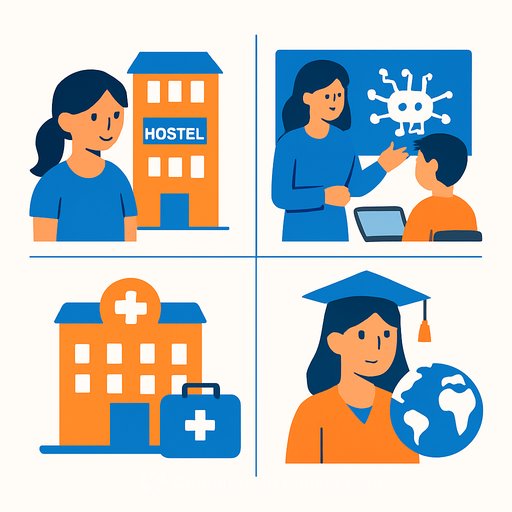
To address gender-specific barriers-especially long hours and lab-based learning-the Budget provides for one girls' hostel in every district, using viability gap funding or capital support.
Action for universities and colleges:
- Identify land and readiness for proposals; line up PPP or CSR partners early.
- Design hostels for lab schedules: safety, late-hours access, study spaces, transport to research blocks.
- Tie hostel access to retention targets in STEM; track enrolment-to-completion for women.
AI-first curricula and teacher upskilling
The government will push AI into curricula from school level, upgrade SCERTs for teacher training, and set frameworks to upskill and reskill engineers and tech professionals in AI and emerging technologies.
Also on the table: AI-enabled matching of workers to jobs and training, visibility for the informal workforce, and measures to attract skilled diaspora and foreign talent.
Steps you can start now:
- Define grade-wise AI learning outcomes (literacy → practical projects → ethics and safety). Pilot in two grades or two departments before scaling; consult resources like AI Design Courses for curriculum and lab design examples.
- Stand up a teacher development track: foundations of AI, prompt fluency, classroom use-cases, assessment integrity.
- Audit labs and data policies for AI use (devices, connectivity, privacy, plagiarism controls, evaluation rubrics).
- For engineering and MCA programs: add applied AI minors, capstone links with industry, and micro-credential pathways.
If you need structured upskilling for faculty and staff, explore practical offerings such as AI Research Courses.
Health education and jobs: Five Regional Medical Hubs
The Budget supports states to set up five Regional Medical Hubs with private partners. Each hub will integrate medical education, research, clinical facilities, AYUSH centers, medical value tourism facilitation, diagnostics, post-care, and rehabilitation.
For states and medical universities:
- Prepare proposals that bundle teaching hospitals, research centers, and allied health programs.
- Plan workforce pipelines for doctors, nursing, diagnostics, rehab, and health-tech roles.
- Build interdisciplinary tracks: medicine × data science, bioengineering, health management.
Lower TCS on overseas education payments
The Tax Collected at Source (TCS) on remittances for education and medical purposes under the Liberalised Remittance Scheme will drop from 5% to 2%.
What admissions and finance offices should do:
- Update fee advisory notes for students heading abroad; revise estimates and payment plans.
- Coordinate with banks and parents on LRS documentation and timelines.
- For international offices: reflect the change in scholarship and loan counseling.
For policy specifics on LRS, refer to the Reserve Bank of India's guidance: RBI LRS FAQs.
Funding context: The 6% of GDP benchmark
The Budget continues the focus on school, higher education, and skills, even as overall public spending on education has historically stayed below the 6% of GDP target in the National Education Policy (NEP) 2020.
Useful reference: NEP 2020 (official PDF).
Quick checklist for education leaders
- Stand up an internal committee to track the new Standing Committee's recommendations and convert them into curriculum and placement actions.
- Start hostel project scoping with district officials; queue proposals for VGF or capital support.
- Launch a faculty AI upskilling sprint this semester; set baseline competencies and certifications.
- Refresh program outcomes to meet services-sector demand; add work-integrated modules.
- For medical and allied health institutions, scope partnerships for the upcoming Regional Medical Hubs.
- Update overseas fee advisories to reflect the 2% TCS rate under LRS.
The message is straightforward: build capacity where students learn, make skills verifiable, and tie programs to real jobs. If you move early, your institution won't just keep up-you'll set the standard others follow.
Your membership also unlocks: