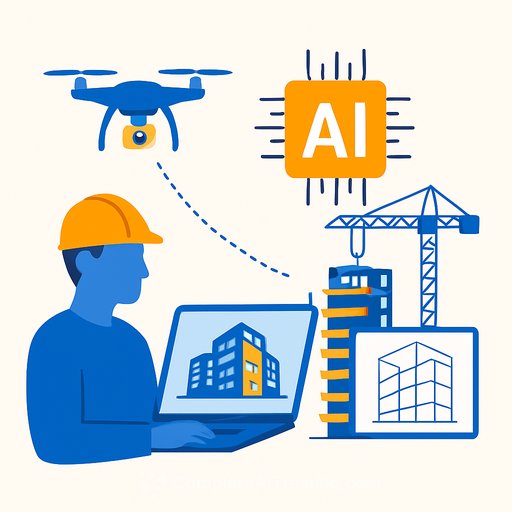
AI for Transforming Construction Site Intelligence and Project Delivery
The way projects get built is shifting from clipboards to computer vision, drones, BIM, and real-time data. Progress and quality checks are moving from opinion to evidence. Less rework, fewer delays, tighter cost control. Safer sites and clearer accountability.
If you build, own, finance, or manage projects, this is practical - see AI for Real Estate & Construction for examples and guidance.
The Old Way: Why It Breaks at Scale
- Site walks by engineers
- Ad hoc photos
- Excel reports and rough estimates
- Paper quality checklists
It's slow, subjective, and often out of date. Issues surface late, fixes cost more, and trust erodes when reported progress doesn't match reality.
What AI-Driven Progress Monitoring Actually Is
AI uses computer vision and machine learning to measure real progress against design and schedule. Data collection is automated: drones, fixed cameras, smartphones, and 360 captures scan the site on a regular cadence.
The system recognizes columns, walls, slabs, MEP runs, finishes, and more-even in tough lighting and messy environments. It aligns visuals with BIM, drawings, and schedules to quantify work, flag variances, and push real-time dashboards. Objective, timestamped, and location-aware.
The Stack That Makes It Work
Computer Vision
Understands what's in each image or video frame. Detects components, work status (complete/partial/defective), and deviations.
Machine Learning
Improves with every project. Handles site noise-clutter, dust, shadows-and learns project-specific features over time.
Drones
Give fast, safe coverage for large or linear sites. Volumetrics for earthworks, structural progress checks, and layout compliance from the air.
Integration with BIM
When images align with 3D models and Design, the system can auto-verify what's built, spot missing elements, and detect sequencing errors.
Smart Sensors
Concrete temp, vibration, humidity, equipment use-fused with visuals for stronger quality and productivity insights.
AI for Quality Control
Automatic defect detection
Finds cracks, misalignments, poor finishes, and surface issues across time-stamped photo sets. Catches what walk-throughs miss.
Checks against specs
Validates bar spacing, formwork alignment, slab thickness, and more against drawings and tolerances.
Stage-gate verification
Pre-pour, post-frame, pre-handover checks-done consistently. Early detection means cheaper fixes and fewer downstream surprises.
Audit-ready records
Evidence with timestamps, locations, and visual proof. Useful for certifications, client reviews, and dispute resolution.
Proven Advantages for Owners, GCs, and Lenders
- Remote visibility: See accurate progress without constant site visits-across one project or a portfolio.
- Schedule control: Spot lags early by comparing as-built vs. plan. Intervene before small slips cascade.
- Lower rework: Early issue detection cuts costly redo work that can swallow 5-10% of budgets.
- Trustworthy reporting: Quantified progress beats guesswork and reduces payment disputes.
- Safer operations: Fewer risky manual inspections; some systems flag unsafe acts or PPE gaps.
Where It's Working Today
- Residential and high-rise: Floor-by-floor tracking, façade and finish quality, MEP coordination.
- Infrastructure: Earthworks volumes, bridge elements, alignment checks across long corridors with drone coverage.
- Industrial and energy: Precision checks for piping, steel, equipment foundations, and tolerances.
- Public projects: Transparent oversight, better compliance, improved spend accountability.
Market Momentum
Analysts see strong growth as sites produce more data and teams seek automation. Fortune Business Insights pegs AI in construction at about USD 3.9B in 2024, reaching roughly USD 22.7B by 2032 (CAGR ~24.6%). Source.
McKinsey notes projects generate terabytes of visual, sensor, and operational data each year, yet only a fraction feeds decisions. That's the gap AI platforms close by turning raw feeds into site intelligence. Learn more.
India outlook
Multiple reports forecast strong adoption in India, driven by infrastructure expansion, modernized corridors, industrial real estate, and rising BIM use. Projections range around 18-35% CAGR across different sources. Growing data center capacity will also help real-time analytics and local processing.
Adoption Hurdles (and how to handle them)
- Data quality: Poor images hurt results. Standardize capture routes, angles, and lighting. Use checklists and 360 paths.
- Team buy-in: Address surveillance fears; position AI as a safety and quality ally. Start with a pilot and share quick wins.
- Integration: Connect AI outputs to your schedule, CDE, BIM, and cost systems. Use open formats and APIs.
- Upfront cost: Start small-one site, one scope, clear KPIs. Savings from reduced rework and fewer delays typically cover the spend.
What's Next
- Predictive alerts: Likely delays, clashes, and quality risks flagged days in advance.
- Autonomous inspections: Drone and rover capture on fixed routes with automatic uploads.
- Daily AI site reports: Progress deltas, blockers, manpower gaps, and safety observations.
- Digital twins: Continuous updates feed operations and maintenance.
- Automated compliance: Code checks and handover paperwork prepared from verified data.
How to Get Started in 30 Days
- Pick one pilot: a floor, a structure, or earthworks scope with clear start/finish milestones.
- Set KPIs: schedule variance detection, rework reduction, issue close-out time, and site-visit reduction.
- Stand up data capture: weekly drone flights, daily 360 walks, and fixed camera points.
- Connect BIM and schedule: ensure models are up to date and activities are structured for comparison.
- Run a 4-week sprint: track wins and gaps; iterate your capture routes and review cadence.
- Scale by template: document routes, file naming, and workflows so other sites can copy-paste.
Upskill your team
Want a curated path to bring AI skills to your project teams? Explore practical AI Productivity Courses.
Your membership also unlocks: