Pentagon's AI weapons policy faces legal challenge from Anthropic
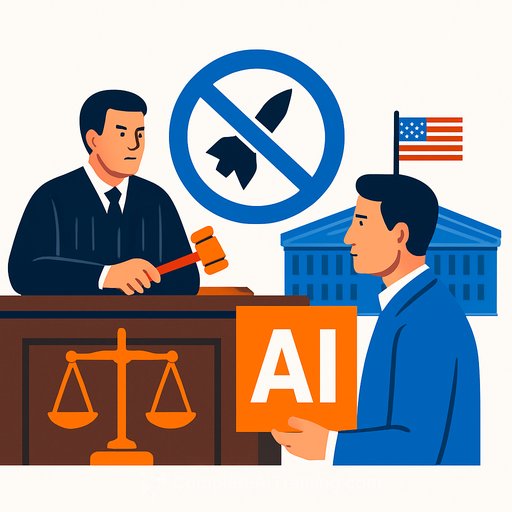
A federal judge in California has signaled that the Defense Department may have illegally punished Anthropic for advocating restrictions on autonomous weapons and mass surveillance. The ruling could force the government to restore billions in military contracts the company lost after being designated a "supply chain risk."
"It looks like an attempt to cripple Anthropic," Judge Rita Lin said during a hearing in the Northern District of California on Tuesday.
The case centers on Anthropic's contractual requirement that its AI models not be used for weapons without human oversight or for domestic surveillance. The Pentagon argues this stance undermines its operational control. Anthropic contends the designation punishes the company for exercising free speech on policy matters.
What's at stake for government agencies
If Anthropic wins, the ruling could establish legal precedent that the government cannot retaliate against contractors for advocating AI safety restrictions. For federal employees and policy officials, this matters because it may force clearer rules about what constraints companies can impose on military AI systems.
The Pentagon has already integrated Anthropic's Claude Gov models into Palantir's Project Maven, which handles data analysis and target selection. OpenAI has since taken over some of this work after Anthropic's contract was terminated.
Why reliability concerns are real
Anthropic's push for human oversight rests on a technical problem: AI models hallucinate. They generate false information with confidence, sometimes catastrophically.
Researchers at George Mason University found that half of all accidents involving self-driving cars in San Francisco stem from "phantom braking" - the vehicle incorrectly detecting an obstacle and braking, causing rear-end collisions. The same failure mode could occur in weapons systems.
Other concerns extend beyond hallucinations. Data biases, model vulnerabilities to foreign manipulation, and questions about what constitutes a legitimate target all remain unresolved. The military currently lacks adequate benchmarks to test whether commercial AI models are reliable enough for weapons integration.
Domestically, researchers from OpenAI and Google have warned that AI-powered surveillance could monitor 70 million cameras and credit card transactions simultaneously. "Even the awareness that such capability exists creates a chilling effect on democratic participation," they wrote in court filings.
Industry pressure and political stakes
Anthropic has positioned itself as the ethical alternative in the AI market. Downloads of Claude surged after its Pentagon contract cancellation, suggesting the company gained public credibility even as it lost government revenue.
The economics of AI development require substantial government contracts. The industry is investing heavily in the 2026 midterm elections, with some companies funding advertisements against candidates who support AI safety disclosure requirements.
Anthropic has taken the opposite approach, donating $20 million to a political action committee supporting candidates who favor AI regulation.
What comes next
The court is expected to decide whether to grant Anthropic a preliminary injunction removing the supply chain risk designation. A ruling in Anthropic's favor could create space for deliberate policy development on AI weapons rather than leaving such decisions to individual companies.
Brianna Rosen, executive director of the Oxford Programme for Cyber and Technology Policy, notes the deeper problem: "For the first time, the United States is using AI to generate targets in large-scale combat operations in Iran. And lawmakers are still debating whether to draw red lines on fully autonomous weapons. The absence of governance is itself a national security risk."
For government professionals, the case signals that AI weapons policy will be shaped by courts and elections as much as by military strategy. Understanding the technical limitations of AI systems - and the legal frameworks developing around them - is becoming essential to policy work.
Learn more about AI for Government and AI for Legal professionals navigating these emerging regulations.
Your membership also unlocks: