This AI spots dangerous blood cells doctors often miss
Date: January 13, 2026 - Source: University of Cambridge
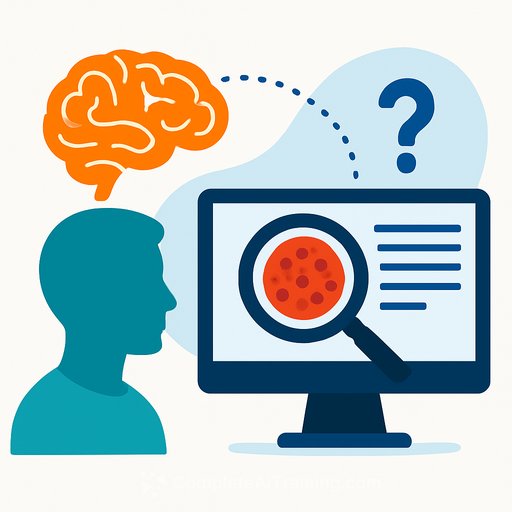
A generative AI system called CytoDiffusion analyzes peripheral blood smears with higher accuracy and consistency than human experts, and it knows when its own judgment is uncertain. In tests, it picked up subtle morphologic signs tied to diseases like leukemia and flagged rare cell types that routinely slip past manual review.
What's new
Most medical imaging models classify into fixed categories. CytoDiffusion takes a different route: it learns the full spectrum of how blood cells can look, then highlights departures from that spectrum. That shift lets it handle edge cases and quantify uncertainty instead of guessing with false confidence.
Why it matters for clinicians and labs
A single smear has thousands of cells - far more than a human can scan in detail. The system can triage routine films, surface unusual cells for review, and reduce missed or ambiguous calls. As one researcher put it, after a full day in the lab, AI can stay consistent when human attention fades.
How CytoDiffusion works
Built on generative modeling (akin to image generators such as DALL.E), the model learns fine-grained morphology: size, shape, cytoplasm texture, nuclear features, staining patterns. Instead of memorizing labels, it models appearance and detects deviations that suggest pathology.
The team trained it on more than 500,000 images from Addenbrooke's Hospital in Cambridge - the largest peripheral blood smear dataset reported to date. It spans common types, rare examples, and tricky lookalikes, improving generalization across microscopes, labs, and stains. The dataset is being released publicly to drive benchmarking and method development worldwide.
Performance highlights
On detecting abnormal cells linked to leukemia, CytoDiffusion showed higher sensitivity than existing systems and matched or exceeded leading models even with fewer examples. Crucially, it calibrated its confidence well: the model avoided confident-but-wrong calls that humans sometimes make.
The team evaluated the system under real deployment pressures: unseen images, different capture devices, and noisy labels. That multi-angle testing offers a clearer read on how a model will behave once it leaves the lab.
Synthetic images that fool experts
The model can generate synthetic blood-cell images that look real to trained eyes. In a small Turing-style test with ten hematologists, experts could not reliably tell real from synthetic. This opens doors for data augmentation, education, and quality assurance - with a parallel need for guardrails to prevent misuse.
Practical implications for research teams
- Shift from rigid classifiers to generative modeling can improve rare-cell detection and domain transfer.
- Uncertainty estimates should be first-class outputs, feeding triage and escalation workflows.
- Large, open, well-annotated morphology datasets are now available to stress-test models under domain shift.
- Synthetic images enable curriculum design and augmentation but call for provenance tracking.
- Benchmarks should include device variation, stain variation, and label uncertainty - not just clean test splits.
Limitations and next steps
Speed remains a bottleneck for high-throughput labs. The system needs broader validation across diverse patient populations to confirm accuracy and fairness before routine deployment. Integration with LIMS, audit trails, and human-in-the-loop review will be key for clinical acceptance and regulatory clearance. Teams responsible for workflow and tool integration may benefit from resources on AI product and workflow design: AI Design Courses.
Who's behind it
The work comes from researchers at the University of Cambridge, University College London, and Queen Mary University of London, within the BloodCounts! consortium. Support included the Trinity Challenge, Wellcome, the British Heart Foundation, Cambridge University Hospitals NHS Trust, Barts Health NHS Trust, the NIHR Cambridge BRC, NIHR UCLH BRC, and NHS Blood and Transplant.
Further reading
Journal context on generative models in healthcare: Nature Machine Intelligence
Upskilling on practical AI methods used here (diffusion models, uncertainty, evaluation): AI Research Courses
Your membership also unlocks: