Warehouse AI Closes the Gap Between Digital Records and Ground Truth
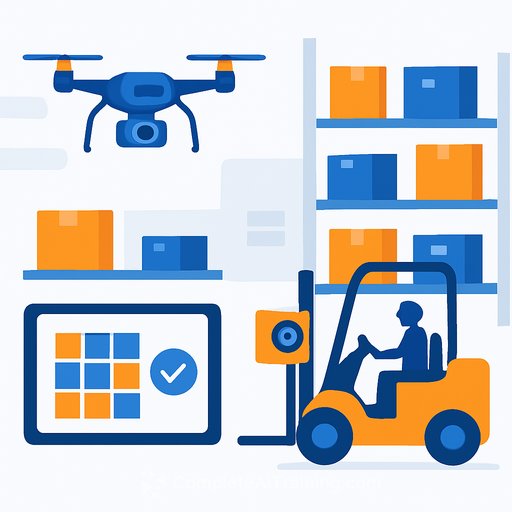
A new class of physical AI is automating inventory tracking in warehouses by using cameras mounted on moving assets-drones, forklifts, and other equipment-to capture real-time data without manual scanning. The technology is accelerating adoption across supply chains as managers recognize the connection between accurate visibility and measurable operational gains.
The persistent problem physical AI solves is straightforward: digital planning systems and control towers often diverge from what's actually happening on the warehouse floor. Managers see discrepancies between inventory records and physical stock, leading to missed shipments, labor inefficiency, and write-offs.
Camera-equipped assets navigate warehouses continuously, digitizing inventory state passively as they move. This eliminates barcode scanning and manual cycle counts, the repetitive tasks that consume warehouse labor.
Where the Real Value Emerges
Inventory accuracy is the entry point, but operational orchestration is where managers see measurable ROI. Accurate, real-time data enables better decisions across workflows: improving on-time, in-full (OTIF) performance, reducing shrink, optimizing labor allocation, and cutting damage and overages.
One case study showed an inventory control and quality assurance department shrink from six employees to one while inventory errors dropped 70%. The reduction didn't mean job losses-it freed workers from repetitive counting tasks to focus on higher-value work in an environment facing persistent labor shortages.
The Technology Stack Matters
Confusion around warehouse AI stems partly from terminology. Physical AI is not a single technology but a stack: computer vision models interpret images, classical Bayesian AI governs movement and drone control, and generative AI extracts insights and enables natural language interaction.
Generative AI, despite recent headlines, is weak at reading images and controlling robots. The heavy lifting in warehouses comes from computer vision and probabilistic models that have existed for years, long before large language models became fashionable.
Hardware Flexibility Lowers Barriers
Vendors that build software to work with off-the-shelf equipment rather than proprietary hardware reduce capital requirements and deployment friction. This approach allows systems to operate in extreme environments: cold storage at minus 20°F and high-temperature warehouses globally.
Cold storage accuracy carries outsized importance. A mistake in cold storage costs four times more than one in ambient conditions, and the environment is hostile to human workers. Removing human intervention from these spaces improves both accuracy and worker safety.
Gather AI, which raised $40 million in Series B funding in February, exemplifies this model. The company builds vision software designed for off-the-shelf hardware rather than manufacturing its own equipment. It currently operates in the U.S. and Dubai, with plans to expand globally.
What Managers Should Know
Physical AI solves a specific problem: the visibility gap that persists even after heavy investment in digital planning tools. It works by automating passive data capture, not by replacing workers.
The technology is not new-computer vision and probabilistic AI have existed for years. What's changed is adoption velocity as managers connect better visibility directly to OTIF, labor efficiency, and shrink reduction.
For operations and supply chain managers, the practical takeaway is this: if your digital systems don't match your physical reality, physical AI addresses that gap. The ROI comes not from eliminating headcount but from redirecting labor toward tasks that add value and making decisions based on accurate data.
Learn more: AI Learning Path for Operations Managers and AI Learning Path for Supply Chain Managers cover how AI-driven visibility and orchestration improve warehouse and supply chain performance.
Your membership also unlocks: