AI, Creativity, and the Human Leap: What Marketers Should Do Now
AI is reshaping how marketing work gets done-audience analysis, segmentation, creative versioning, and distribution are getting faster and cheaper. But a deeper question cuts through the hype: can AI be creative, or does it just remix what already exists?
In a recent conversation, Suraj Srinivasan (Harvard Business School) and David Sable (Stagwell) put a clean line between creativity and replication. Their take is simple and useful for anyone running campaigns: AI is a powerful tool, but the spark that changes the status quo is still human.
Creativity vs. replication
"AI can make us creative, can help us be creative," Sable said. "I don't think that in and of itself, it is creative." Tools evolve-cave walls, canvas, film, screens-but the human leap hasn't changed.
That leap is the point. Creativity isn't about better pattern-following. It's about breaking the pattern. If your brief only optimizes what worked last quarter, you'll get more of last quarter.
The Monet and da Vinci lessons
Sable points to a moment in art history that every marketer should study. In one gallery, a typical masterwork of its time hung beside a Claude Monet piece that looked like it arrived from the future. The contrast wasn't incremental; it was a leap.
Same with Leonardo's The Last Supper. Across from it sits a more conventional fresco by Giovanni Donato da Montorfano-excellent for its era. Then you face Leonardo's wall and ask, how was this even possible? It didn't refine the reference set. It ignored it.
That's the "da Vinci factor": if an AI trained on everything up to that moment, it would output another Giovanni-not The Last Supper. For context, see overviews of Claude Monet and The Last Supper.
Where AI already wins in marketing
- Insight acceleration: sift through years of data in hours to spot patterns, motivations, and emerging pockets of demand.
- Creative versioning: generate multiple copy, image, and video variants for segments and channels at a fraction of the time and cost.
- Distribution at scale: personalize and iterate faster based on performance signals.
But there's a ceiling. "You can get some of it from AI," Sable said. "But you've all seen it. The AI is pretty soulless." The delta between good and great still comes from the human leap.
How to pair human imagination with AI systems
- Define the leap: Before prompting, state the status quo you're breaking. What belief, behavior, or format are you flipping?
- Run insight sprints: Use AI to mine qualitative and quantitative inputs into sharp tensions, not just trends. Convert data into a point of view.
- Write better prompts: Set Role, Objective, Constraints, and Context. Ask for three divergent routes (not just variations). Then push for contradictions, edge cases, and "what's missing." Explore Prompt Engineering if you want to level this up.
- Treat outputs as mood boards: Use AI to explore territories and speed options, then choose one human-led concept to craft with tone, timing, and taste.
- Version with intent: Let AI explode a core idea into formats per segment, channel, and stage of journey. Keep one narrative spine.
- Test for feeling, not just clicks: Pair performance metrics with qualitative feedback to judge memorability and emotional pull.
- Set brand guardrails: Codify voice, do/don't language, legal, and ethical rules so speed doesn't erode trust.
Skills to prioritize this quarter
- Insight synthesis: Turning raw data into a sharp creative tension.
- Prompt fluency: Framing, constraints, and iterative prompting to get usable outputs.
- Taste and judgment: Knowing what moves people, not just what fills a template.
- Story framing: One clear idea, told simply, adapted for each channel.
- Ethical use: Bias checks, rights management, and transparency.
A weekly workflow you can start Monday
- Mon: AI-assisted research sprint → 5 insights → pick 1 tension.
- Tue: Generate 3 radically different creative territories. Kill two.
- Wed: Expand the winner into a narrative spine and brand-safe messaging.
- Thu: AI-version into channel/segment assets. Add human polish.
- Fri: Launch A/Bs, gather signals, and schedule a 30-minute insight retro.
Make wonder a KPI
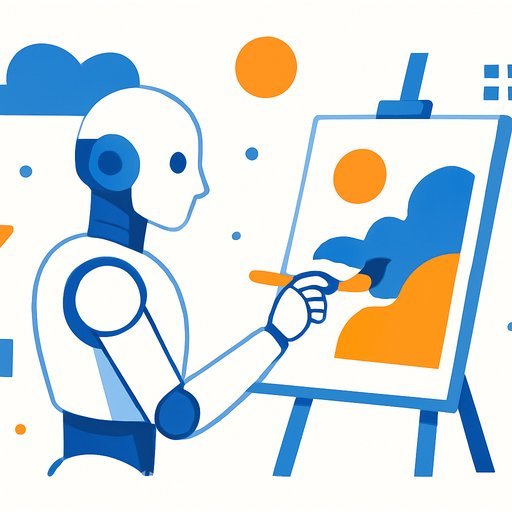
"Wonder is the beginning of wisdom." That line matters more as prompts become the new brush and your screen becomes the canvas.
AI speeds the work. Your job is the leap-reframing the brief, asking the question no one asked, and pushing past the reference set. Make curiosity and imagination measurable inside your team.
If you're building the stack to do this at scale, start here: AI for Marketing.
Your membership also unlocks: