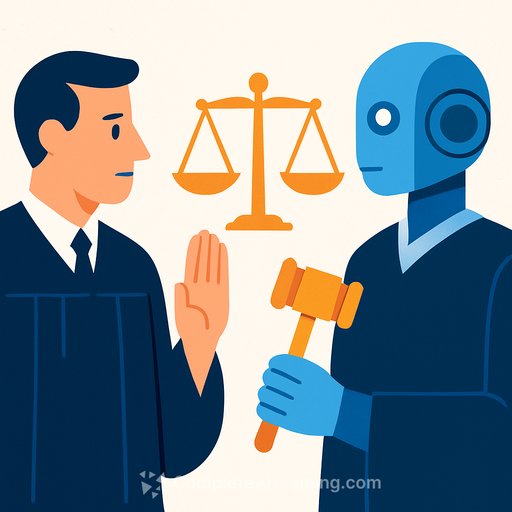
Eric Posner to present 2026 Ryerson Lecture on AI and the Future of Law
Prof. Eric Posner will deliver the University of Chicago's 2026 Nora and Edward Ryerson Lecture on April 16 at 5 p.m. in Friedman Hall at the David Rubenstein Forum. The event is free and open to the public, with registration opening in early March.
Posner, the Kirkland & Ellis Distinguished Service Professor of Law, has been on the UChicago faculty since 1998. His work has influenced debates in antitrust, financial regulation, constitutional law and international law. In recent years, he has zeroed in on artificial intelligence and its role in legal decision-making, a topic addressed in resources on AI for Legal.
The lecture will focus on how large language models (LLMs) are challenging long-held assumptions about judgment, accuracy and authority in the law. "AI is the most important technological development in many years," Posner said. "It offers both promise and risks. I am interested in how AI can both help us understand the law and how it can help us improve the legal system."
Drawing on Research, including his recent work on LLM performance in judicial decision-making, Posner will discuss evidence that AI systems may outperform human judges on certain measures. He'll also press the harder question: what courts are for-both as arbiters of disputes and as stabilizing institutions in a democracy.
"LLMs are less likely than human judges to make factual and legal errors and more likely to be objective," Posner said. "But it doesn't follow that they can perform the social and political functions of the judiciary, one of which is to modify the law without seeming to."
Why this matters for legal professionals
- Quality and error rates: If LLMs can reduce factual and legal mistakes, firms and courts will need clear standards for review, auditing and attribution.
- Judicial function vs. computational output: Even with high accuracy, algorithmic decisions do not replace the institutional role of courts-precedent-setting, legitimacy and public trust.
- Workflows and accountability: Expect more human-in-the-loop processes, documented prompts, and explainability requirements in filings and internal memos.
- Ethics and governance: Bar rules, disclosure norms and model risk frameworks will move from optional to expected practice.
- Client expectations: Faster drafts and research are table stakes; counsel will be judged on judgment-when to rely on AI, when to override it and how to justify the call.
Event details
- Date and time: April 16, 2026, at 5 p.m.
- Location: Friedman Hall, David Rubenstein Forum (University of Chicago)
- Access: Free and open to the public; registration opens in early March for both virtual and in-person attendance
About the Ryerson Lectures
Established in 1972 through a bequest from Nora and Edward Ryerson, the annual lecture recognizes UChicago faculty whose scholarship has lasting significance. Recent lecturers include economist James A. Robinson, philosopher Jonathan Lear, cosmologist Wendy Freedman and paleontologist Neil Shubin.
Further reading and next steps
If you need a quick primer on LLMs before the lecture, see this overview of large language models for context on capabilities and limits: What is an LLM?
Planning to upskill your team for LLM-enabled legal work? Explore curated AI learning paths by job role: Complete AI Training - Courses by Job
Your membership also unlocks: