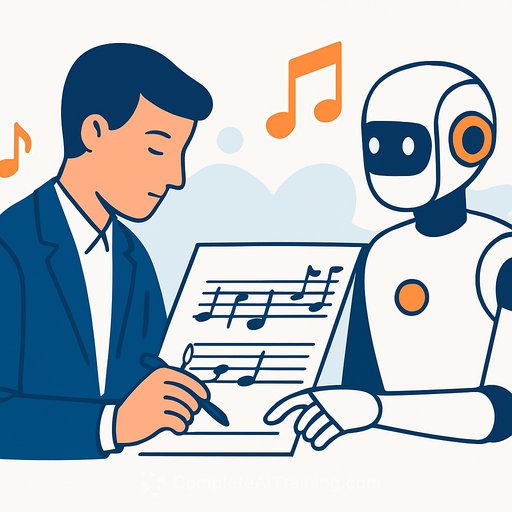
Can AI Really Replace Human Composers? Lessons For Writers
AI can sketch a melody, copy a style, and spit out a full soundtrack before your coffee cools. That's impressive. But the question isn't "can it make music?" The question is "can it make music you feel?"
This debate matters to writers. Music composition shows us where AI shines, where it falls short, and how to build a workflow that keeps your voice at the center.
What AI already does well in composition
- Speed: drafts, variations, and iterations on command.
- Pattern recall: it maps styles, chord progressions, and structures with eerie accuracy.
- Endless output: more options than you'll ever need, 24/7.
- Style mimicry: convincing impressions of genres, moods, and eras.
Translate that to writing: AI is excellent at first passes, outlines, summaries, and pattern-heavy formats like product pages, FAQs, or SEO snippets.
Where humans still win
- Taste: choosing the one line, the one phrase, the one motif that carries meaning.
- Story: shaping tension, silence, and timing so the work lands at the right moment.
- Context: cultural references, subtext, and restraint. Knowing what not to say.
- Originality under constraints: turning limits into a signature.
AI can generate content. You assign weight, intention, and consequence. That is authorship.
A practical hybrid workflow for writers
- Define intent in one sentence: audience, outcome, and angle.
- Use AI for scaffolding: headlines, outlines, and rough paragraphs.
- Add voice: rewrite transitions, sharpen verbs, cut filler, and insert lived experience.
- Refine structure: shorten, reorder, and add contrast. Keep paragraphs to 2-4 sentences.
- Stress test: read aloud, check for clichés, and verify claims.
Prompt patterns that transfer from music to writing
- Reference + rule: "Write 3 intros in the tone of a minimalist essayist. Max 60 words. One metaphor only."
- Theme + constraint: "Summarize this topic with a sports metaphor, then rewrite with a culinary metaphor."
- Variation set: "Give me 5 versions of this paragraph: one punchy, one reflective, one contrarian, one humorous, one formal."
- Negative prompt: "Avoid buzzwords and filler. No adverbs unless necessary."
The taste loop: how to keep your voice
- Collect: save 20 lines you wish you wrote. Label why they work.
- Reduce: limit your style rules to 3-5 non-negotiables.
- Compare: after AI drafts, measure against your rules and your swipe file.
- Decide: delete 70%, keep 20%, rewrite 10% from scratch.
Your taste is the filter. The tighter the filter, the stronger the voice.
Quality control checklist before publishing
- Specificity: concrete nouns beat vague claims.
- Structure: clear setup, turn, and close. No meandering.
- Original phrasing: replace clichés and stock transitions.
- Evidence: link or cite when making factual claims.
- Readability: 2-4 sentence paragraphs, active voice, clean verbs.
Ethics, rights, and risk
AI outputs that are fully machine-generated may not qualify for copyright in some jurisdictions. Mixed works can be protected if the human contribution is meaningful. Always check current guidance and document your process.
- Policy reference: U.S. Copyright Office: AI Initiative
- Training data debate: Creative Commons on AI & content
If a prompt nudges a model toward a living writer's exact style, proceed carefully. Soundalikes in music have legal history; writing is heading the same way.
Will AI replace composers? The honest answer
For background music and utility tasks, AI is already competitive. For pieces that carry story, taste, and cultural weight, human direction is still the edge. The same holds for writing.
The winning approach is simple: let AI handle repetition and volume, while you handle meaning and selection.
Career strategy for writers in an AI era
- Own a voice: publish consistently so readers know what you stand for.
- Own a niche: solve a specific problem for a specific group.
- Own a system: document prompts, checklists, and editing steps.
- Ship faster: smaller pieces, higher cadence, tighter feedback loops.
Want structured training and tool stacks?
Curated tools and courses can save months of trial and error. Explore collections built for practical workflows:
AI can write. You decide what's worth reading. That decision is your moat.
Your membership also unlocks: