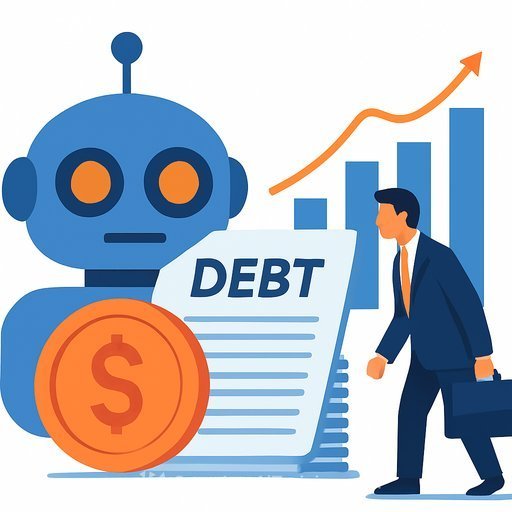
AI vs. Finance's Perpetual Profit Machine
Will AI eat finance? The short answer: it could take a big bite out of the industry's favorite profit pools. In AI for Finance, models like Claude can already draft research notes, build three-statement models, and stress-test scenarios. Banks have deep moats, but in a fully automated future, a lot of intermediation looks optional.
Why profits are at risk
For decades, finance got paid on frictions: information gaps, delays, spreads, and paperwork. The internet and smartphones wiped out a lot of that. AI goes after what's left - analysis, advice, and operations - and it does it at machine speed and near-zero marginal cost.
That means tighter spreads, lower fees, and fewer billable hours. If you charge for labor, you're exposed. If you charge for outcomes, you're in a better spot.
Where AI bites first
- Research: First drafts of notes, earnings previews, comps, and model updates in minutes. Humans shift to thesis, channel checks, and edge.
- Financial modeling: Automated three-statement builds, DCF shells, sensitivity tables, and quick scenario rewrites with auditable steps.
- Credit underwriting: File spreading, covenant checks, cash-flow tagging, and early-warning signals across portfolios.
- Sales and trading support: RFQ triage, client summaries, trade rationales, and post-trade analytics with compliance filters.
- Ops and finance: KYC refresh, document extraction, reconciliations, and close processes with fewer breaks and faster cycle time.
- Client service: 24/7 responses grounded in policies and product books, with handoffs to humans for edge cases.
What still defends incumbents (for now)
- Licenses and regulation: Hard to copy, slow to change.
- Balance sheets: Funding, capital, risk appetite - real moats in credit and markets.
- Data and distribution: Proprietary histories and entrenched client access.
- Trust and liability cover: Clients pay for accountability and recourse.
These hold, but they won't protect fee levels where AI proves the same quality at lower cost. Expect margin pressure even if volumes grow.
Three likely scenarios
- AI-augmented incumbents: Same products, faster delivery, lower unit costs. Fees compress; volume and share matter more.
- Platform front-ends: Big tech and fintech own the client interface; banks become balance-sheet utilities underneath.
- Automation at scale: Advice, modelling, and many ops tasks run as software. Intermediation shrinks to regulation, risk, and complex deals.
Moves to make in the next 90 days
- Map profit pools: List top fees, spreads, and hours by product. Circle the ones driven by manual analysis or handoffs.
- Pick 3 use cases: One revenue (e.g., research drafting), one cost (e.g., KYC doc extraction), one risk (e.g., early warnings). Ship pilots, not slide decks.
- Stand up guardrails: Data access rules, prompt libraries, red-teaming, human-in-the-loop checkpoints, and audit logs.
- Reprice what you can: Shift from time-and-materials to outcomes or subscriptions where delivery is now instant.
- Refactor workflows: Remove steps the model makes obsolete. Don't pave the cow path.
- Instrument everything: Track cycle time, error rate, and unit cost before and after. If it doesn't move, kill it.
- Retrain roles: Analysts write prompts, review outputs, and own judgment. Managers own QA, not keystrokes.
- Negotiate data: Secure rights for synthetic use and fine-tuning; prevent leakage to public models.
- Vendor risk: Paper model ownership, IP, data retention, and exit plans into contracts.
- Talk to clients: Explain what's automated, what stays human, and how pricing reflects it.
Operating controls you actually need
- Model risk management: Documented use cases, training data lineage, challenger tests, and drift monitoring.
- Output verification: Deterministic checks (math, references) and probabilistic checks (consistency, bias).
- Content safety: PII scrubbing, trade surveillance triggers, and policy grounding.
- Audit trails: Prompts, versions, reviewer IDs, and decision rationale stored immutably.
Two helpful references if you're setting this up: NIST AI Risk Management Framework and the Fed's SR 11-7 Model Risk Management.
Metrics that tell you it's working
- Cost-to-income ratio by product
- Time-to-quote and time-to-close
- Research output per analyst and revision latency
- Error rate in models and documents
- Basis points of fee/spread vs. peers
- Complaint rate and regulatory findings
Talent and tooling
- Small, senior-led pods: Product owner, risk lead, domain SME, data engineer, and prompt engineer.
- Tool mix: One general LLM, one retrieval layer over your content, and narrow models for math-heavy tasks.
- Training path: Start with prompt patterns, governance basics, and use-case playbooks that fit your book of business. For finance leaders, consider the AI Learning Path for Vice Presidents of Finance to align strategy and governance.
If you need a quick overview of practical options, this curated list of AI tools for finance is a useful starting point. For role-based upskilling, see courses by job.
The takeaway
AI strips out the last profitable frictions in research, modelling, and ops. Incumbents will still matter - balance sheets and licenses don't vanish - but fee pressure is coming. Build with AI at the core, price for outcomes, and put oversight where it counts. The perpetual profit machine won't disappear, but it will pay less to those who cling to old workflows.
Your membership also unlocks: