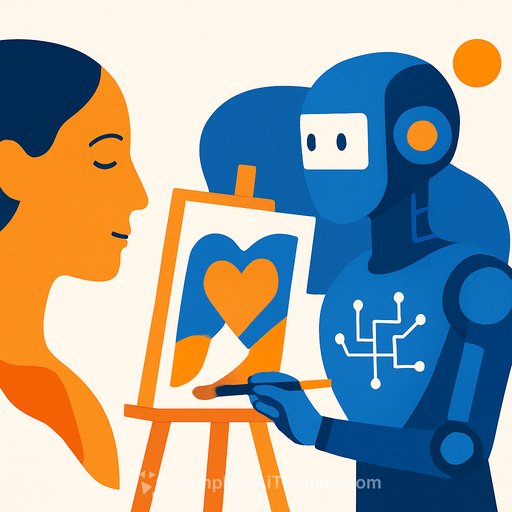
Can AI Create Art?
Can artificial intelligence absorb countless examples of great art and then produce something truly novel, moving, and artistic? This question sits at the core of debates about AI’s role in creative fields.
I don’t use AI to write my columns or other personal projects. However, I often experiment with AI for various tasks, including asking it to write on topics I’ve already researched and written about. More often than not, the AI delivers strong results—solid research, coherent writing, a clear narrative flow, and an appropriate tone. Sometimes, I even suspect the AI outperforms me. But I always submit my own work. Why? Because writing is a creative act that I enjoy deeply. Passing the task to AI would diminish the satisfaction of creating something from scratch.
Writing as Human Creativity
Writing is a uniquely human activity, crafted through imagination and emotion. The best writers strive to enter the realm of Art with a capital A—the highest form of expression.
The question of AI and art is especially charged. Can AI be considered an artist? Or is art a space reserved solely for humans?
AI and the Secrets of Creativity
My interest in AI dates back years, from when I was a student and jazz saxophone player trying to understand Charlie Parker’s solos. I wanted to uncover why he chose certain notes, hoping to improve my own playing.
I even published a paper on using AI to analyze his style, yet I never played like Parker. Understanding the notes didn't answer how he created solos on the spot—an entirely different challenge. This example highlights a key point: creativity isn’t just about knowledge or patterns; it’s also about real-time invention.
Can AI Synthesize Novel Art?
Imagine this: you’re driving at night, and a violin concerto plays on the radio. It moves you to tears. You pull over, captivated until the end. Later, you learn it was AI-generated.
Is this possible? Absolutely. AI-composed music and AI-written prose can be genuinely moving. Claims that AI art has “no soul” often stem from undefined ideas of what “soul” means. If your definition of art includes novelty, surprise, and the ability to evoke emotion, AI has already created plenty of examples that fit.
The Role of Intention
Was that AI-generated concerto truly art? From the listener’s perspective, the answer can be yes. But what about intention? Does the artist’s intent matter?
Some argue that the human who prompts the AI deserves credit as the artist. But prompting is more like nudging an unpredictable machine; it’s not the same as an artist painting with brush in hand.
Even more, certain AI systems operate without human prompts, generating thousands of artworks independently. Among them, some will undoubtedly move people.
Is AI Just a Tool?
There’s a popular idea that AI is simply a new tool for artists, like paintbrushes or typewriters. But this comparison falls short. A paintbrush is an extension of an artist’s vision, while AI independently creates its own outputs.
AI does not possess a visceral drive to create like humans do. It generates based on data and algorithms, lacking personal experience or emotion.
Does Knowing the Origin Matter?
Do we, as viewers or readers, need to know whether a piece was made by human hands or AI? Not necessarily. If the work moves you, that’s what counts.
Humans will continue to create art because it is fundamental to who we are. As for AI, it’s an emerging presence in our creative lives—something new to observe and understand.
Further Reading
Your membership also unlocks: