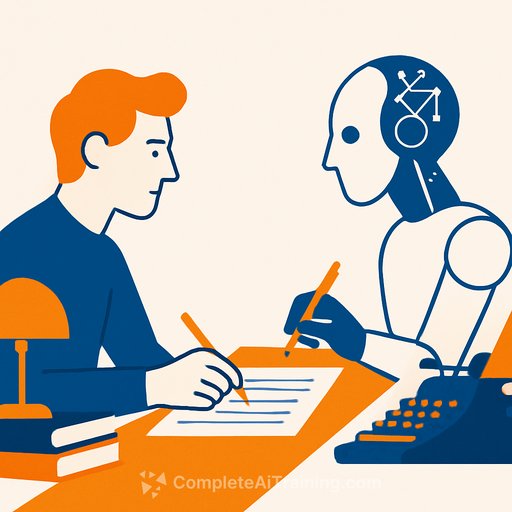
When AI Out-Writes Writers, Can Human Creativity Survive?
At the 2025 Lijiang River Literary Award ceremony in Guilin City, Liu Chuxin accepted the trophy for his novel Ni Tan ("Mud Pit"). His speech was filled with raw emotion, as he shared a personal story of grief and inspiration. His late girlfriend's final letter urged him to channel pain into art, reminding him that life's hardships become legends when looked back upon. This deeply human experience contrasts sharply with the emotionless output of artificial intelligence, which is increasingly capable of producing superior creative work.
Just a month before, acclaimed sci-fi author Liu Cixin expressed unease about AI’s role in creativity. Known globally for the Three-Body Problem trilogy, Liu admitted his creative spark had dimmed. Comparing his search for inspiration to "searching for meteorites in the vast, barren Gobi Desert," he revealed a growing creative block.
The moment that truly unsettled Liu was when he used the AI model DeepSeek to continue a chapter of his novel. The AI’s output surpassed his own writing, leaving him with a profound sense of loss and uncertainty about the future role of human writers.
The Growing Debate on AI and Creativity
Across China, writers, artists, and scientists are questioning what AI’s rapid progress means for creativity. Could AI become a superior creative force, challenging not only individual writers but also the very concept of creativity?
Science fiction author Han Song views AI as a tool that opens new collaborative possibilities. AI can analyze vast amounts of data, spark novel ideas, and suggest unexpected solutions. However, Han emphasizes that human creativity is deeply tied to consciousness and emotional experience — aspects AI cannot replicate yet. He sees AI as a partner to augment human creativity, not replace it.
Han points out that AI operates within algorithmic limits, while creativity often emerges from unpredictable human awareness. He also suggests that future science fiction writing without AI might become impractical, given AI’s ability to generate groundbreaking speculative ideas.
Concerns About AI’s Impact on Artistic Endeavors
Not everyone shares Han’s optimism. Director and screenwriter Yu Baimei voiced concerns at the 2025 Beijing International Film Festival about AI’s growing creative power. Yu warned that AI’s ability to analyze and replicate human creative patterns could eventually surpass human imagination itself. This might not destroy human art but could render it obsolete.
The fear that AI could overshadow human creativity is real. Liu Cixin’s feeling of displacement reflects a larger anxiety among artists: that the essence of art—rooted in personal experience and imperfection—may be lost as AI advances.
Will Human Creativity Adapt or Fade?
History shows that new technologies like photography, cinema, and digital media have not eliminated traditional art but pushed it to evolve. Some believe AI will similarly push creativity into new directions rather than diminish it entirely.
Whether AI will fully surpass human creativity remains uncertain. One thing is clear: the relationship between creators and technology is entering uncharted territory. Writers and artists must rethink their roles as the lines blur between human and machine-generated creativity.
Despite his worries, Liu Cixin holds onto a sliver of hope. He acknowledges human cognitive limits but sees AI as potentially breaking through those barriers. This suggests a future where AI and human creativity coexist, each with its own strengths.
What Writers Should Take Away
- AI tools can enhance your creative process by generating ideas and offering new perspectives.
- Human creativity remains unique because it stems from lived experience and emotional depth.
- Embracing AI as a collaborator rather than a competitor could open new creative avenues.
- Staying informed about AI developments can help writers adapt and maintain relevance.
For writers interested in exploring how AI can support their craft, resources like Complete AI Training’s courses for writers provide practical guidance on integrating AI tools effectively.
The challenge ahead is clear: preserving the human heart in creativity while leveraging AI’s expanding capabilities. How writers choose to engage with this shift will shape the future of storytelling itself.
Your membership also unlocks: