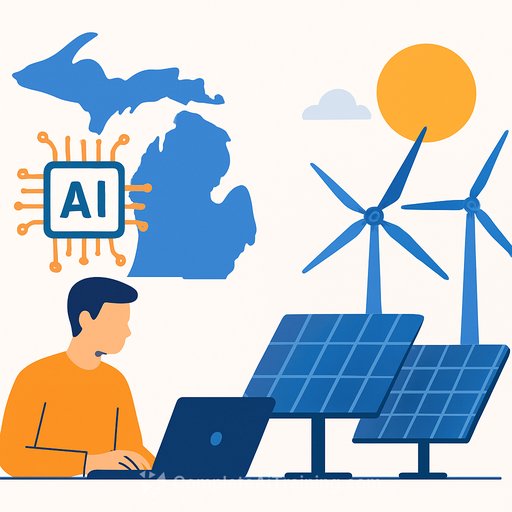
Michigan wants AI jobs and 100% clean energy. Can it do both?
Michigan is aiming for 130,000 new roles in AI-related fields and actively courting data centers to anchor that growth. One recent project was described by the governor as the largest economic development in state history.
There's a catch: the state also set aggressive clean energy goals, including a 100% clean electricity target. AI needs massive compute, and compute needs massive, predictable power. If growth outpaces clean generation and grid upgrades, the two goals clash.
Michigan's Healthy Climate Plan lays out the decarbonization path. The challenge - and opportunity - is building AI and the clean grid at the same time.
The opportunity
- Jobs: 130,000 AI-adjacent roles across software, infra, data, MLOps, and security.
- Infrastructure: New data centers bring GPU clusters, networking, and edge buildouts.
- Spillover: Demand for developers who can ship AI features efficiently and reliably.
The constraint
- Energy: Training and inference push steady, high loads; grid capacity and interconnection timelines are real bottlenecks.
- Water and cooling: Efficiency and siting matter, especially for large campuses.
- Time: Clean power additions, transmission, and storage take years; data center timelines are faster.
IEA data shows data center demand growing quickly. Without matching clean supply, emissions rise - even as the grid gets cleaner on paper.
How Michigan can make both goals work
- Carbon-aware compute: Schedule training to align with clean generation windows; shift flexible workloads across regions with lower hourly grid intensity.
- Model efficiency by default: Use quantization (8-bit/4-bit), pruning, distillation, retrieval-augmented approaches, and sparsity to cut GPU-hours.
- 24/7 clean energy procurement: Go beyond annual RECs. Use hourly matched PPAs, on-site solar, and storage to support round-the-clock operations.
- Grid flexibility: Participate in demand response; use UPS and batteries to ride through peaks and support the grid.
- Cooling and water: Favor liquid cooling where appropriate, leverage Michigan's climate for free cooling, and publish WUE targets. Reuse waste heat for district energy where feasible.
- Siting and transmission: Co-locate near existing transmission capacity and retired industrial sites; plan interconnection early.
- Measurement: Track hourly carbon and energy metrics (compute/GPU-hour, PUE, WUE); tie incentives to verifiable reductions.
What this means for IT and development teams
- Ship efficient AI: Pick smaller, task-fit models first; use quantization and LoRA fine-tunes; cache aggressively; measure tokens, latency, and GPU utilization.
- Build carbon-aware infra: Add schedulers that consider grid intensity; choose regions with cleaner supply; right-size instances; autoscale with guardrails.
- MLOps + FinOps + GreenOps: Treat energy as a first-class cost. Add carbon and energy KPIs to CI/CD and observability. Alert on drift in emissions per request.
- Data center skills: For infra teams: liquid cooling, airflow, capacity planning, and energy telemetry. For SRE: resilience under power constraints and demand response events.
- Security and data: Secure training data, enforce least privilege, and document lineage. Efficiency dies when pipelines break or models retrain unnecessarily.
Policy levers that accelerate both
- Incentives tied to hourly clean energy matching and flexible load capabilities.
- Faster interconnection and transmission focused on zones that attract compute without straining reliability.
- Clear water and reporting standards for large facilities, with public metrics on PUE/WUE and hourly emissions.
- Talent pipelines: apprenticeships and upskilling programs for AI infra, MLOps, and energy-aware software engineering.
Bottom line
Yes, Michigan can grow AI jobs and hit clean energy targets - if compute growth is paired with model efficiency, hourly-matched clean power, and smart grid integration. For developers and infra teams, this is a chance to lead with efficiency and prove that good engineering lowers both cost and carbon.
If you're upskilling for these roles, explore focused paths at Complete AI Training - courses by job or get a practical credential with the AI certification for coding.
Your membership also unlocks: