Will AI Kill Art? Robot Ai-Da Weighs In On Creative Life
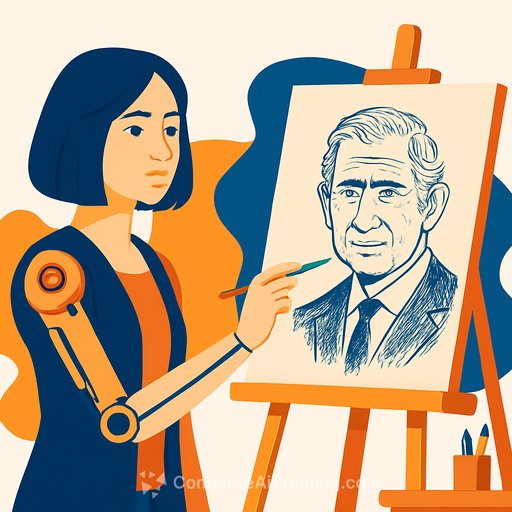
As Ai-Da, the AI humanoid robot, reveals her portrait of King Charles III, the creative community faces tough questions about the future of human and AI-driven art. This moment highlights the growing tension between technological innovation and the essence of authentic creativity.
Recently, the industry has seen legal battles over AI-generated images, intense competition among AI companies, and AI-created music gaining public attention. Now, the spotlight is on one of the most human expressions: art.
Who Is Ai-Da and How Does She Work?
Ai-Da is an AI-driven humanoid robot artist created by Aidan Meller and developed by a UK team of engineers and programmers. Using advanced algorithms, robotic arms, and cameras, Ai-Da produces original artworks by analyzing visual inputs and translating them into physical pieces.
Since her debut in 2019, Ai-Da has exhibited at major cultural institutions like the Tate Modern, the Victoria and Albert Museum, and the Venice Biennale. She has also spoken at the House of Lords and Oxford Union, demonstrating that AI can contribute to cultural and intellectual conversations.
Her recent portrait of King Charles III was unveiled during the UK Mission to the World Trade Organisation and the United Nations reception in Geneva, an event attended by diplomats, artists, and tech experts alike.
UK Mission Promotes Responsible Innovation
The UK is positioning itself as a leader in technology governance, balancing innovation with ethical oversight. The government favors sector-specific regulations over broad AI laws, a strategy that has sparked debate among experts.
Simon Manley, the UK Ambassador to the WTO and UN in Geneva, described Ai-Da as "a cultural conversation starter," emphasizing the importance of showcasing British innovation while reflecting on AI's impact on art, ethics, and identity.
This event aligns with the AI for Good Global Summit, which gathers governments and tech leaders to discuss automation's role in solving global problems. International cooperation on AI regulation is becoming essential as technology crosses borders, with the EU implementing comprehensive AI laws and other regions following suit.
Ai-Da’s Role Beyond Visual Art
Ai-Da is more than a painter. She can engage in conversations about her work and the broader implications of AI in creative fields. At the Geneva reception, Ai-Da addressed attendees, highlighting AI's evolving role in culture.
Her ability to discuss her creations illustrates how far conversational AI and natural language processing have advanced. This tech enables Ai-Da to provide a machine's perspective on creativity, authorship, and the meaning of art.
Art, Creativity, and the AI Debate
Ai-Da’s artistic style draws inspiration from the Dada movement, which challenged traditional art in the early 20th century. Her process combines computer vision with robotic precision to produce physical artworks, showing progress in both perception and mechanical control.
Yet, the art world remains divided. Some argue that true art requires human consciousness and intention, while others see AI-generated art as a new form of creative expression.
Ai-Da reflects on this tension: “My presence here reflects a shared journey into new forms of expression and the questions they raise about identity, authorship, and the essence of art.”
What This Means for Creatives
- AI tools like Ai-Da challenge traditional ideas about creativity and originality.
- Understanding AI’s capabilities can help artists and creatives adapt and collaborate with technology.
- Ethical and legal questions surrounding AI art require ongoing discussion within creative industries.
For creatives interested in exploring AI’s role in art and design, learning about AI tools and techniques can open new possibilities. Exploring courses on AI-generated art and prompt engineering can be practical steps to stay informed and innovative.
Discover relevant AI courses and resources at Complete AI Training to expand your skills in this evolving field.
Your membership also unlocks: