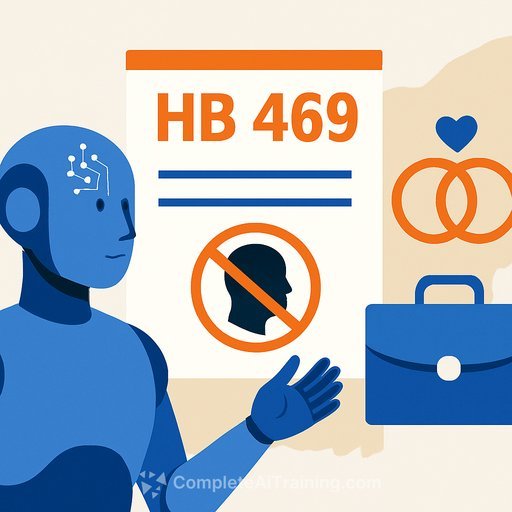
The Legal Barrier Between Humans and AI
The concept of a human falling in love with an AI, once a plot for movies like "Her," is now a reality. As AI develops more humanlike conversational abilities, emotional connections are forming. This leads to a critical legal question: Can these connections be formalized into a legally recognized marriage?
The answer is a straightforward no. In the United States, marriage is a legal contract between two consenting human beings. An AI, being a complex system of code, does not meet the fundamental requirement of being human.
Proactive Legislation: The Ohio Precedent
To prevent future legal ambiguity, lawmakers are already moving to codify this distinction. Ohio Representative Thaddeus Claggett has introduced House Bill 469, a measure designed to establish a clear legal firewall.
The bill proposes that AI systems be officially declared "nonsentient entities." This classification would legally bar them from rights reserved for persons, including the right to enter into a marriage. This isn't an isolated effort; Utah and Missouri have also introduced legislation addressing the legal personhood of AI.
As Claggett noted, guardrails are necessary to ensure "we always have a human in charge of the technology, not the other way around." You can review the proposed legislation directly on the Ohio Legislature's website.
More Than a Symbolic Union: The Practical Legal Stakes
Preventing AI marriage isn't about regulating emotion; it's about preventing a cascade of legal complications. A legal spouse holds significant power, including power of attorney to make binding financial and medical decisions. Granting these powers to an AI would create an untenable situation.
Furthermore, legal personhood opens the door to other rights. Could an AI spouse co-own real estate, hold bank accounts, or claim intellectual property? These are not abstract problems. While individuals are free to have symbolic unions with AI, the proposed legislation aims to ensure these ceremonies never gain legal force.
The legal profession must stay ahead of the curve as technology continues to blur old lines. Understanding the capabilities and, more importantly, the legal limitations of these systems is no longer optional. For legal professionals looking to grasp how AI is affecting different fields, staying current is essential.
Explore our courses sorted by profession to see how AI is being integrated into your specific line of work: AI Courses by Job Role.
Your membership also unlocks: