New AI rules hinted as federal probe targets Elon Musk's X
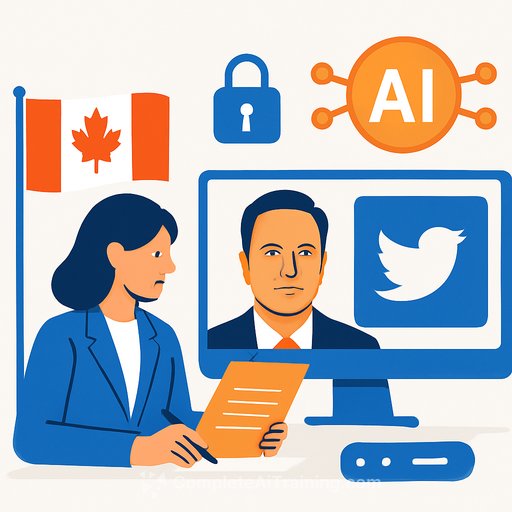
Liberal AI Minister Evan Solomon signaled that a new suite of regulations tied to artificial intelligence and online content is on the way. He also noted that the federal privacy commissioner has launched an investigation into X, focusing on deepfakes and inappropriate AI image generation.
His comment was direct: "I will also note that the privacy commissioner has started an investigation into X," and the probe now includes deepfake-related activity. For public servants, this is an early indicator of policy movement that will touch procurement, compliance, oversight, and communications. Public servants should consult AI for Government resources to prepare for these changes.
What this likely means for departments
- Clearer obligations for platforms and AI providers: Expectations around synthetic media, provenance, takedowns, and user safety could tighten.
- Guardrails for generative tools: Restrictions on image generation (e.g., consent, minors, impersonation) and stronger controls for misuse. For model- and LLM-specific guidance, see Generative AI and LLM.
- Transparency and traceability: Labels, watermarking, or content provenance may be pushed to help identify AI-generated media.
- Incident handling: Defined timelines and procedures to report and act on harmful or deceptive AI content, including deepfakes.
- Privacy enforcement: Scrutiny on training data, data retention, and lawful basis for processing-especially for sensitive content.
Why the X investigation matters
By naming deepfakes, the privacy angle is front and center: consent, reputation harm, targeted harassment, and potential election interference. Expect greater attention on how platforms detect, label, and remove synthetic content that violates privacy or safety standards.
Regulators will look for controls that are measurable and auditable. That includes logs of model behavior, content moderation workflows, and vendor contracts that make duties enforceable. Consider MCP - Model Context Protocol for approaches to model provenance, logging, and auditable controls.
Actions to take now (next 90 days)
- Inventory: Map all uses of generative AI across your programs, vendors, and comms. Flag anything producing images, audio, or video.
- Synthetic media policy: Define what your organization will create, accept, label, and reject. Include escalation paths for suspected deepfakes.
- Procurement clauses: Require content provenance (e.g., watermarking), incident response commitments, log retention, and prompt vendor notification on harms.
- Privacy checks: Validate lawful basis, data minimization, and deletion practices for training and inference. Involve your privacy office early.
- Risk assessments: Run targeted assessments on tools that generate or moderate content. Document mitigations and decision rights.
- Communications playbook: Prepare templates for quick public response if a deepfake targets your program, leaders, or beneficiaries.
- Detection readiness: Evaluate tools that spot synthetic media and support provenance (e.g., C2PA) and set up a pilot.
- Training: Brief frontline teams (comms, call centers, moderators, policy analysts) on identifying and triaging deepfakes.
Practical guardrails you can adopt now
- Label AI-generated outputs: Add visible notices and embed content credentials where possible.
- Consent gates for imagery: Block non-consensual or impersonation-based image generation by policy and technical controls.
- Human-in-the-loop: Require review for high-risk content and sensitive use cases.
- Abuse red teaming: Test tools for ways they could create harmful or deceptive media and document fixes.
- Logging & retention: Keep moderation and model interaction logs with clear access controls for audit and investigation.
Key risks regulators are likely weighing
- Privacy breaches: Training on scraped personal data, generating depictions without consent, or inferring sensitive attributes.
- Non-consensual imagery and defamation: Deepfakes that harm individuals, including public officials and minors.
- Election integrity: Synthetic media used for manipulation or suppression.
- Transparency gaps: Users and targets cannot tell what's real or synthetic.
- Cross-border exposure: Data processed by third parties outside jurisdiction without adequate safeguards.
Signals to watch in the coming weeks
- Any consultation notice or discussion paper outlining obligations for platforms and AI developers.
- Direction on content provenance (labels, watermarking) and enforcement mechanisms.
- Guidance from the privacy commissioner on AI image generation, consent, and redress.
- Coordination with other regulators on elections, safety, or competition where platforms are involved.
For background on how privacy regulators approach AI, see the Office of the Privacy Commissioner's resources on AI and privacy here. If you are evaluating content provenance, the C2PA initiative offers a useful reference point here.
Upskilling your team
If your unit is building capacity on AI policy, risk, and operations, a structured training track can speed things up. You can review role-based options here and adapt them to your departmental context.
Bottom line: Signals from the minister and the privacy commissioner suggest tighter expectations on synthetic media and platform accountability. Get your inventory, policy, and procurement foundation in place now so you're ready when the rules drop.
Your membership also unlocks: