
AI news ·
Cannes divides over AI as Aronofsky backs the technology and del Toro says he would rather die than use it
Cannes this week exposed a sharp split in Hollywood over AI, with Darren Aronofsky defending it as a practical tool while Guillermo del Toro said he'd "rather die" than use it.
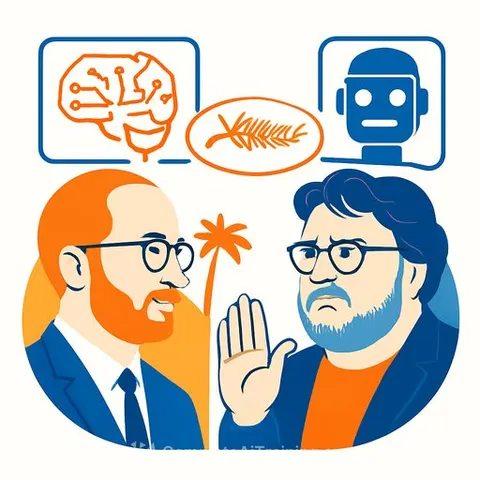
Cannes Exposes Deep Divisions Over AI in Film
The film industry's sharpest debates over artificial intelligence played out this week at Cannes, with directors and studio executives staking out opposing positions on whether AI represents cinema's next creative tool or a threat to filmmaking itself.
Darren Aronofsky defended his use of generative AI through his studio, Primordial Soup, arguing the technology solves practical production problems. He cited a project where AI tools allowed filmmakers to avoid placing a real newborn on set by digitally transforming an actor's prop into a baby.
"AI is not impersonating a person, it's actually a tool," Aronofsky said at an "AI for Talent" summit on Cannes' beach. "They're not replacing anything, they're purely additive."
His studio has partnered with Google DeepMind on projects including Dustin Yellin's short film Goodnight Lamby, which premiered at the festival.
Elsewhere at Cannes, AI startups promoted their capabilities. Chuck Russell, using his company Neumorphic AI, unveiled two science-fiction features built with AI technology. "AI technologies are expanding the cinematic toolbox to a scale we've never had before," he said.
Steven Soderbergh's new documentary, John Lennon: The Last Interview, created with Meta, used AI for about 10% of its imagery to reconstruct Lennon and Yoko Ono's final radio conversation. Soderbergh described the stylized sequences as "thematic surrealism" and compared the approach to conventional visual effects.
The opposing view came from Guillermo del Toro, who said he would "rather die" than use AI in his films. Reese Witherspoon has taken the opposite approach, investing in AI storytelling tools.
Jury member Demi Moore acknowledged concerns about protecting artists but said fighting AI adoption was futile. "AI is here, to fight it is a battle that we will lose," she said.
Peter Jackson, who received an honorary Palme d'Or, offered a middle position. "AI used in the right way, it's just a tool like any other tool," he said. "But like anything, it's going to come down to the imagination and originality of the person feeding the instructions into the AI program."
Seth Rogen dismissed AI-assisted screenwriting outright while promoting his animated film Tangles. "If your instinct is to use AI, you shouldn't be a writer," he said.
Industry Concerns Persist
Studio executives have suggested hybrid AI productions could allow multiple mid-budget films to be made for the cost of a single blockbuster. The 2023 unveiling of Tilly Norwood, an AI-generated "actress" marketed as a potential Hollywood star, sparked backlash from actors and unions.
Last year's competition film Emilia Pérez used AI voice modification to extend an actor's vocal range. The Academy of Motion Picture Arts and Sciences faced criticism over AI use to improve Adrien Brody's accent in The Brutalist, which won him an Oscar.
New Academy rules now require acting to be "demonstrably performed by humans," though enforcement remains unclear.
Aronofsky framed AI as part of cinema's long technological evolution, comparing it to the arrival of sound, portable cameras, and visual effects. He dismissed fears that computers would replace human storytellers as "science fiction."
"A Guillermo del Toro, a Leonardo DiCaprio movie at Imax will always exist," Aronofsky said. "Storytelling is not going away. These tools are hopefully going to make it easier for many new storytellers to tell stories and connect."
Films primarily generated by AI remain banned from Cannes' main competition.