
AI news ·
Carnegie Mellon researchers build open-source software to move AI between robots
Carnegie Mellon's Robot I/O framework cuts robot setup time to just two hours. The open-source tool lets researchers reuse modular code across different hardware.
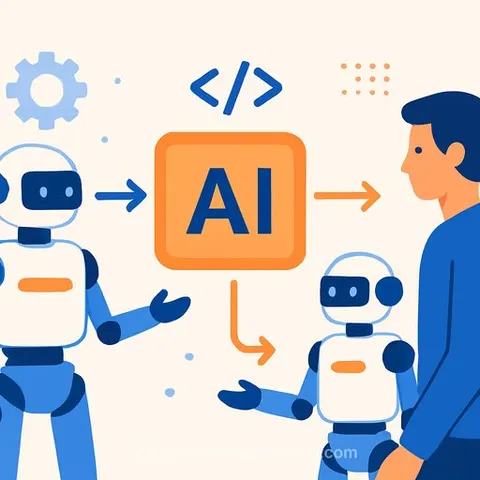
Researchers at Carnegie Mellon University's School of Computer Science have released an open-source software framework called Robot I/O (RIO) that sharply reduces the time needed to set up new robots for AI research. The framework addresses what the team calls the biggest bottleneck in robot learning: not a shortage of ideas, but a lack of shared infrastructure that forces labs to rebuild software from scratch every time they switch hardware.
"The biggest bottleneck in robot learning research isn't ideas; it is infrastructure," said Jean Oh, an associate research professor in the Robotics Institute. "Students can spend an entire semester or even their entire first year simply setting up a robot before they can begin their research. RIO gives researchers and engineers a lightweight, modular foundation for deploying robots quickly on any platform."
A two-hour setup test
RIO's design was put to a direct test when Reya Shukla, an undergraduate intern with machine learning experience but no robotics background, was asked to unpack a robotic arm and configure it for teleoperation using the framework. Following the documentation, she went from opening the box to controlling the robot in about two hours. That speed reflects the problem RIO was built to solve: advances in robot intelligence have accelerated, but the supporting infrastructure has not kept pace.
Reusing tools across robots
Research groups typically write custom software for each robot, making it difficult to share tools, data, and AI models across platforms. Code developed for one system often must be rewritten for another, which hampers reproducibility and slows the exchange of advances between labs. RIO is built around modular software components that can be reused across different robots and projects. Instead of rebuilding infrastructure each time hardware changes, researchers can combine existing components and customize the system to their needs.
RIO arrives as new AI approaches are changing how robots are controlled. Existing robotics software was largely designed before these more general-purpose intelligence systems became common. "Today, everyone talks about needing more data," said Eliot Xing, a Ph.D. student in the Robotics Institute. "But robot data doesn't come from thin air. You need robots to collect it, and that takes robot infrastructure. We've been missing some shared building blocks that other AI fields have-the ones that let researchers build on each other's work instead of starting from scratch every time."
One pipeline, many platforms
Vernon Luk, an incoming student in the Master of Science in Robotics program, and Megan Lee, a recent graduate of the Master of Science in Robotics Systems Development program, found that RIO simplified work with multiple robots while developing policies for humanoid and bimanual platforms. "Since the building blocks are designed to be swappable, you can use the same pipeline for all the robots you work with," Luk said. "You don't have to write special code to collect data or train policies for different platforms, even when they have additional cameras or robot arms."
By providing a shared foundation for robot control, data collection, and AI deployment, the framework could accelerate research and make robotics more approachable for newcomers. Jonathan Francis, lead research scientist at the Bosch Center for Artificial Intelligence and courtesy faculty in the Robotics Institute, noted that in industrial settings, real deployments rarely involve just one robot, one sensor setup, or one fixed environment. "RIO helps make robot learning systems more reusable across platforms, which can shorten the path from a research prototype to something that can be tested and adapted in the real world," he said.
Building toward broader deployment
RIO remains an active research project, but some team members are continuing to build on the technology through Lavoro AI, a startup co-founded by Oh that focuses on simplifying robot deployment and accelerating robot learning. Future work will expand hardware support and further lower the barrier to bringing new robots online, with a longer-term vision of building robotics foundation models that enable robots to rapidly and autonomously adapt to new tasks and environments across platforms.
Why this matters for Science & Research professionals
For researchers and engineers who work with robotic systems, RIO removes a recurring source of friction: the months of custom coding that often precede any actual experiment. The framework's modular design means that data collection pipelines, teleoperation interfaces, and AI policy training can move with the researcher across different hardware, cutting setup time and improving reproducibility. Professionals who apply AI in scientific settings can also look to structured resources like the AI Learning Path for Research Scientists to build the skills needed for deploying and adapting such tools in their own labs. The approach reflects a broader shift in robotics toward infrastructure that treats hardware as interchangeable, allowing research teams to spend less time on plumbing and more time on the science.
Provided by Carnegie Mellon University.