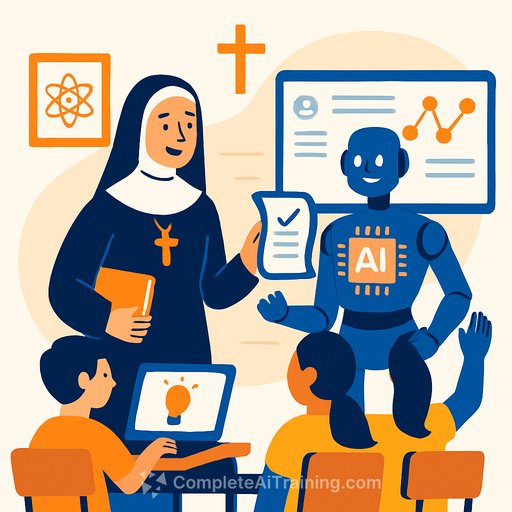
Brave New Classroom: Catholic Schools Nationwide Integrate AI into Teaching Plans
Reading, writing, arithmetic—and now AI. Catholic schools across the country are incorporating artificial intelligence into their educational strategies. Teachers and experts agree that AI is set to change Catholic education in practical and meaningful ways.
Building AI Literacy in Catholic Education
Father Nate Wills, director of Higher-Powered Learning at the University of Notre Dame, emphasizes the need to develop AI literacy among teachers, students, and parents. Teacher training is a critical first step to introduce AI tools and demonstrate how they can transform teaching and assessment.
“Teachers need to understand what tools are available to empower students and adapt their methods,” Wills says. The Higher-Powered Learning initiative offers seminars, training, and policy resources to help schools integrate AI effectively. Still, the pace and scale of change can feel overwhelming.
Setting Guidelines and Policies
RAND Corporation data from fall 2023 shows that 18% of K-12 teachers use AI regularly in their teaching, with another 15% having tried it at least once. A key early action is creating clear AI policies for students and staff. These policies are living documents that must evolve with technology.
Brad Snyder, associate superintendent in the Diocese of Orange, compares this shift to the arrival of the internet in the 1990s. “We don’t use card catalogs anymore; AI will change how we access and process information,” he explains.
Snyder stresses the importance of monitoring AI use while mentoring students. “Students will use AI regardless. Teaching them to use it responsibly ensures it supports their learning, not replaces it.” He also highlights that technology can’t replace community and relationship-building—core elements of Catholic education—but it can make teaching more effective and personalized.
Practical Applications in the Classroom
Steve Tortorello from the Archdiocese of Chicago describes AI as a “supercharged teacher’s assistant” and “thought partner.” For example, AI can quickly generate tailored practice materials based on student interests, such as worksheets that include references to popular culture, making lessons more engaging.
“If it took 45 minutes to create an adjective worksheet, AI can do it in seconds,” Tortorello notes. It can also differentiate materials by adjusting reading levels to meet students’ varied abilities, allowing everyone to work at their own pace and challenge level.
Teachers remain central to the process. AI-generated content requires human review and adaptation to fit classroom needs. This technology not only saves time but also helps reduce teacher burnout—an increasing concern in education.
National Support and Training
On July 8, OpenAI and Microsoft announced a $23 million investment in AI training for teachers, including funding from the AI startup Anthropic. This will support the creation of a national training center aimed at equipping educators with AI skills.
Case Study: Union Catholic High School
At Union Catholic High School in New Jersey, Assistant Principal Noreen Andrews recalls the moment AI’s impact became clear: when the AP College Board began using AI to write exam essay questions. That moment sparked a focused approach on AI literacy, starting with teacher training and expanding to student education.
Union Catholic earned the Responsible Artificial Intelligence in Learning (RAIL) endorsement, recognizing their commitment to ethical and safe AI use. Andrews emphasizes teaching students to use AI responsibly rather than restricting access. “Our goal is to prepare students to thrive with AI as part of their learning toolkit.”
Conclusion
Catholic schools are actively integrating AI into their classrooms by educating educators, setting evolving policies, and supporting students in responsible use. AI is becoming a practical tool to personalize learning, save teachers time, and prepare students for future challenges.
For educators interested in AI training and resources, platforms like Complete AI Training offer courses tailored to different skill levels and roles within education.
Your membership also unlocks: